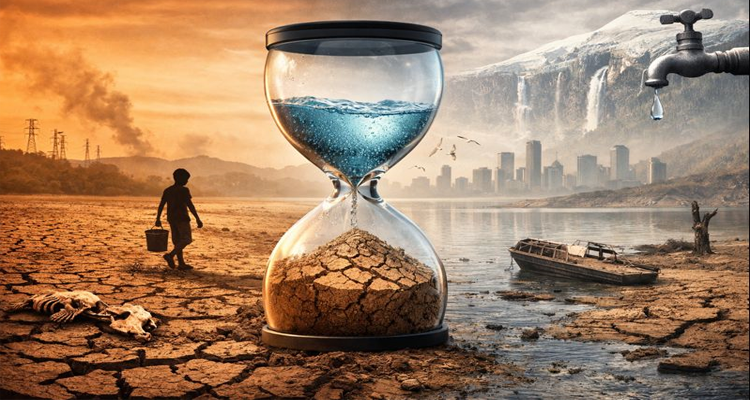
News Desk: The world is no longer facing a temporary water shortage but has crossed into a far more dangerous phase of global water bankruptcy, according to a major new report released by United Nations researchers on Tuesday.
For decades, the phrase “global water crisis” suggested that shortages were reversible. The new assessment, however, warns that in many regions water systems are now so overused, polluted and damaged that they can no longer return to their historical condition.
“For much of the world, ‘normal’ is gone,” said Kaveh Madani, Director of the UN University Institute for Water, Environment and Health. “This is not meant to spread despair, but to encourage honest action. We must admit where we failed in order to protect the future.”
World enters year of ‘global water bankrupcy’
UN report urges shift from crisis response to bankruptcy management
UN warns: ‘Rivers, lakes and aquifers depleting faster than nature can replenish.’ @MollyGambhir brings you more details pic.twitter.com/2zapGvHK6a
— WION (@WIONews) January 21, 2026
From Crisis to Bankruptcy
The report introduces the term water bankruptcy to describe a condition marked by both insolvency and irreversibility.
Insolvency refers to withdrawing and contaminating water faster than natural systems can replenish it. Irreversibility refers to permanent damage to natural water reserves such as wetlands, lakes, aquifers and glaciers, making full recovery impossible.
Unlike a short-term crisis, the report states, bankruptcy means the system itself has been fundamentally weakened.
UN report declares global state of ‘water bankruptcy’
The world is entering an era of “global water bankruptcy” with rivers, lakes and aquifers depleting faster than nature can replenish themhttps://t.co/gLjPhsodP1 pic.twitter.com/b840XRbEfO
— AFP News Agency (@AFP) January 21, 2026
A Rapidly Shrinking Water World
According to the findings, more than half of the world’s large lakes have declined since the early 1990s, while nearly 35 per cent of natural wetlands have been lost since 1970.
Today, almost three-quarters of the global population live in water-insecure or critically water-stressed countries. About four billion people face severe water shortages for at least one month every year.
The economic impact is also severe, with drought-related losses estimated at more than $300 billion annually.
Unequal Burden
The report notes that the burden of water collapse falls disproportionately on small farmers, Indigenous communities, low-income urban populations, women and youth, while the benefits of overuse have often gone to powerful economic and political interests.
Because water systems are linked through trade, migration and geopolitics, failures in one region are increasingly affecting food security, energy supplies and political stability elsewhere.
A Call for Structural Change
Comparing water management to financial systems, Madani said bankruptcy should not be seen as the end, but as the beginning of a recovery process.
“Just as with financial bankruptcy, the first step is to stop the bleeding, protect essential services, restructure unsustainable claims, and invest in rebuilding,” he said.
The report urges governments to move away from short-term crisis responses and adopt long-term strategies that protect remaining water resources, restore what can still be saved, and align policies with ecological realities rather than past assumptions.
A Stark Warning
The report concludes that continuing to treat water failures as temporary problems will only deepen environmental damage and fuel social conflict.
The age of water crisis, it says, is over.
The world has entered the age of water bankruptcy.