
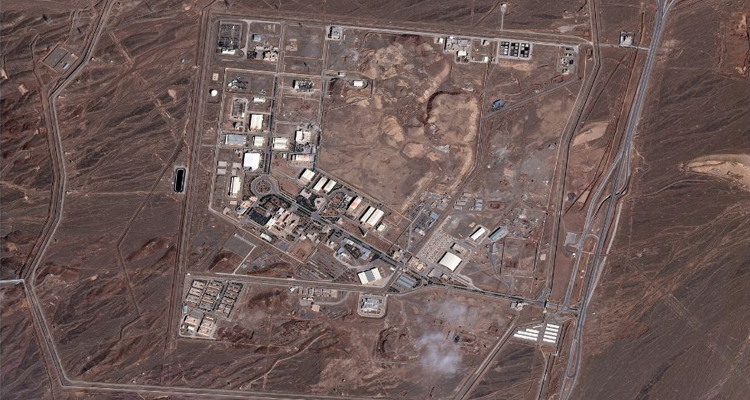
Fresh satellite images indicate structural damage at Iran’s primary uranium enrichment hub in Natanz following the latest wave of US-Israeli military strikes, adding a new flashpoint to the intensifying regional conflict.
An assessment by the Washington-based Institute for Science and International Security (ISIS) states that three key structures at the Natanz Nuclear Facility were destroyed. The buildings reportedly functioned as entry points to underground centrifuge halls — two designated for personnel access and one serving as the main vehicle ramp to subterranean sections of the complex.
Analysts reviewing high-resolution commercial satellite imagery concluded that the strikes targeted access routes leading to halls believed to house thousands of centrifuges used for uranium enrichment.
Contradiction With Initial IAEA Assessment
The findings appear to contrast with earlier remarks by Rafael Grossi, head of the International Atomic Energy Agency (IAEA), who had stated there was no immediate indication that nuclear facilities had been directly damaged. Grossi later clarified that the agency’s assessment was based on limited available information and that communication with Iranian authorities remained incomplete.
David Albright, founder of ISIS, said the strikes likely occurred between Sunday afternoon and Monday morning local time but noted that satellite data alone could not determine whether US or Israeli forces carried out the attack.
#WATCH: Animated satellite images showing before and after images of #Iran‘s #Natanz nuclear facility, which was hit by #US–#Israel strikes on March 1, according to Iran’s atomic energy chief in a letter to @iaeaorg quoted by IRNA news agency #IranWar https://t.co/NxOPMs1ynn pic.twitter.com/ywagJGoOTL
— Arab News (@arabnews) March 3, 2026
Iran Accuses US and Israel
Iran’s representative to the IAEA, Reza Najafi, accused Washington and Tel Aviv of striking safeguarded nuclear infrastructure and rejected allegations that Tehran is pursuing nuclear weapons, calling such claims politically motivated.
Natanz has long been central to Iran’s enrichment programme and has previously faced sabotage operations and military action. The underground design of the facility was intended to shield it from aerial attacks.
Satellite shows Iran’s Natanz Nuclear Facility damaged amidst US-Israeli airstrikes pic.twitter.com/oebriRUcbd
— New York Post (@nypost) March 3, 2026
Earlier Strikes and Uranium Stockpile
Last year, then US President Donald Trump declared that American strikes had “obliterated” key Iranian nuclear installations, including the Isfahan Nuclear Technology Center and the Fordow Fuel Enrichment Plant. Independent reviews later suggested the damage was serious but stopped short of complete destruction.
International monitors had earlier reported that while centrifuge operations were disrupted, Iran’s stockpile of 60 percent enriched uranium — a level approaching weapons-grade purity — remained largely intact. At the time, the IAEA estimated the stockpile at approximately 440 kilograms.
Rising Nuclear Tensions
The renewed damage at Natanz is likely to intensify diplomatic strain at the IAEA and the United Nations, as global powers grapple with the expanding conflict. While infrastructure can be rebuilt, experts warn that the broader strategic implications of repeated strikes on nuclear facilities could deepen instability across the Middle East.
updated