
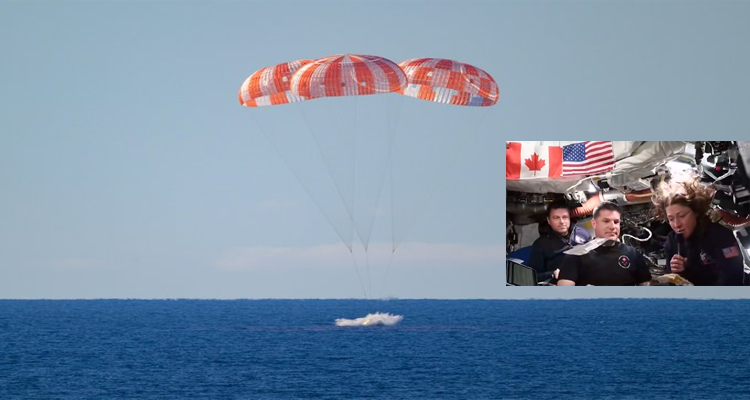
News Desk: In a landmark moment for global space exploration, the crew of NASA’s Artemis II mission has safely returned to Earth, completing a historic 10-day journey around the Moon. The mission concluded with a successful splashdown in the Pacific Ocean near California at 5:07 PM EST (2:37 AM IST, April 11).
Textbook Re-entry and Splashdown
The Orion spacecraft re-entered Earth’s atmosphere at a blistering speed of nearly 40,000 km/h, enduring extreme heat before deploying parachutes for a controlled descent. The capsule then made a precise splashdown, marking a flawless end to the deep-space mission.
The Artemis II crew splashed down in the Pacific Ocean aboard the Orion spacecraft, after a 10-day flight around the moon and back https://t.co/X1sJoGsVSX pic.twitter.com/wnOu1zop7a
— Reuters (@Reuters) April 11, 2026
Crew Safely Recovered
All four astronauts—commander Reid Wiseman, pilot Victor Glover, mission specialist Christina Koch, and Jeremy Hansen of the Canadian Space Agency—were safely recovered by U.S. Navy teams shortly after landing.
Initial medical checks confirmed that the crew members are in good health, following their return from deep space.
Artemis II astronauts have safely landed on Earth after historic 10 day moon mission pic.twitter.com/N0zU7PZmOe
— non aesthetic things (@PicturesFoIder) April 11, 2026
Historic Journey Around the Moon
Artemis II marks the first human mission beyond low-Earth orbit since the Apollo 17 mission (1972). During the mission, the astronauts traveled nearly 402,000 kilometres from Earth, performing a lunar flyby and venturing farther than any human mission in decades.
The spacecraft followed a free-return trajectory, looping around the Moon and using its gravity to return to Earth—demonstrating a safe and fuel-efficient path for future missions.
Key Systems Successfully Tested
The mission achieved its primary objectives, including testing:
- Orion’s life-support systems in deep space
- Navigation, propulsion, and communication systems
- The spacecraft’s heat shield during high-speed re-entry
These results are critical for upcoming missions such as the Artemis III mission, which aims to land humans on the Moon.
A Major Step Toward the Future
NASA officials hailed the mission as a complete success, noting that Artemis II has validated key technologies required for long-duration human spaceflight.
The mission not only signals a return to lunar exploration but also lays the foundation for a sustained human presence on the Moon and future missions to Mars.
Bottom Line:
With the safe return of its crew, Artemis II has successfully reopened the path to deep space—bringing humanity one step closer to setting foot on the Moon once again.