
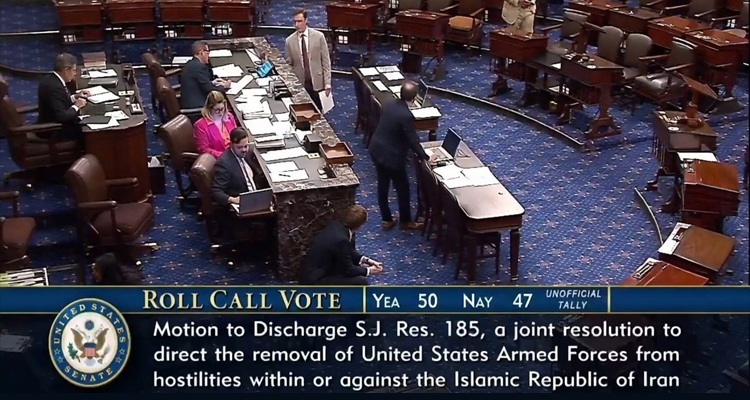
News Desk: In a significant rebuke to President Donald Trump’s foreign policy approach, the US Senate has approved a war powers resolution seeking to restrict the president’s ability to launch or continue military action against Iran without congressional authorization.
The move reflects growing unease within Washington over the possibility of a prolonged conflict in the Middle East and marks one of the strongest bipartisan efforts yet to reassert Congress’s constitutional authority over matters of war.
The resolution, led by Democratic Senator Tim Kaine, was passed after a closely watched Senate vote in which a handful of Republicans crossed party lines to support the measure. The proposal invokes the 1973 War Powers Resolution, a law designed to prevent presidents from engaging US forces in extended military conflicts without approval from Congress.
US Senate Moves Closer To Blocking Trump From Launching Iran War Alone
The vote passed 50-47 after seven failed attempts, pushing a resolution that would force Trump to get Congress approval before any military campaign against Iran. pic.twitter.com/ltkR7jT8S8
— RT_India (@RT_India_news) May 20, 2026
Senate Pushes Back on Executive Military Authority
Senator Kaine argued that while a president has the authority to defend the United States from imminent threats, any sustained military campaign against Iran must receive explicit authorization from lawmakers.
“The Constitution is clear that Congress, not the president alone, has the power to declare war,” Kaine said during the Senate debate.
The resolution gained momentum amid escalating tensions between Washington and Tehran following recent military confrontations in the region. Critics in both parties have warned that the United States risks being drawn into another costly and unpredictable Middle East conflict without a clear congressional mandate.
Several Republican senators joined Democrats in backing the measure, signaling growing discomfort even within Trump’s own party over the administration’s Iran strategy.
Triggered by Escalating Iran Tensions
The Senate vote comes months after heightened military exchanges involving Iran and US-backed operations in the Middle East sharply raised fears of a wider regional war.
Although President Trump recently suggested that tensions had eased following ceasefire efforts, lawmakers pushing the resolution argued that continued military deployments and operational readiness indicated the risk of escalation remained high.
Supporters of the measure also expressed concern that Congress had increasingly been sidelined in major military decisions over the past two decades, allowing presidents of both parties to expand executive war-making powers.
The US Senate advanced a war-powers resolution that would end the Iran war unless President Trump obtains Congress’ authorization, a rare rebuke of the Republican leader 80 days after US and Israeli forces began striking Iran https://t.co/VuIz14dc34
— Reuters (@Reuters) May 20, 2026
White House Defends Trump’s Actions
The White House swiftly defended the president’s authority, insisting that Trump acted within his constitutional powers as commander-in-chief to protect American personnel and strategic interests.
Administration allies argued that limiting presidential flexibility during an international crisis could weaken US deterrence against adversaries like Iran.
Trump supporters also accused Democrats of politicizing national security issues at a sensitive geopolitical moment.
Uncertain Future in the House
Despite passing the Senate, the resolution faces an uncertain path in the Republican-controlled House of Representatives, where Trump loyalists are expected to resist any attempt to constrain presidential military authority.
Even if the measure clears Congress, President Trump is widely expected to veto it. Overriding such a veto would require a two-thirds majority in both chambers — a highly difficult threshold in the current political climate.
Still, political observers say the Senate vote carries symbolic and constitutional significance, underscoring mounting bipartisan concern over unchecked executive military powers and America’s deepening involvement in Middle East tensions.
The development is also being viewed as a broader debate over the balance of power in Washington, particularly at a time when global conflicts are increasingly testing the limits of presidential authority in foreign policy decisions.