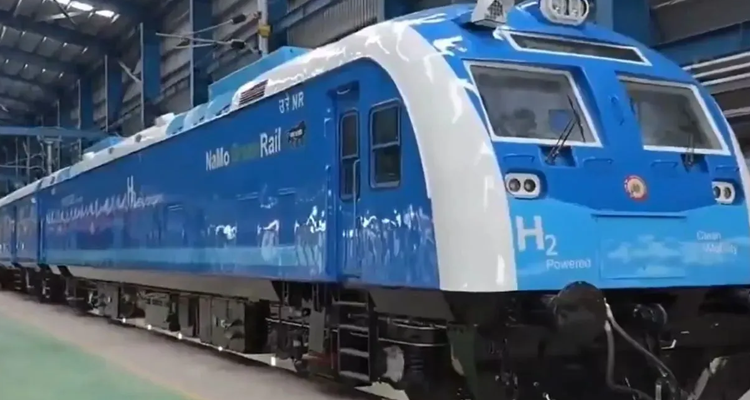
New Delhi: In a landmark step towards green and sustainable transportation, India is set to launch its first daily hydrogen-powered passenger train service on the Jind–Sonipat route in Haryana, marking a major milestone in the modernization of Indian Railways. The Ministry of Railways has approved daily operations of the hydrogen-powered train, with Prime Minister Narendra Modi expected to flag off the service on July 17.
The pioneering service will operate on the 89-kilometre Jind–Sonipat section under Northern Railway’s Delhi Division, becoming India’s first regular hydrogen-powered passenger train and one of the first such services in Asia. The project underscores the country’s growing commitment to reducing carbon emissions and promoting clean-energy mobility.
🚨 𝐆𝐑𝐄𝐄𝐍 𝐌𝐎𝐁𝐈𝐋𝐈𝐓𝐘 𝐌𝐈𝐋𝐄𝐒𝐓𝐎𝐍𝐄!
India’s first Hydrogen Train on Jind-Sonipat route to revolutionise rail travel. Eco-friendly, cost-effective & indigenous innovation powering net-zero goals. Atmanirbhar Bharat leading sustainable transport! 🇮🇳🚄🌿 pic.twitter.com/qb0ouJzCMM
— India Lens (@IndiaLens_real) July 9, 2026
A Big Leap Towards Green Railways
Unlike conventional diesel trains, the hydrogen-powered train runs on hydrogen fuel cells, which generate electricity through a chemical reaction between hydrogen and oxygen. The only by-products are water and heat, making it a virtually zero-emission mode of transport and a cleaner alternative for non-electrified railway routes.
The train has been developed by the Integral Coach Factory (ICF), Chennai, in collaboration with Indian Railways as part of the national mission to adopt environmentally friendly technologies. It recently completed extensive trial runs and mandatory safety tests, including emergency braking, oscillation, and performance assessments, before receiving approval for passenger operations.
Advanced Technology on Board
Designed specifically for regional passenger services, the train features hydrogen fuel-cell propulsion, advanced onboard safety systems, automatic doors, air-conditioned coaches, and modern passenger amenities. During trials, it demonstrated speeds of up to 120 kmph, while regular commercial operations are expected at around 75 kmph for optimal efficiency and safety.
A dedicated hydrogen production and refuelling facility has also been established at Jind to support the train’s daily operations, ensuring a reliable supply of clean fuel.
Supporting India’s Net-Zero Goals
The hydrogen train project aligns with India’s broader vision of achieving net-zero carbon emissions by 2070 and strengthening sustainable public transport. Railways, one of the world’s largest transport networks, is gradually transitioning to greener technologies through electrification, renewable energy integration, and now hydrogen-powered mobility.
Officials believe the success of the Jind–Sonipat pilot could pave the way for deploying hydrogen trains on other non-electrified routes across the country, significantly reducing dependence on fossil fuels while lowering operating emissions.
A Milestone for Indian Innovation
The launch represents more than just a new train—it signals India’s entry into the global league of nations adopting hydrogen-based rail transport. As countries worldwide invest in alternative fuels for cleaner mobility, India’s first daily hydrogen-powered train showcases the nation’s growing technological capabilities and commitment to building a greener, more sustainable railway network.