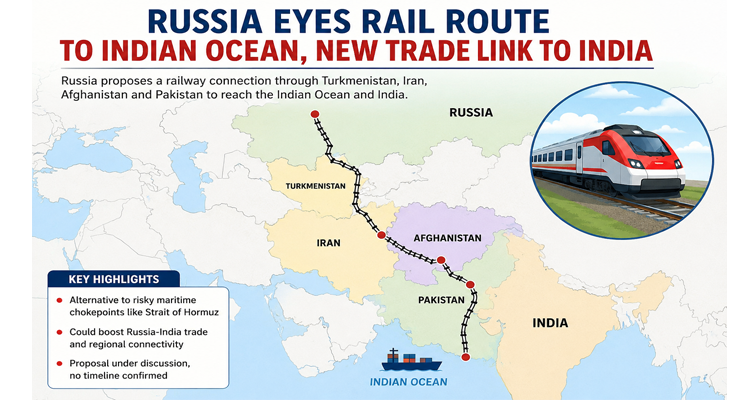
Russian Deputy Prime Minister Marat Khusnullin has said Moscow should examine the possibility of developing a rail connection towards the Indian Ocean, citing growing risks around strategic waterways including the Bosphorus Strait and the Strait of Hormuz.
Speaking to Russia’s TASS news agency, Khusnullin said alternative land routes through Central Asia, Iran, Afghanistan and Pakistan could be considered, with the broader objective of creating additional avenues for Russian trade with markets including India. Current reporting, however, indicates that this remains at the proposal and feasibility-discussion stage, with no confirmed construction schedule.
From Russia to India: A Possible New Eurasian Trade Artery
The idea fits into Moscow’s broader push to build alternative transport corridors connecting Russia with South Asia and the Indian Ocean.
Russia, India and Iran have already been working on the International North–South Transport Corridor (INSTC), a multimodal network designed to move cargo between India, Iran, Russia and onward into Europe while reducing dependence on the traditional Suez route.
🇷🇺🇮🇳 ICYMI: Russia Eyes Direct Rail Route To India Via Indian Ocean
Russian Deputy PM Marat Khusnullin said Moscow should explore rail access through Turkmenistan, Iran, Afghanistan and Pakistan to reduce dependence on routes vulnerable to disruptions around the Bosphorus and… pic.twitter.com/Lie0kaS1wX
— RT_India (@RT_India_news) August 9, 2026
The Indian government has described the INSTC as a multimodal corridor linking the Indian Ocean and Persian Gulf to the Caspian Sea through Iran and onward to Russia. The route envisages sea, road, rail and inland-waterway connections rather than one continuous railway.
Russia has separately discussed expanding north-south connectivity through Kazakhstan and Turkmenistan, as well as routes involving Iran. Khusnullin has also previously spoken of the potential for transport links through Afghanistan and Pakistan.
Why the Strait of Hormuz Has Changed the Equation
The latest proposal comes against the backdrop of the severe disruption to shipping through the Strait of Hormuz, one of the world’s most important maritime chokepoints.
The waterway normally carries a huge share of global energy trade, including roughly a quarter of seaborne oil trade and a significant volume of LNG and fertiliser shipments. The disruption has forced shipping companies and governments to reassess their dependence on a single strategic passage.
The impact has also been felt in India. The Indian government said in April that disruptions caused a substantial cargo backlog at major ports, although coordinated measures subsequently cleared nearly 90% of the accumulated backlog.
The crisis has highlighted a wider vulnerability: even countries located far from the conflict zone can face higher freight costs, insurance premiums, longer transit times and shortages when a major maritime chokepoint is disrupted.
INSTC Could Become Even More Important
For India and Russia, the development gives additional strategic weight to the INSTC.
The two countries have reiterated their commitment to expanding the corridor and improving its infrastructure. The route is intended to reduce both transportation time and logistics costs while providing an alternative to conventional maritime routes.
A major advantage is that the INSTC can connect India with Russia without requiring cargo to travel through the Suez Canal. India’s Chabahar connectivity in Iran is particularly important because the port provides access towards Afghanistan and Central Asia while bypassing Pakistan.
At the same time, Russia has been investing heavily in north-south connectivity as it seeks to diversify trade routes following the disruption of its traditional links with European markets.
Afghanistan and Pakistan Add Another Dimension
The Afghanistan-Pakistan option would represent a different branch from the established India-Iran route.
Russia has previously held discussions with both Afghanistan and Pakistan on developing international transport corridors. At the 2025 KazanForum, Khusnullin said Afghanistan could serve as a transit country, while Pakistan had presented calculations for multiple routes connecting its territory with Moscow, St Petersburg and Central Asia.
Khusnullin has also discussed the possibility of a north-south motorway through Afghanistan to Pakistan, describing Pakistan as a promising market for Russia.
However, turning these concepts into a reliable railway network would require enormous investment, new infrastructure and agreements among several countries. Analysts have previously pointed to gaps in Iranian rail infrastructure and the need for substantial investment in cross-border transport facilities as major challenges for the wider north-south network.
A Strategic Shift, Not Yet a Railway Project
For now, the proposed Indian Ocean rail link should be viewed as part of Russia’s broader strategy to create a network of alternative trade corridors, rather than as a railway project that has already received final approval.
If eventually realised, however, such connectivity could have major implications. Russia would gain more options for reaching the Indian Ocean and South Asian markets, while India could benefit from additional overland access to Russian and Eurasian markets.
The bigger message from Moscow is clear: future trade routes may have to be built not around a handful of vulnerable maritime chokepoints, but through a diversified network of railways, roads, ports and multimodal corridors across Eurasia.
For India and Russia, the emerging north-south connectivity architecture could therefore become far more than a transport project—it could evolve into a strategic trade bridge linking Russia, Central Asia, Iran and the Indian Ocean.