Bokaro: Bokaro Steel Plant (BSL) has achieved a significant technological and operational breakthrough with the commissioning of a new Coal Dust Injection (CDI) pneumatic conveying system, enabling the transfer of pulverised coal from Bokaro Power Supply Company Pvt Ltd (BPSCL) to Blast Furnace-3 (BF-3).
The system was successfully commissioned on August 15, marking a major step towards improving fuel efficiency and reducing production costs at the steel plant.
From Challenge to Strategic Solution
The project was initially conceived to bridge a 10-tonne-per-hour shortfall in coal dust supply for Blast Furnaces 4 and 5. Following the proposed decommissioning of BF-5, BSL management redesigned the project to supply BF-3, which did not have its own coal milling facility.
The redesigned system has now provided BF-3 with a dedicated and modern coal dust injection arrangement.
650-Metre Pipeline Poses Engineering Challenge
The project involved extensive civil, mechanical, electrical and automation work, including construction of concrete dumper ramps at the BPSCL Coal Handling Plant and modification of existing conveyor arrangements.
A key engineering challenge was transporting pulverised coal through a 650-metre-long DN250 pipeline. Engineers developed a system using controlled nitrogen flow and precise solids loading to ensure uninterrupted movement of coal dust and prevent blockages.
At BF-3, the coal dust is distributed through a 24-way split system to individual tuyeres.
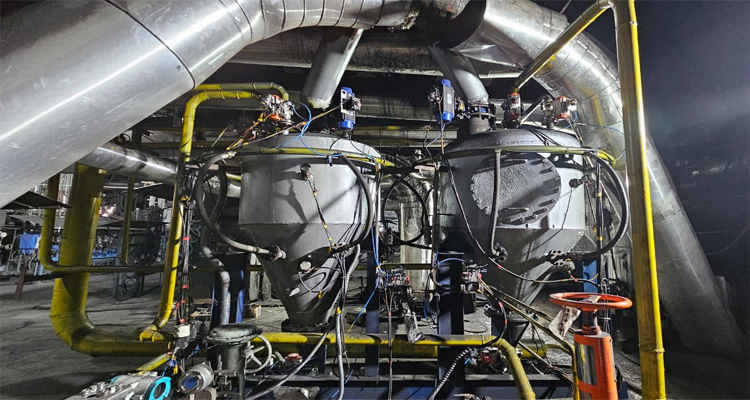
The system incorporates two 1.4-cubic-metre blow tanks operating through a seven-step automated cycle, ensuring a continuous and stable flow of coal dust.
Capacity Exceeds Design Target
Commissioning trials conducted on August 15 demonstrated that the system can theoretically handle up to 15 tonnes of coal dust per hour, against its designed capacity of 10 tonnes per hour. Its actual operating capacity, however, remains linked to the production capability of the BPSCL ball mill.
PLC-based automation, two-stage nitrogen pressure regulation and dedicated purging arrangements have also been incorporated to enhance operational safety and minimise the risk of pipeline choking.
Potential ₹100-Crore Annual Saving
The biggest attraction of the project is its potential economic benefit. By replacing a portion of high-cost coke with pulverised coal at a Coke Replacement Ratio (CRR) of 0.85, the CDI system is expected to help BSL save around ₹100 crore annually in coking coal-related costs.
Four-Month Execution
Adding to the achievement, the entire project—from conceptualisation to commissioning—was completed in just four months, reflecting the coordinated efforts of BSL’s engineering and operational teams.
The project was executed under the guidance of the Director-in-Charge and ED (Works) and driven by the CGM (Utilities).
The pipeline and erection work involved Janishar Imam (DGM, SIGS), SW Kispotta (AGM, GU), RN Deo (DM, GU) and V K Sharma (GM, GU). Electrical integration was led by Manish Snehi (Deputy Manager, GU), while PLC and automation work was handled by Basant Keshav (GM, ETL) and Mantosh Kumar (DGM, ETL).
Anupam Roy (GM) and Venketesh Kumar (AGM, CR-M) also made significant contributions to the project.
The successful commissioning of the CDI system underscores BSL’s growing focus on indigenous engineering, fuel optimisation and cost-efficient steel production, turning an operational challenge into a major economic and technological gain.