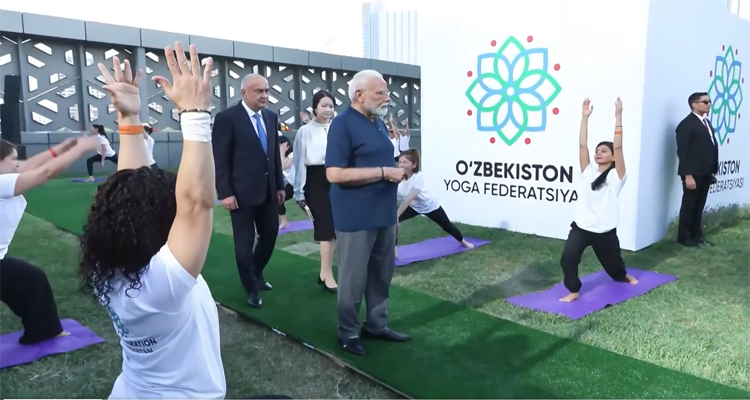
Tashkent: Prime Minister Narendra Modi on Sunday joined a yoga session organised by the Yoga Federation of Uzbekistan in Tashkent, highlighting the growing popularity of yoga in the Central Asian nation as India and Uzbekistan moved to deepen their strategic partnership with a series of key agreements.
Modi interacted with participants at the session and later joined them for a group photograph. The programme was part of his two-day state visit to Uzbekistan at the invitation of President Shavkat Mirziyoyev.
𝐘𝐨𝐠𝐚 𝐢𝐬 𝐈𝐧𝐝𝐢𝐚’𝐬 𝐬𝐨𝐟𝐭 𝐩𝐨𝐰𝐞𝐫 𝐢𝐧 𝐚𝐜𝐭𝐢𝐨𝐧!
In Tashkent, PM Modi rolls out the mat with the Yoga Federation of Uzbekistan, proving that shared wellness builds stronger bonds. ⬇️ pic.twitter.com/7mjyDevqyr
— BJP (@BJP4India) August 30, 2026
The yoga event provided a people-centric dimension to a visit marked by major decisions aimed at expanding bilateral cooperation. India and Uzbekistan agreed to elevate their Strategic Partnership to a Comprehensive Strategic Partnership and set a target of increasing bilateral trade to US$5 billion by 2030.
The two sides also agreed on cooperation in the supply of uranium, adding an important energy dimension to the expanding bilateral relationship.
Yoga emerges as cultural bridge
The Ministry of External Affairs said yoga has considerable appeal in Uzbekistan and is helping bring people and cultures closer while strengthening people-to-people ties.
The India-Uzbekistan joint statement also recognised yoga’s role in promoting healthy lifestyles and strengthening connections between the people of the two countries. India and Uzbekistan welcomed cooperation between the Yoga Federation of Uzbekistan and India’s Ministry of AYUSH on training yoga instructors.
The two countries also welcomed Uzbekistan’s participation in international Yogasana competitions and agreed to continue supporting the promotion and development of yoga in Uzbekistan with the participation of Indian experts.
They further underlined the importance of the International Day of Yoga, observed annually on June 21.
India emboldens uranium ties with Uzbekistan
PM Modi announces long-term uranium deal with Tashkent@BislaDiksha has more pic.twitter.com/HxdgZu9xAc
— WION (@WIONews) August 30, 2026
From trade to uranium, partnership expands
The broader Modi-Mirziyoyev talks covered a wide range of strategic and economic areas, including trade and investment, defence and security, digital public infrastructure, healthcare, critical minerals, agriculture, education, tourism and space cooperation.
The decision to raise the partnership to a Comprehensive Strategic Partnership marks a significant step in India’s engagement with Central Asia. The $5 billion trade target by 2030 also signals an ambition to substantially expand commercial ties.
The agreement on uranium supply adds further strategic weight to the relationship, particularly as India seeks to strengthen long-term energy security and diversify its sources of nuclear fuel.
Against this backdrop, Modi’s participation in the yoga programme underscored that India-Uzbekistan ties are not limited to government-to-government cooperation. Cultural exchanges and yoga are increasingly serving as avenues for strengthening connections between the two societies.
Modi’s Uzbekistan visit was his fourth to the country. After completing his Tashkent engagements, he departed for Bishkek, Kyrgyzstan, to participate in the 26th Shanghai Cooperation Organisation (SCO) Summit from August 31 to September 1.
The yoga session, therefore, stood out as a softer but significant element of a visit that delivered hard strategic outcomes—from an upgraded partnership and a $5 billion trade ambition to uranium cooperation—while reinforcing India’s cultural and people-to-people outreach across Central Asia.