
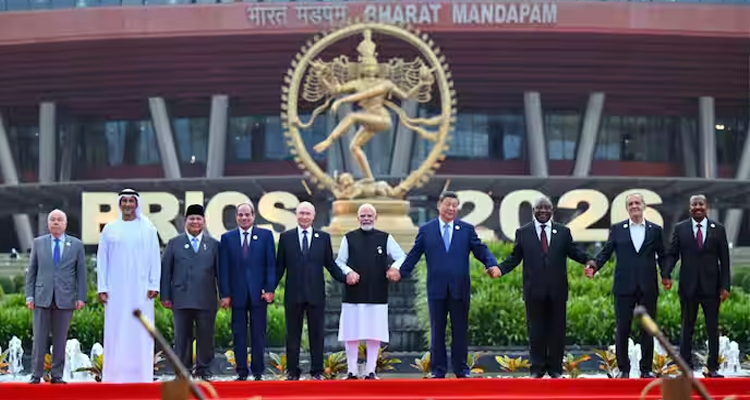
New Delhi: The 18th BRICS Summit in New Delhi has produced a wide-ranging New Delhi Declaration, putting terrorism, West Asia, trade, local-currency settlements, global governance reforms, artificial intelligence and the concerns of the Global South at the centre of the grouping’s agenda.
Adopted by consensus on Saturday, the declaration reflects India’s effort to push BRICS towards a more practical and action-oriented platform while navigating sharp differences among members over geopolitical conflicts and global trade.
🚨 BRICS JUST DROPPED ITS FIRST BIG SET OF OUTCOMES… HERE’S WHAT MATTERS.
The 18th BRICS Summit opened today in New Delhi, and leaders unanimously adopted the New Delhi Declaration on day one.
The summit continues tomorrow, but several important economic and technology… pic.twitter.com/MRSoNcgsZB
— Sumit Kapoor (@moneygurusumit) September 12, 2026
Here are the major takeaways:
1. No common BRICS currency — focus shifts to local currencies
One of the biggest talking points around BRICS has been the possibility of a common currency to reduce dependence on the US dollar.
The 2026 declaration, however, does not endorse the creation of a common BRICS currency. Instead, members backed deeper cooperation on cross-border payments and greater use of national currencies in trade and investment.
The bloc is working towards making cross-border payments faster, safer and cheaper by improving interoperability between members’ payment and messaging systems.
For India, this approach is significant because it avoids the complexities of a single BRICS currency while strengthening mechanisms that can facilitate trade in the rupee and other national currencies.
The BRICS group of nations unanimously adopted a joint declaration expressing ‘deep concern’ over the war in the Middle East and urged maximum restraint. READ: https://t.co/nXJgNWjwVH pic.twitter.com/o40AozQil9
— Reuters (@Reuters) September 12, 2026
2. Strong condemnation of terrorism
Counter-terrorism emerged as one of the declaration’s strongest themes.
BRICS leaders strongly condemned the April 22, 2025 Pahalgam terrorist attack, in which 26 people were killed, and reaffirmed their commitment to combating terrorism in all its forms.
The declaration specifically refers to the cross-border movement of terrorists, terror financing and safe havens, while calling for those involved in terrorism and its support networks to be held accountable.
The leaders also backed a zero-tolerance approach to terrorism, rejected double standards and called for faster progress towards a Comprehensive Convention on International Terrorism at the United Nations.
3. West Asia: Call for restraint and diplomacy
The escalating conflict in West Asia was another major challenge for BRICS diplomacy.
The declaration expressed serious concern over the worsening violence and called for maximum restraint, dialogue and diplomatic solutions.
The consensus was particularly significant because BRICS now includes countries with sharply differing positions on the conflict, including Iran and the UAE. Reuters reported that reaching agreement on the language was difficult but ultimately produced a joint declaration focused on diplomacy and de-escalation.
4. Pushback against unilateral tariffs and trade barriers
BRICS also took aim at unilateral trade measures.
The declaration raised concerns over unilateral tariffs and non-tariff measures, arguing that such actions can disrupt international trade and supply chains.
The grouping reiterated its support for an open, predictable and rules-based multilateral trading system and called for reform of the World Trade Organization (WTO).
5. India’s push for UN Security Council reform
The declaration reinforces the BRICS position on reforming global institutions to give the Global South greater representation.
India’s long-standing demand for permanent membership of a reformed UN Security Council received support from the grouping, strengthening New Delhi’s diplomatic case for a greater role in global decision-making.
The declaration broadly calls for a more representative, fairer and more effective multilateral system.
6. AI and technology move up the BRICS agenda
Artificial intelligence has emerged as another major area of cooperation.
BRICS endorsed a more inclusive, safe and development-oriented approach to AI, with particular attention to the interests of developing countries.
India’s leadership also highlighted the India AI Impact Summit and the need for stronger global AI governance, while BRICS members seek greater cooperation in emerging technologies.
7. New focus on financial resilience
Beyond currency settlements, BRICS is seeking to deepen financial cooperation.
The grouping backed greater mobilisation of resources through the New Development Bank and continued work on mechanisms designed to support investment and development across member and partner countries.
A proposed BRICS Risk Lab in Gujarat’s GIFT City, promoted by India, is among the initiatives highlighted during India’s chairship.
8. Tackling organised crime and terror financing
The declaration goes beyond traditional counter-terrorism measures.
BRICS leaders expressed concern over terror financing, money laundering, illicit financial flows, cyber-enabled crime, trafficking and cross-border fraud networks.
They called for stronger information-sharing and cooperation among law-enforcement, financial-intelligence, customs, tax and regulatory authorities.
9. Global South at the centre
A central message running through the declaration is BRICS’ ambition to strengthen the voice of emerging markets and developing countries.
The leaders reaffirmed their commitment to a more representative global order and greater cooperation with BRICS partner countries.
India’s 2026 chairship has emphasised practical cooperation rather than simply expanding the bloc’s geopolitical footprint, with initiatives spanning health, agriculture, digital technology, climate resilience and development.
10. From rhetoric to implementation
Perhaps the biggest takeaway from the 2026 declaration is the attempt to move BRICS from broad political statements towards practical cooperation.
From local-currency payments and AI governance to counter-terrorism, financial crime, supply-chain resilience and development finance, the agenda reflects an expanded BRICS seeking greater institutional depth.
The challenge, however, will be implementation. With the grouping now comprising countries with sometimes sharply divergent geopolitical and economic interests, maintaining consensus while turning declarations into concrete mechanisms will remain the real test.
Bottom Line
The New Delhi Declaration is not a launchpad for a common BRICS currency — at least not yet. Its more immediate economic ambition is to make trade in national currencies and cross-border payments easier.
Politically, the declaration gives India important gains on counter-terrorism, the Pahalgam attack, UN reform and Global South representation, while economically it pushes local-currency settlements, development finance and trade cooperation.
In short, BRICS 2026 has chosen incremental financial de-dollarisation, stronger counter-terror cooperation and a broader Global South agenda over the dramatic creation of a single BRICS currency.
updated


