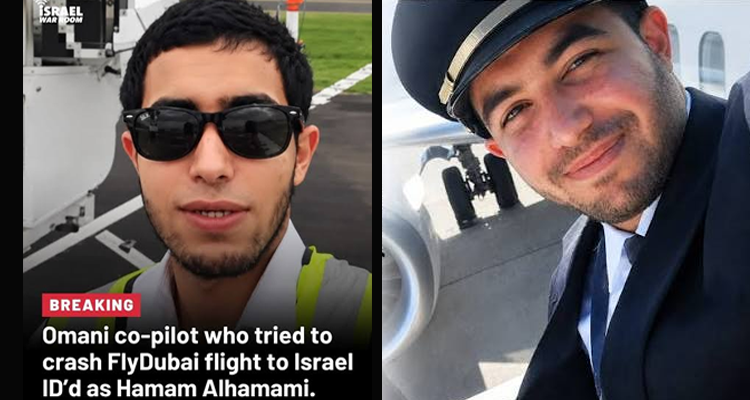
News Desk: The investigation into the alleged attack aboard a Flydubai passenger aircraft bound for Israel has revealed fresh details about the motive of the Omani co-pilot and the dramatic steps reportedly taken by Israeli authorities during the mid-air crisis.
The incident involved Flydubai Flight FZ1073, which was flying from Dubai to Tel Aviv on September 30. The aircraft was carrying more than 170 people when the co-pilot allegedly attacked Indian captain Smit Machchhar inside the cockpit.
Investigators reportedly believe the co-pilot, Hamam al-Hammami, had planned the attack before joining Flydubai. During questioning, he allegedly said he wanted to take revenge for Israel’s military campaign in Gaza and was prepared to die in the attack.
The alleged Gaza-related motive remains part of the ongoing investigation, and authorities are still examining whether he acted alone or had any outside support.
Ben Gurion Airport reportedly in his sights
The investigation has also reportedly uncovered evidence that the co-pilot had deliberately sought employment with an airline operating flights to Israel.
He allegedly told investigators that he wanted to take control of the aircraft and crash it into Ben Gurion Airport, Israel’s main international airport near Tel Aviv.
Reports indicate that he had previously travelled to Israel as a pilot and may have studied the route and airport environment before allegedly attempting to carry out the attack.
Investigators are also examining whether he had considered an attack during an earlier flight but abandoned the plan.
Captain fought back
The alleged attack began as the aircraft approached Israel.
The co-pilot reportedly attacked Captain Smit Machchhar with an emergency axe inside the cockpit. Despite being injured, Machchhar fought back and managed to open the cockpit door.
Passengers and crew members rushed forward and helped overpower the attacker.
Two off-duty pilots travelling on the aircraft subsequently assisted in regaining control of the plane. The aircraft was diverted toward Saudi Arabia and eventually landed safely at Tabuk.
The incident was later treated as a suspected terrorist attack.
Israel prepared for shoot down jet
The situation became extremely serious when the aircraft reportedly lost thousands of feet of altitude and communication with the cockpit was disrupted.
Israeli authorities reportedly feared that the aircraft could have been hijacked and turned into a weapon similar to the aircraft used in the September 11 attacks in the United States.
Israel scrambled fighter jets and temporarily closed its airspace as officials tried to establish what was happening aboard the Flydubai aircraft.
According to reports, Israeli authorities were prepared to shoot down the aircraft if it continued toward Israel and was judged to pose an immediate threat to civilians or a major target.
Fighter pilots were reportedly instructed to attempt to establish visual contact with the aircraft and determine whether the situation could be resolved.
The aircraft eventually turned away from Israel and headed toward Saudi Arabia. With the immediate threat apparently removed, the Israeli response was stood down.
Israeli sources tell CBS News that Israel was ready to shoot down flydubai Flight 1073 with all passengers on board after the Omani copilot attacked the captain, scrambling fighter jets before calling them off as the plane went to make an emergency landing in Saudi Arabia.
The sources say that as part of a protocol for a potential 9/11-style incident, the Israeli Air Force sought to contact the cockpit after the plane made a sharp plunge, but didn’t receive an answer. A committee formed in advance was then swiftly convened, and a command center was set up, as fighter jets were scrambled and Israel closed its airspace, according to the report.
The warplanes were called back, however, once Israel realized that the plane was turning toward Saudi Arabia, which had scrambled its own fighter jets.
The sources add that if the flight got closer, Israel would have dispatched planes into Jordan’s airspace to investigate. The IAF pilots would have then sought to get as close to the cockpit as they could in an effort to establish visual contact and size up the situation, before doing the same for the cabin to determine if there was any panic among the passengers.
After checking in on the plane, the IAF would update the committee, which the sources say would in turn contact the defense minister and prime minister if the plane had been hijacked and the terrorists weren’t responding. Ultimately, the decision to shoot down the plane would rest with the prime minister, an outcome the sources quoted by CBS News say would’ve been preferable to having it crash into Ben Gurion Airport, the Azrieli Center in Tel Aviv or another “high-value target.”
Find the latest updates on The Times of Israel.
— The Times of Israel (@TimesofIsrael) October 6, 2026
Was Azrieli Towers another possible target?
The incident has also raised questions about whether the Azrieli Towers, one of Tel Aviv’s most recognizable landmarks, could have been considered as an alternative target.
However, this point remains unconfirmed.
The strongest reports from the investigation identify Ben Gurion Airport as the principal intended target. References to a Tel Aviv skyscraper or the Azrieli complex should therefore be treated as a possible scenario rather than an established fact.
The towers contain offices, commercial establishments, retail facilities and other businesses and form one of the most recognizable parts of Tel Aviv’s skyline.
Their prominent location on Menachem Begin Road and their considerable height make the complex one of the city’s most visible landmarks.
Shin Bet joins probe
Israel’s domestic security agency Shin Bet has reportedly joined the investigation. Israeli investigators are examining the co-pilot’s background, travel history, contacts and possible extremist connections.
Authorities are also trying to determine whether the alleged plot was entirely self-directed or whether anyone helped him plan or execute it.
The investigation has raised additional questions about commercial pilot screening, intelligence sharing and security checks for foreign aviation personnel.
Security questions remain
The case has put renewed focus on how a pilot who reportedly had previously attracted security concerns was able to obtain employment with an international airline and operate a passenger flight to Israel.
Investigators are expected to examine his recruitment history, previous employment, aviation records and communications.
For now, the emerging picture is that the co-pilot allegedly wanted to turn a routine passenger flight into a deadly attack motivated by his anger over the Gaza war. Ben Gurion Airport remains the principal reported target, while the reported connection to the Azrieli Towers remains unconfirmed.
The investigation is continuing, and authorities have yet to release a complete account of the evidence behind the alleged motive and target selection.