by Ashis Sinha
India is exploring methanol fuel to reduce fossil fuel dependence and promote green shipping. Discover its benefits, challenges and future potential.

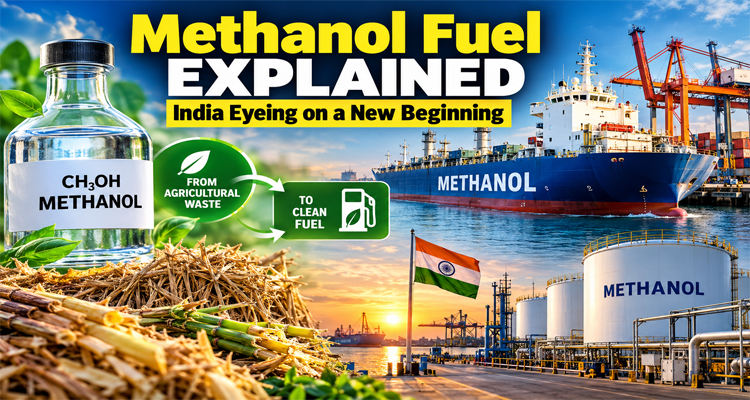
India is exploring methanol as an alternative fuel to reduce dependence on imported fossil fuels, diversify its energy mix and promote cleaner shipping. Following the expansion of ethanol blending in petrol, the government is now looking at methanol as another potential option, particularly for the maritime sector, where the search for lower-emission fuels is gaining momentum.
From ships and industrial applications to power generation and specialised transport systems, methanol offers several possible uses. However, its success in India will depend on affordable domestic production, suitable infrastructure, supportive policies and the availability of fuel with demonstrably lower environmental impacts.
What Is Methanol Fuel?
Methanol, chemically known as CH₃OH, is a colourless, flammable liquid alcohol used widely in the chemical industry. It can also serve as a fuel for specially designed engines, marine vessels and certain power-generation systems.
Methanol can be produced from coal, natural gas, biomass and agricultural residues. Another option is green methanol, which can be manufactured using renewable electricity, green hydrogen and captured carbon dioxide.
Unlike conventional petrol and diesel, methanol offers multiple production pathways and can be stored and transported as a liquid. Its environmental benefits, however, depend on how it is manufactured. Methanol produced from fossil fuels can have a substantial carbon footprint, while renewable-based production offers greater potential for reducing lifecycle emissions.
Why Is India Turning Towards Methanol?
India imports substantial quantities of crude oil to meet its energy requirements, leaving its economy exposed to international price fluctuations and supply disruptions. Developing alternative fuels using domestic resources could help diversify the country’s energy supply and create new industrial opportunities.
The government’s interest in methanol follows its experience with ethanol blending in petrol. While ethanol blending has primarily targeted road transport, methanol offers additional possibilities, particularly in shipping, industrial applications and selected power-generation systems.
NITI Aayog’s Methanol Economy programme has explored the use of methanol produced from domestic resources, including coal and biomass. The initiative also examines dimethyl ether (DME), a methanol derivative that can be blended with liquefied petroleum gas (LPG).
India has already demonstrated its ability to produce methanol from domestic coal. In 2021, an indigenous pilot plant at Bharat Heavy Electricals Limited’s research and development centre in Hyderabad demonstrated the conversion of high-ash Indian coal into methanol, with a reported production capacity of 0.25 tonnes per day.
The next challenge is to move beyond pilot-scale production and develop commercially viable supply chains that can support wider adoption.
Methanol: A Potential Alternative Fuel for Ships
The maritime sector is emerging as an important area for methanol adoption. As international shipping faces growing pressure to reduce greenhouse-gas emissions, ship operators are examining alternatives to conventional marine fuels.
Methanol has attracted interest because it is a liquid fuel that can be stored and supplied through dedicated infrastructure. Vessels designed or adapted to use methanol could help shipping companies diversify their fuel choices, provided the fuel’s lifecycle emissions and overall costs are competitive.
Recognising this potential, the Indian government is examining ways to encourage methanol use at ports. Proposed measures include tax exemptions or other fiscal incentives, standardising fuel prices and charges across ports, and simplifying the approval procedures required for methanol bunkering, or refuelling ships.
These measures could make methanol more commercially attractive to shipping companies. Consistent pricing and clearer regulations would also help operators plan fuel purchases and assess the financial implications of switching from conventional marine fuels.
The Ministry of Ports, Shipping and Waterways has initiated a study examining ways to promote methanol in the maritime sector. The focus includes improving refuelling infrastructure and bringing greater consistency to port-related charges and procedures.
The broader objective is to make methanol bunkering more accessible, reduce unnecessary delays and help ships complete refuelling operations more efficiently.
Government’s Focus: Modernising Port Infrastructure
Fuel availability alone will not be sufficient to encourage shipping companies to adopt methanol. Indian ports will also need appropriate storage facilities, transfer systems, safety equipment and trained personnel to handle the fuel.
At present, the development of methanol bunkering infrastructure remains an important requirement for wider adoption. Differences in port charges, operating procedures and approval requirements could make refuelling more complicated and expensive for shipping operators.
The government’s proposed approach seeks to address these barriers by promoting greater uniformity across ports. Standardised procedures, predictable fuel pricing and faster clearances could reduce administrative burdens and make Indian ports more attractive to vessels using alternative fuels.
Dedicated storage and distribution facilities would also be needed to ensure a reliable supply of methanol. Given the fuel’s toxicity and flammability, infrastructure development must be accompanied by strict safety protocols, appropriate emergency-response arrangements and clear handling standards.
If implemented effectively, these improvements could help establish a more dependable methanol supply network along India’s maritime routes.
Producing Methanol from Agricultural Waste
One of the most promising opportunities for India is the production of methanol from agricultural residues.
The country generates large quantities of crop residues, some of which are burned or left underutilised. Converting suitable agricultural waste into methanol could create an additional source of domestic fuel while opening new markets for farmers and biomass-processing industries.
Biomass-based methanol production could also support rural employment, waste utilisation and the development of local supply chains. Agricultural residues could become valuable industrial feedstock rather than being treated solely as waste.
However, the process requires investment in conversion technology, collection networks, processing plants and transportation systems. Agricultural residues are dispersed across large areas, and their availability varies by region and season. Collecting them economically and ensuring a consistent feedstock supply would therefore be essential.
Increasing domestic methanol production could improve fuel availability for ports and industrial users. It would also require adequate storage facilities, transport links and distribution arrangements to move the fuel from production centres to coastal locations.
Renewable-based production would offer the greatest climate benefits when supported by efficient processes and sustainable feedstock management. Methanol manufactured from coal may improve domestic fuel availability, but without effective carbon capture, it can carry a significant greenhouse-gas burden.
Green Methanol: India’s Next Energy Opportunity
Green methanol could become an important component of India’s long-term clean-energy strategy. It can be produced using renewable hydrogen and captured carbon dioxide, potentially creating a lower-carbon fuel for shipping and other applications that are difficult to electrify directly.
India’s efforts to establish standards for green methanol and develop port-based production facilities reflect growing interest in this emerging market.
A notable development is the proposed e-methanol facility at Kandla Port in Gujarat, associated with Assam Petro-Chemicals Ltd and Deendayal Port Authority. The project has been announced with a planned capacity of 150 tonnes per day and an investment of ₹2,300 crore, with implementation envisaged in phases.
The project is intended to support the production and supply of green marine fuel. Its progress could help establish a foundation for India’s participation in the developing international market for lower-emission shipping fuels.
However, the commercial viability of green methanol will depend on the cost of renewable electricity, the availability of green hydrogen, access to suitable carbon dioxide sources and the development of reliable demand from shipping companies.
Methanol in Road Transport and Other Sectors
Although shipping is attracting particular attention, methanol has potential applications beyond the maritime industry.
It can be blended with petrol or used in specially designed engines. For example, M15 fuel contains 15 per cent methanol and 85 per cent petrol. India’s Ministry of Road Transport and Highways notified emission standards for vehicles using M15, M100 and methanol-based MD95 fuel in 2018.
Methanol has also been explored for railway applications and power generation. DME, which can be produced from methanol, is another potential alternative for selected fuel applications.
However, higher methanol blends may require modifications to engine components, fuel systems and materials. Compatibility cannot be assumed for all existing vehicles, and widespread adoption would require appropriate standards, testing and refuelling infrastructure.
For India, the most practical approach may be to develop methanol applications selectively, concentrating first on sectors where the fuel offers clear economic or operational advantages.
Benefits and Challenges of Methanol Adoption
Methanol could offer India several potential benefits:
- Energy diversification: Domestic production could reduce reliance on imported petroleum fuels.
- Agricultural waste utilisation: Crop residues could become feedstock for fuel manufacturing.
- Maritime decarbonisation: Lower-carbon methanol could help shipping companies reduce lifecycle emissions.
- Industrial development: New facilities could create opportunities in manufacturing, logistics, storage and port operations.
- Fuel innovation: Multiple production pathways could support the development of India’s alternative-energy industry.
Nevertheless, important challenges remain. Methanol contains less energy per litre than conventional petrol and diesel, which can affect fuel consumption and operating costs. Large-scale production must also become commercially competitive.
Its toxicity and flammability require specialised handling and strict safety measures. Port infrastructure, fuel standards, transportation networks and dependable supplies must be developed before widespread adoption becomes practical.
Most importantly, the environmental performance of methanol must be assessed according to its production pathway. A shift from petroleum to coal-based methanol would not automatically deliver a reduction in greenhouse-gas emissions.
Can Methanol Mark a New Beginning for India’s Energy Sector?
India’s growing interest in methanol reflects a broader effort to diversify its energy resources and identify alternatives for sectors that remain dependent on conventional fossil fuels.
The government’s focus on port infrastructure, uniform fuel pricing, streamlined clearances and domestic production could help create the conditions needed for methanol adoption in shipping. At the same time, agricultural residues and renewable energy offer opportunities to develop more sustainable production pathways.
The transition, however, will require more than policy announcements. Investment in production facilities, reliable supply chains, storage infrastructure and safety systems will be essential. Shipping companies must also have a clear economic incentive to adopt methanol-powered vessels.
Methanol is unlikely to replace petrol and diesel across India overnight. Its more realistic role is as part of a diversified energy strategy, with maritime applications and selected industrial uses potentially providing important early opportunities.
Methanol could open a new chapter in India’s alternative-fuel journey, particularly if the country can combine domestic production with efficient port infrastructure and genuinely lower-carbon manufacturing. Whether it becomes a major energy solution will depend on the ability to turn technological potential into an affordable, safe and commercially sustainable fuel system.