
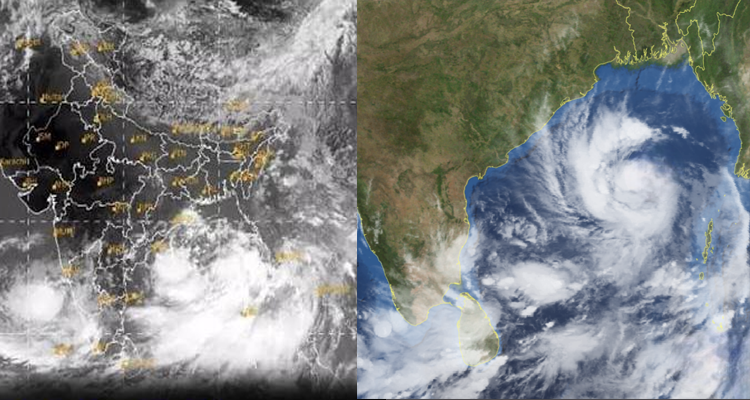
Visakhapatnam: Cyclone Arnab is gathering strength over the Bay of Bengal and advancing towards India’s eastern coast, prompting the India Meteorological Department (IMD) to issue a red-message cyclone warning for coastal Andhra Pradesh and adjoining southern Odisha.
Satellite imagery shows a well-organised cloud system swirling over the sea as the storm intensifies. The cyclone is forecast to strengthen into a severe cyclonic storm by midnight on October 26 and a very severe cyclonic storm on October 27, raising concerns over destructive winds, heavy rainfall and coastal disruption.
According to the IMD, Cyclone Arnab, pronounced ‘Ornab’, is expected to cross the Andhra Pradesh and Yanam coasts between Bapatla and Visakhapatnam, close to Yanam, by the forenoon of October 28.
At landfall, the storm could generate maximum sustained winds of 115–125 kmph, with gusts reaching 140 kmph.
🌧️IMD Weather Warning ⚠️
Under the influence of the impending Cyclonic Storm “Arnab,” isolated extremely heavy rainfall is likely over Coastal Andhra Pradesh & Yanam on 27th–28th October, Odisha on 28th October, Chhattisgarh on 28th–29th October, and East Uttar Pradesh on 29th October, 2026.
Heavy to very heavy rainfall is also likely at isolated places over Odisha, Vidarbha, Telangana, East Madhya Pradesh, East Uttar Pradesh, Jharkhand and Bihar during 27th–30th October, 2026.
Stay alert and follow official weather updates.
#CyclonicStormArnab #WeatherAlert #HeavyRainfall #IMD #WeatherUpdate #RainfallWarning
@moesgoi @airnewsalerts @DDNational @ndmaindia @ICRER_MHA
— India Meteorological Department (@Indiametdept) October 26, 2026
Cyclone Moves Closer to Eastern Coast
In its morning bulletin on October 26, the IMD located the cyclone over the east-central and adjoining west-central Bay of Bengal near latitude 15.4°N and longitude 88.5°E. The system was then moving westwards at around 15 kmph.
By 5.30 pm, the cyclone had moved west-northwestwards and intensified into a severe cyclonic storm. It was located approximately 490 km southeast of Gopalpur in Odisha and 490 km east-southeast of Visakhapatnam in Andhra Pradesh.
The storm is expected to continue moving west-northwestwards before turning northwest towards the Andhra Pradesh coast. Its projected track and increasing intensity have placed coastal communities on heightened alert.
Strong Winds, Heavy Rain Pose Major Threat
The approaching cyclone could damage vulnerable houses, uproot trees, disrupt electricity supplies and affect road and rail connectivity. Heavy to very heavy rainfall may trigger waterlogging and flooding in low-lying areas, depending on the storm’s track and local weather conditions.
Rough to very rough sea conditions are also expected over affected parts of the Bay of Bengal, posing risks to fishing boats and other maritime operations.
The IMD has advised fishermen not to venture into the southwest and adjoining central Bay of Bengal, as well as along and off the coasts of Andhra Pradesh, Odisha and Yanam, from October 26 to 29.
Emergency Preparedness Intensified
The National Crisis Management Committee reviewed preparedness for the approaching cyclone on October 26. State administrations have reported arrangements for shelters, evacuation measures and the deployment of National Disaster Response Force and State Disaster Response Force teams on standby. District control rooms have also been activated.
Residents in vulnerable coastal districts have been urged to follow official weather bulletins and local administration advisories. Authorities are monitoring the cyclone’s movement as preparations intensify ahead of its expected landfall.
With Cyclone Arnab forecast to reach very severe intensity before crossing the coast, the next two days will be crucial for emergency preparedness. The final impact will depend on the cyclone’s actual path, strength and rainfall distribution as it approaches land.