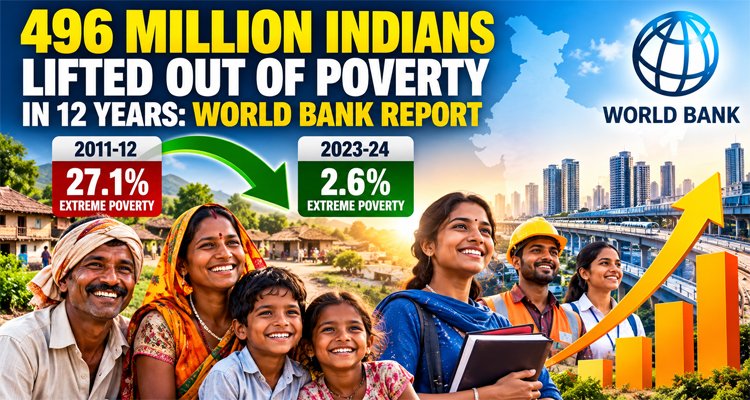
News Desk: India has achieved a remarkable reduction in poverty over the past 12 years, with an estimated 496 million people moving out of poverty between 2011-12 and 2023-24, according to the World Bank’s latest assessment. The country’s extreme poverty rate has plunged from 27.1 per cent to just 2.6 per cent during the period, marking one of the fastest declines in poverty recorded globally.
The World Bank’s October 2026 Poverty and Equity assessment highlights substantial improvements in household consumption, employment opportunities and access to welfare support. The findings indicate that economic growth, expanding employment, particularly among women, and government-backed social protection programmes have played important roles in improving living conditions across the country.
According to the assessment, the proportion of Indians living below the lower-middle-income poverty threshold of $4.20 per person per day, calculated using 2021 Purchasing Power Parity (PPP), declined from 57.7 per cent in 2011-12 to 16.1 per cent in 2023-24.
The decline represents a significant improvement in the economic circumstances of millions of households, particularly in rural India, where poverty has historically been more widespread.
Extreme poverty drops sharply across rural and urban India
The decline has been visible in both rural and urban areas, although rural communities have recorded a particularly significant improvement in absolute numbers.
According to the World Bank’s estimates, extreme poverty, measured against the international poverty line of $3 per person per day in 2021 PPP terms, declined as follows:
| Category | 2011-12 | 2023-24 |
|---|---|---|
| Overall India | 27.1% | 2.6% |
| Rural India | 31.0% | 3.1% |
| Urban India | 17.4% | 1.4% |
The reduction in the broader lower-middle-income poverty category was also substantial. Rural poverty fell from 64.9 per cent to 19.3 per cent, while urban poverty declined from 39.7 per cent to 8.6 per cent.
Despite the progress, the challenge is not completely over. Around 35 million Indians continue to live in extreme poverty, while approximately 232 million remain below the $4.20-a-day lower-middle-income poverty threshold.
India’s poverty reduction story is one of the most remarkable development achievements of the past decade.
According to the World Bank’s October 2026 Poverty and Equity Brief, 496 million people were lifted out of poverty between 2011 and 2023. The proportion of Indians living below the lower-middle-income poverty line of $4.20 a day fell dramatically from 57.7% to 16.1%.
Even more strikingly, extreme poverty, measured at $3 a day, declined from 27.1% to just 2.6%.
Multidimensional poverty has also witnessed a sharp decline, reflecting improvements in living standards beyond income alone.
The World Bank attributes this progress to strong consumption growth, rising employment, particularly among women, and expanded social transfers, including food subsidies.
With poverty projected to decline further, India’s development journey is demonstrating how sustained economic growth, employment generation and targeted welfare delivery can transform lives at an unprecedented scale.
This is the story of an India moving decisively from poverty alleviation to the aspiration of shared prosperity.
— Amit Malviya (@amitmalviya) October 30, 2026
Consumption growth, employment and welfare schemes drive progress
The World Bank has identified stronger household consumption, expanding employment and social transfers as important contributors to India’s poverty reduction.
Government-supported food subsidies and other social protection programmes have helped vulnerable households meet essential consumption needs. Improved access to basic services and welfare benefits has also contributed to better living conditions.
Employment growth has been another important factor. Between 2017 and 2023, employment increased by approximately 134 million, nearly twice the growth in the working-age population.
A notable development has been the increasing participation of rural women in paid employment. Their contribution has become an important component of India’s changing labour market.
However, the report also draws attention to the quality of employment. A substantial share of new jobs has emerged in relatively low-productivity activities, while real earnings have remained broadly stagnant. This raises questions about whether employment growth is translating into sustained improvements in household incomes.
Multidimensional poverty also witnesses a major decline
India’s progress is not limited to income and consumption-based measurements. The country has also recorded considerable improvements in multidimensional poverty, which takes into account factors such as education, healthcare, sanitation, housing and access to essential services.
According to the Oxford Poverty and Human Development Initiative’s Multidimensional Poverty Index, India’s multidimensional poverty rate declined from 53.8 per cent in 2005-06 to 16.4 per cent in 2019-21.
The World Bank’s own multidimensional poverty measure placed the figure at 15.5 per cent in 2022-23.
These improvements reflect the importance of access to basic facilities alongside rising household consumption in determining people’s overall quality of life.
Regional inequalities and unemployment remain major concerns
Despite the impressive national figures, poverty reduction has not been uniform across states and regions.
The World Bank has highlighted that approximately 57 per cent of India’s remaining poor population is concentrated in a contiguous geographical belt stretching from Uttar Pradesh to West Bengal.
This concentration underlines the need for greater investment in employment generation, infrastructure, education and economic opportunities in states with persistent poverty challenges.
Youth unemployment is another area of concern. The assessment points to an increase in youth unemployment from 14.6 per cent in the first quarter of FY26 to 15.9 per cent in the corresponding quarter of FY27, with rural young women particularly affected.
The gap between educational qualifications and available employment opportunities also remains a challenge. Generating productive, stable and adequately paid jobs will be essential to ensure that poverty reduction translates into long-term economic security.
World Bank sees further decline in poverty
The World Bank expects India’s poverty levels to decline further in the coming years, although the pace of improvement could moderate.
Its projections suggest that poverty under the $4.20-a-day threshold could decline from an estimated 14.2 per cent in 2026 to 12.1 per cent by 2028.
However, the Bank has clarified that these are indicative projections based on microsimulations and could change depending on economic conditions, employment trends and new household survey data.
Understanding the poverty estimates
The latest assessment uses international poverty thresholds expressed in Purchasing Power Parity (PPP), which adjusts for differences in the cost of living between countries. Therefore, the $3 and $4.20 figures should not be interpreted as direct currency conversions into Indian rupees.
The World Bank has also updated its poverty measurement methodology using revised household consumption survey data and adjustments to ensure comparability between different survey periods.
This methodological aspect is important when comparing the latest estimates with older poverty figures, as changes in measurement can influence the reported poverty levels.
A significant achievement, but challenges remain
The reduction of poverty among nearly half a billion people represents a major development in India’s economic and social progress. It reflects improvements in consumption, employment opportunities and access to welfare support over more than a decade.
Nevertheless, the remaining 232 million people below the $4.20 poverty threshold, persistent regional disparities, youth unemployment and stagnant real earnings underline the scale of the work ahead.
The next challenge for India will be to move beyond poverty reduction towards sustainable prosperity by creating better-paying jobs, strengthening rural economies, improving educational and healthcare facilities and ensuring that economic growth reaches the most vulnerable sections of society.
The World Bank’s findings therefore present a picture of substantial progress, alongside a reminder that poverty eradication and inclusive economic development remain unfinished tasks.
Sources:
World Bank – April 2026 India Development Update – Latest poverty estimates for 2011-12 to 2023-24.
World Bank – India’s Long-Term Poverty Trend, 2011-12 to 2023-24.
World Bank – June 2025 Update to Global Poverty Lines.
DD India – Report on India’s poverty reduction, October 30, 2026.