
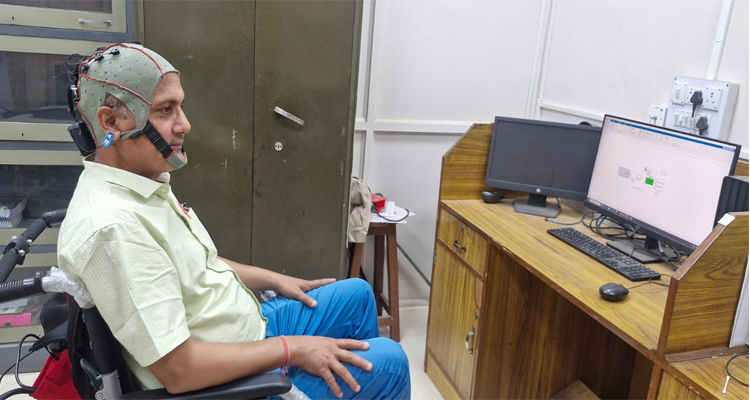
News Desk: In a major leap for assistive technology, researchers at Birla Institute of Technology, Mesra (BIT) have developed a cutting-edge system that allows wheelchairs to be controlled directly through brain signals—offering new hope for people with severe mobility impairments.
Brain Signals Turned into Motion
This technology is particularly significant for individuals suffering from conditions like spinal cord injuries, strokes, ALS, and cerebral palsy, where independent movement is often impossible.
Hybrid AI Model Boosts Accuracy
At the core of the system is a Hybrid Quantum-Enhanced CNN-LSTM model, which simultaneously analyses multiple dimensions of brain signals—including frequency, spatial patterns, and complexity—to accurately decode user intent.
Unlike conventional EEG-based systems that struggle with noise and variability, this model delivers sharper precision and faster processing.
High Accuracy, Near Real-Time Response
- Accuracy: 92.71%
- Response Time: 77.6 milliseconds
- False Command Rate: Just 2.8%
The system also achieved 90.23% accuracy on international datasets, highlighting its global reliability. Importantly, it functions efficiently even on limited hardware, making it suitable for portable deployment.
Real-World Testing & Simple Commands
The research team used an 8-channel wireless EEG system to collect brain data from participants with no prior experience—boosting its real-world applicability.
Users were trained with simple mental cues:
- Thinking about left-hand movement → Wheelchair turns left
- Thinking about right-hand movement → Wheelchair turns right
- Resting state → Wheelchair stops
From Lab to Life
A working prototype has already been developed at the institute’s EEE lab, achieving over 80% accuracy in real-world conditions. The system wirelessly transmits brain signals to the wheelchair’s motor unit, enabling instant response based purely on thought.
Expert Insight
Lead researcher Dr. Prabhat Kumar Upadhyay said the goal is to create affordable, non-invasive, and fast-response assistive systems that can move beyond laboratory settings into everyday use.
He added that while quantum elements are currently simulated, future work will involve testing on real quantum hardware.
The project has been funded by the Indian Council of Medical Research, with a long-term vision to develop reliable brain-controlled assistive technologies that can significantly enhance independence for people with disabilities.