
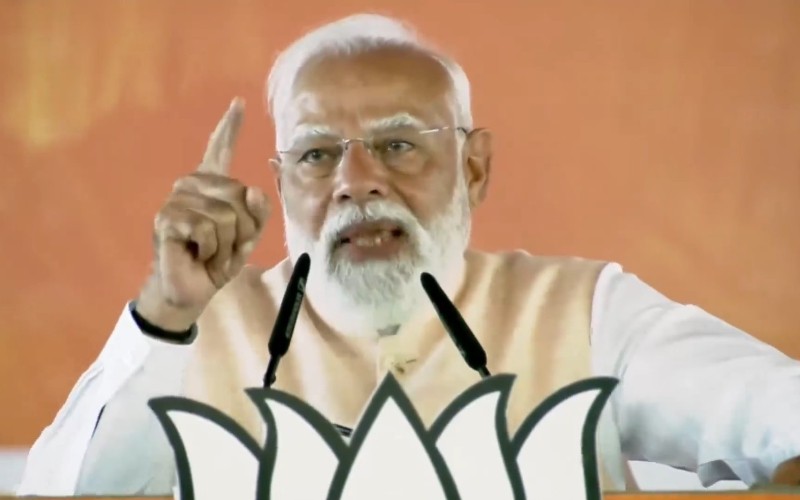
Malda: Prime Minister Narendra Modi on Saturday said India’s youngest voters are increasingly aligning with the BJP’s development-centric politics, asserting that the party’s sweeping mandate in the Brihanmumbai Municipal Corporation elections reflects a generational shift in political thinking.
Addressing a packed rally in Malda, Modi said Gen Z voters are backing governance, infrastructure, and opportunity over appeasement and stagnation. He expressed confidence that West Bengal would soon mirror this trend in the forthcoming Assembly elections, signalling what he described as an inevitable change in the state’s political direction.
“Young India wants progress and accountability. That trust is now firmly with the BJP,” the Prime Minister said, adding that Bengal’s electorate was ready to turn the page.
पश्चिम बंगाल में भाजपा की सरकार बनने पर हम ना सिर्फ राज्य का पुराना गौरव लौटाएंगे, बल्कि मालदा सहित पूरे राज्य के किसानों और नौजवानों के लिए नए अवसर लेकर भी आएंगे। pic.twitter.com/iQUMWTMeMb
— Narendra Modi (@narendramodi) January 17, 2026
Direct message to the ruling establishment
Switching to Bengali, Modi delivered a sharp political punch, saying “Ei sarkar palano dorkar,” a clear call for change. He accused the ruling All India Trinamool Congress of presiding over misgovernance and alleged that development initiatives sent by the Centre were deliberately stalled.
Without mincing words, he claimed that corruption and political interference had deprived ordinary citizens of welfare benefits, asserting that Bengal’s revival would begin only after a new government takes charge.
Infiltration framed as a security and social issue
Making border-related concerns central to his address, the Prime Minister said unchecked infiltration has become one of Bengal’s most serious challenges. He argued that demographic imbalances and law-and-order disturbances were not accidental but the result of political protection.
Referring to incidents of unrest in districts such as Malda and Murshidabad, Modi alleged that social tensions were being fuelled by vote-bank politics, warning that national security could not be compromised for electoral gains.
‘Syndicate culture has strangled development’
Modi also accused the state government of nurturing a “syndicate culture,” claiming that intimidation, extortion, and organised networks had replaced transparent governance.
He alleged that these networks were enabling illegal settlements and creating fear at the grassroots level, adding that firm corrective measures would follow if the BJP assumes power.
Assurance to refugee communities
Seeking to allay fears among refugee groups, including the politically influential Matua community, the Prime Minister reiterated that those who escaped religious persecution need not feel insecure.
He reminded them that the Citizenship Amendment Act offers legal protection and dignity, assuring that their rights and future would be safeguarded.
BJP-governed states held up as contrast
Modi pointed out that West Bengal is now ringed by BJP-ruled states, which he said have demonstrated better governance, infrastructure growth, and social stability.
“Bengal should not be left behind,” he said, urging voters to give the BJP a chance to deliver similar results.
Echoing national security concerns
The Prime Minister’s remarks reinforced earlier warnings by Union Home Minister Amit Shah, who has repeatedly flagged illegal migration along the eastern border as a national security concern.
With Assembly elections drawing closer, issues such as governance, corruption, infiltration, and development are set to dominate Bengal’s political discourse, setting the stage for a high-stakes electoral contest between the BJP and the Trinamool Congress.