
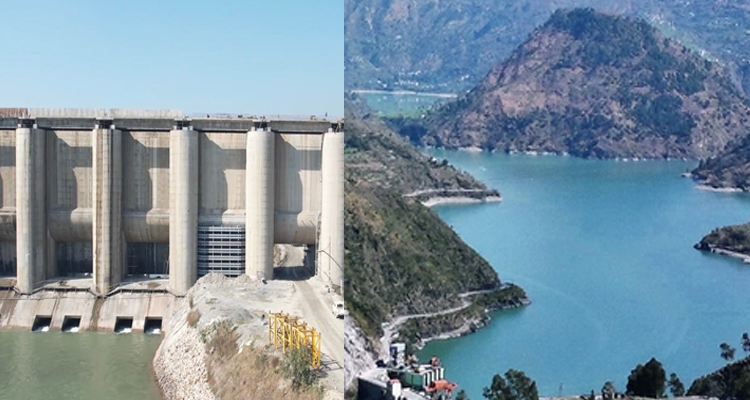
New Delhi: With the peak summer season approaching, India is preparing to significantly reduce the outflow of surplus Ravi River water into Pakistan, as the long-delayed Shahpur Kandi Dam project moves toward completion.
The development comes amid a hardened water policy from New Delhi following its decision to place the Indus Waters Treaty in abeyance last year — a move that has accelerated work on key projects on the eastern rivers allocated exclusively to India.
Dam in Final Stretch
Jammu and Kashmir’s Jal Shakti Minister Javed Ahmed Rana has confirmed that construction of the Shahpur Kandi Dam, located along the Punjab–Jammu and Kashmir border, is in its final phase. Officials expect the project to be operational by March 31.
Once commissioned, the dam will enable India to fully utilise Ravi waters that currently flow unutilised into Pakistan, marking a major shift in the management of eastern Indus basin resources.
Rana said the project will prioritise irrigation needs in the drought-prone Kandi belt, particularly in Kathua and Samba districts, where water scarcity has long hampered agriculture.
Water to Be Redirected
At present, excess Ravi water passes downstream through Madhopur into Pakistan, the lower riparian state. With the new infrastructure in place, that surplus will instead be diverted to Indian territory.
Officials estimate the project will irrigate about 5,000 hectares in Punjab and more than 32,000 hectares in Kathua and Samba combined, offering relief to parched farmland and boosting local farm output.
Former irrigation minister Taj Mohideen has maintained that the dam’s operations fall fully within India’s rights, noting that the Indus Waters Treaty grants New Delhi exclusive control over the Ravi.
Project Decades in the Making
The Shahpur Kandi Dam was originally conceived in 1979 to prevent Ravi waters from flowing unused into Pakistan. Former Prime Minister Indira Gandhi laid the foundation stone in 1982, but the project remained stalled for decades due to inter-state disputes between Punjab and the then state of Jammu and Kashmir.
It was eventually granted national project status in 2008, reviving momentum.
Built at an estimated cost of ₹3,394.49 crore, the dam is funded largely by Punjab (about 80%), with the Centre contributing the remainder. The structure rises 55.5 metres and includes a 7.7-km hydel channel.
Treaty Freeze Marks Policy Shift
India’s tougher stance on water cooperation followed the April 23, 2025 terror attack in Pahalgam that killed 26 civilians. A day later, New Delhi placed the Indus Waters Treaty in abeyance — the first such step since the pact was signed in 1960.
Indian officials indicated that continued cooperation on river waters cannot proceed alongside persistent cross-border terrorism, signalling a broader recalibration of policy.
Strategic Concerns for Pakistan
Pakistan’s agriculture depends heavily on the Indus river system, with roughly 80–90% of its farming linked to these waters. Analysts note that the country’s limited reservoir capacity — estimated to store only about a month’s flow — heightens its vulnerability to upstream changes.
Following the treaty freeze, India has fast-tracked several hydropower and storage projects across the basin, including Sawalkote, Ratle, Bursar, Pakal Dul, Kwar, Kiru, and Kirthai I and II. Work on the Sawalkote project was also recently expedited.
With the Shahpur Kandi Dam nearing completion, the coming months could mark a significant shift in the hydro-strategic dynamics of the region.