
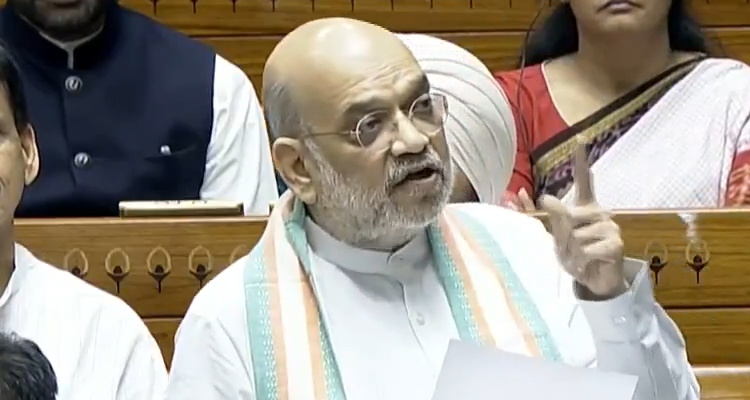
New Delhi: In a strong assertion on India’s internal security landscape, Union Home Minister Amit Shah on Monday declared that the country is on the brink of being completely free from Naxal violence, with only a formal announcement remaining.
Addressing the Lok Sabha during a discussion on internal security, Shah said that Maoist insurgency has been effectively dismantled across the country. He reiterated the government’s target to eliminate Naxalism nationwide by March 31, suggesting that the goal has nearly been achieved.
नक्सली हिंसा करने वालों के दिन अब लद गए हैं। pic.twitter.com/HQPw9tNLpC
— Amit Shah (@AmitShah) March 30, 2026
Bastar’s Transformation Takes Centre Stage
Highlighting the turnaround in Bastar—once considered the epicentre of Maoist activity—Shah emphasized that the region is now witnessing rapid development. He noted that villages are being equipped with schools, ration shops, and improved healthcare infrastructure, including Primary Health Centres and Community Health Centres at local levels.
According to Shah, welfare delivery has expanded significantly, with residents receiving Aadhaar cards, ration cards, and access to subsidised food grains—marking a shift from years of neglect.
“The shadow of Red Terror had long stalled development in Bastar. Today, that shadow has lifted, and the region is moving forward on the path of growth,” he said.
Dialogue Open, But Zero Tolerance for Violence
Reaffirming the Centre’s dual approach, Shah said the government remains willing to engage in dialogue with Maoists who surrender arms, offering rehabilitation and reintegration into mainstream society. However, he issued a clear warning that those continuing violent activities will face strict action.
Political Flashpoint in Parliament
The debate also sparked sharp political exchanges, with the ruling party holding the Indian National Congress responsible for the spread of Maoism during its tenure.
Shah pointed out that the insurgency, which has claimed nearly 20,000 lives and impacted millions, stemmed from a failure to deliver development in tribal regions. He referenced former Prime Minister Manmohan Singh, who had earlier termed Naxalism as one of India’s biggest internal security threats, questioning why stronger action was not taken at the time.
Security + Development Strategy Paying Off
The government maintains that a combined strategy of intensified security operations and focused development initiatives has significantly weakened Maoist networks. While isolated incidents still occur in remote pockets, officials believe the insurgency is now in its final phase.
With the March 31 deadline approaching, the Centre’s bold claim signals a potentially historic shift in India’s long-running battle against Left-wing extremism.