
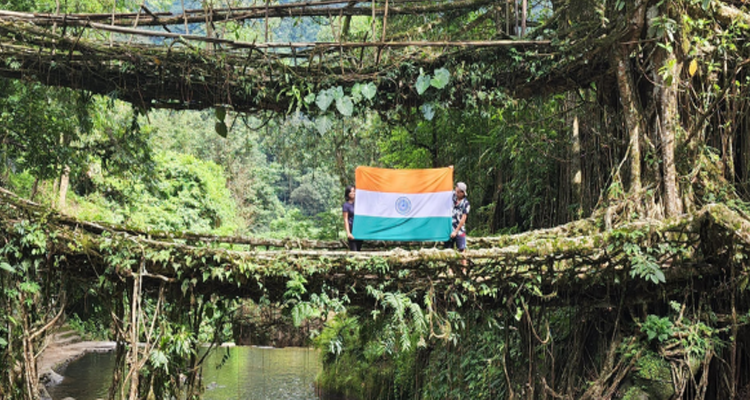
New Delhi: India has taken a major step to secure global recognition for Meghalaya’s iconic living root bridges by formally submitting their nomination to UNESCO for World Heritage status. The dossier, titled “Jingkieng Jri / Lyu Chrai Cultural Landscape,” has been entered for evaluation under the 2026–27 World Heritage cycle.
The nomination was handed over by India’s Ambassador and Permanent Representative to UNESCO, Vishal V. Sharma, to Lazare Assomo Eloundou, Director of UNESCO’s World Heritage Centre.
#Meghalaya’s Living Root Bridges (Jingkieng Jri) dossier has been formally submitted to UNESCO in Paris by India’s Ambassador and Permanent Representative to UNESCO, Vishal V. Sharma, for consideration for inclusion in the World Heritage List 2026–27.
The nominated cultural… pic.twitter.com/sU2jM1EEiT
— All India Radio News (@airnewsalerts) January 29, 2026
A Living Cultural Landscape
Spread across the Khasi and Jaintia Hills, the nominated site represents a rare living heritage system shaped by indigenous Khasi and Jaintia communities over centuries. The bridges—grown by guiding the aerial roots of rubber fig trees across rivers—are not just engineering marvels, but symbols of a sustainable way of life rooted in harmony with nature.
The cultural landscape reflects a deep bond between people, ecology and belief systems, expressed through traditional land-use practices, community governance and ecological stewardship.
Nature, Faith and Sustainability
At the core of the nomination are the living root bridges, which embody the indigenous philosophy of coexistence with nature and reverence for Mei Ramew (Mother Earth). These natural structures, some over a hundred years old, continue to grow stronger with time—standing as living examples of climate-resilient, low-impact infrastructure.
#WATCH | Hally War of Meghalaya is being awarded the Padma Shri for preserving and promoting the eco-friendly afforestation practices of the Khasi people.
He safeguarded indigenous bioengineering knowledge, teaching the bio-weaving of traditional living root bridges in the East… pic.twitter.com/3wHmYh0SMI
— All India Radio News (@airnewsalerts) January 25, 2026
Collective National Effort
Ambassador Sharma credited the leadership of the Prime Minister, the Union Minister for Culture, and the Chief Minister of Meghalaya, along with the support of the Archaeological Survey of India, the Ministry of External Affairs, and local communities who continue to safeguard this heritage.
The submission underscores India’s growing commitment to preserving living cultural landscapes and strengthening global heritage conservation through UNESCO.
If approved, Meghalaya’s living root bridges would join India’s prestigious list of World Heritage Sites, placing this extraordinary tradition on the world stage.