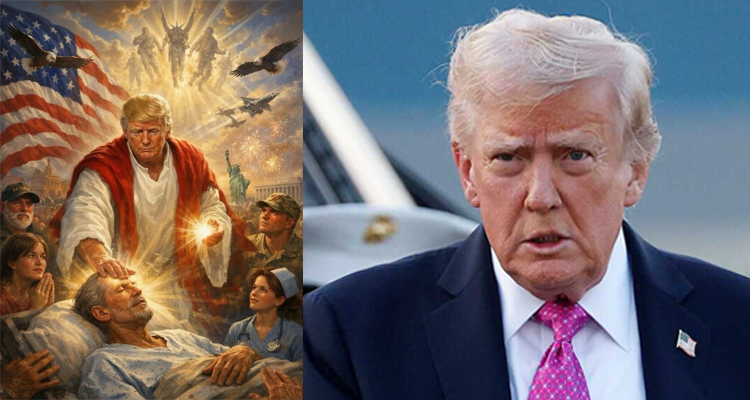
News Desk: In a move that has stirred sharp global reactions, US President Donald Trump shared an AI-generated image portraying himself as Jesus Christ blessing a pope—just hours after launching a scathing attack on Pope Leo XIV.
A Post That Sparked a Storm
The image, posted on Trump’s Truth Social platform, shows him in a divine, Christ-like form surrounded by glowing light, appearing to perform a miracle while blessing the pontiff. The timing of the post raised eyebrows, coming soon after Trump publicly criticised the Pope over his stance on global conflicts, particularly tensions involving Iran.
In his remarks, Trump reportedly labelled the Pope as “weak” and accused him of poor judgment on international affairs—comments that signalled a deepening and unusually public rift between the White House and the Vatican.
Politics Meets AI Symbolism
The AI-generated visual has been widely interpreted as more than just a meme. Analysts suggest it reflects a growing trend in modern politics—using artificial intelligence to craft powerful, often controversial imagery that blends symbolism with messaging.
By casting himself in a messianic role, Trump appeared to lean into a narrative of strength and authority, though critics argue such portrayals cross ethical and cultural lines.
New media post from Donald J. Trump
(TS: 12 Apr 21:49 ET) pic.twitter.com/uWUoEG1bSQ
— Commentary: Trump Truth Social Posts On X (@TrumpTruthOnX) April 13, 2026
Backlash and Support
The reaction was swift and divided. Religious leaders and commentators condemned the image as disrespectful, with some calling it outright blasphemous for using sacred Christian imagery in a political context.
At the same time, Trump’s supporters dismissed the criticism, describing the post as satire or a reflection of today’s meme-driven political culture, where exaggeration and symbolism often dominate online discourse.
A Growing Rift
The controversy comes against the backdrop of increasing friction between Trump and the Vatican. Pope Leo XIV has repeatedly called for restraint and peace amid rising global tensions—remarks widely seen as indirect criticism of aggressive geopolitical strategies.
Trump’s response, both verbal and visual, now appears to have taken that disagreement into a more provocative and public arena.
Bigger Questions on AI and Public Discourse
Beyond the political clash, the episode has reignited concerns about the use of AI-generated content by powerful figures. As such tools become more accessible, experts warn of a blurred line between satire, propaganda, and influence.
With no clarification yet from Trump on the intent behind the image, the debate continues—raising larger questions about the intersection of technology, faith, and political messaging in the digital age.