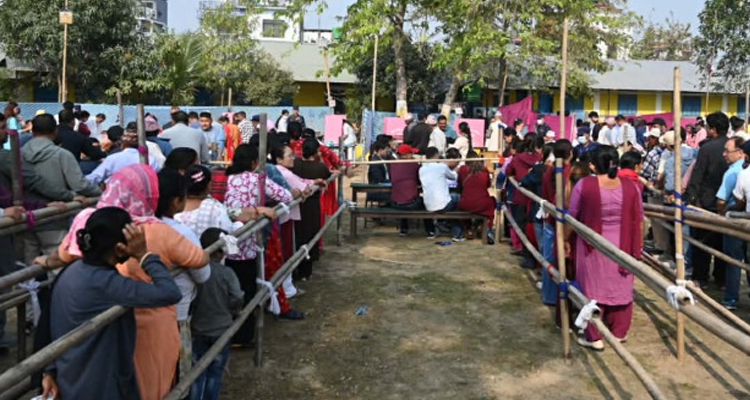
News Desk: Voting for Nepal’s parliamentary elections concluded peacefully on Thursday evening, with more than 60 percent of the country’s nearly 19 million registered voters casting their ballots under tight security arrangements across the Himalayan nation.
According to the Election Commission of Nepal, polling began at 7 am local time and ended at 5 pm in a single phase across all 77 districts. Authorities set up 23,112 polling centres under 10,963 polling stations to facilitate voting nationwide. Security was significantly heightened, with over 341,000 personnel deployed, including nearly 149,000 temporary election police.
Ballot counting has already begun to determine the winners of the 275-member House of Representatives of Nepal. Each voter was allowed to cast two votes — one for an individual candidate under the first-past-the-post system and another for a political party under proportional representation.
Voter turnout around 60 percent in Nepal’s parliamentary elections
Election Commission reports largely peaceful polling; counting to begin once all ballot boxes are collected.https://t.co/FV0D8WQDJg
— The Kathmandu Post (@kathmandupost) March 5, 2026
A total of 3,406 candidates representing more than 65 political parties, along with 1,143 independents, contested 165 seats under the first-past-the-post model. Another 3,135 candidates competed for the remaining 110 seats allocated through proportional representation.
Several prominent leaders are seen as key contenders for the prime minister’s post, including Balendra Shah of the Rastriya Swatantra Party, KP Sharma Oli of the Communist Party of Nepal (Unified Marxist–Leninist), Gagan Thapa of the Nepali Congress, and Pushpa Kamal Dahal of the Communist Party of Nepal (Maoist Centre).
In a notable electoral contest, Shah and Oli are both competing from the Jhapa-5 constituency in eastern Nepal, located close to the strategically significant Siliguri Corridor—often referred to as India’s “Chicken’s Neck”.
The elections are expected to end the tenure of the interim government led by former Nepal Supreme Court Chief Justice Sushila Karki, who assumed office in September last year following a massive youth-led anti-corruption movement that forced the collapse of the Oli-led coalition government.
After casting her vote in Kathmandu, Karki expressed satisfaction over the largely peaceful polling process and absence of violence. Earlier this week, she addressed the nation urging citizens to vote responsibly and maintain harmony during the elections and the upcoming Holi celebrations.
Meanwhile, the Rastriya Prajatantra Party revived its campaign for restoring Nepal’s constitutional monarchy and reinstating the country as a Hindu state. The party organized several rallies backing former king Gyanendra Bir Bikram Shah Dev, who has lived as a private citizen in Kathmandu since the monarchy was abolished nearly two decades ago.
Pro-monarchist groups continue to demand the return of the monarchy—at least in a ceremonial capacity—often staging rallies with national flags and slogans whenever the former royal visits rural areas.
The final results are expected to determine the next government and shape Nepal’s political direction amid growing debates over governance, corruption, and the country’s constitutional identity.