
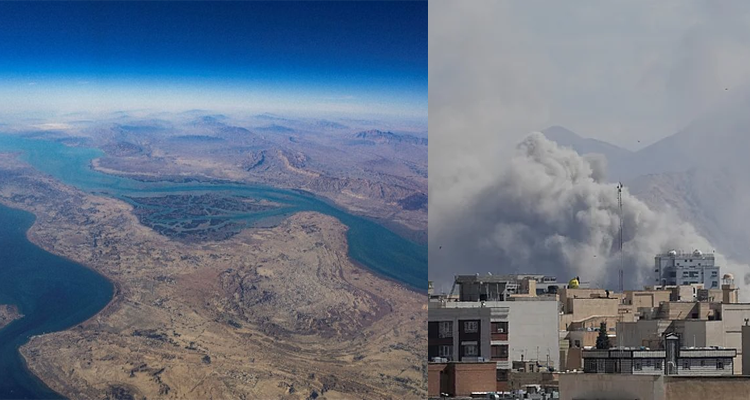
Washington/Tehran: Tensions between the United States and Iran escalated sharply after the U.S. military launched strikes on Iran’s strategically important Qeshm Island in the Strait of Hormuz, following a wave of Iranian missile and drone attacks targeting regional allies Kuwait and Bahrain.
According to the U.S. Central Command (CENTCOM), American forces conducted what it described as “self-defense strikes” against military facilities on Qeshm Island, including a drone-control station and other sites allegedly linked to Iranian missile and drone operations. The Pentagon said the action came after Iranian forces launched multiple missiles and unmanned aerial vehicles toward Gulf states and civilian maritime traffic in the region.
Qeshm Island, located near the narrow Strait of Hormuz through which nearly one-fifth of the world’s oil passes, holds significant strategic importance for Iran’s military operations in the Persian Gulf. Reports from the region indicated that explosions were heard near military installations on the island shortly after the U.S. operation.
West Asia Escalation: US Strikes in Strait of Hormuz After Iran Targets ‘American Air Bases’
🇺🇸 CENTCOM claimed it had conducted ‘self-defence’ strikes on a military ground control station on Qeshm Island after ‘intercepting’ three missiles fired towards Bahrain and some drones.… https://t.co/iL5OoXvRmV pic.twitter.com/KJeksDtgty
— RT_India (@RT_India_news) June 3, 2026
Iranian Attacks Trigger Retaliation
The U.S. military stated that Iranian missiles and drones targeted facilities in Bahrain and Kuwait, although most of the projectiles were intercepted by American and allied air-defense systems or failed to reach their intended targets. Kuwait reported damage at its international airport, while Bahrain activated emergency warning systems as incoming threats were detected.
An additional wave of Iranian drones attempting to attack U.S. forces in Kuwait failed to impact intended targets tonight. U.S. Central Command air defenses successfully downed multiple drones and ensured no American personnel or assets were harmed.
— U.S. Central Command (@CENTCOM) June 3, 2026
In response, American forces intercepted several Iranian drones and ballistic missiles before launching retaliatory strikes on Qeshm Island. CENTCOM maintained that the operation was intended to neutralize immediate threats and protect U.S. personnel, partners, and international shipping routes in the Gulf.
PENTAGON CLAIMS 100% SUCCESS shooting down Iranian ballistic missiles
BOMBS Iran’s Qeshm Island in ‘response’ — CENTCOMhttps://t.co/Jbd7MJG90M pic.twitter.com/tgeP0nI7jz
— RT (@RT_com) June 2, 2026
Iran Condemns US Action
Iran’s Islamic Revolutionary Guard Corps (IRGC) condemned the U.S. strikes, claiming that the attacks targeted a communications facility near Qeshm Island. Tehran argued that its subsequent missile and drone operations were a direct response to American actions in and around the Strait of Hormuz. Iranian officials warned that any further attacks on Iranian territory would invite a “decisive response.”
The IRGC also claimed responsibility for strikes against U.S.-linked military assets in the Gulf region, including facilities associated with the U.S. Fifth Fleet. However, U.S. officials said no American military installations suffered significant damage.
Peace Efforts Under Strain
The latest exchange of fire comes at a time when already fragile ceasefire and diplomatic efforts between Washington and Tehran appear to be faltering. Recent negotiations aimed at reducing tensions and addressing Iran’s nuclear program have reportedly stalled amid widening regional conflicts involving Iran-backed groups and U.S. allies.
Analysts warn that continued military exchanges near the Strait of Hormuz could threaten global energy supplies and further destabilize the Middle East. The waterway remains one of the world’s most critical maritime trade routes, carrying a substantial portion of global oil exports.
Strategic Significance of Qeshm Island
Qeshm Island, Iran’s largest island, sits at the entrance of the Strait of Hormuz and has long served as an important military and logistical hub for Iranian naval and drone operations. Its proximity to major shipping lanes makes it a key strategic asset in any confrontation involving Gulf security and international energy transit.
With both sides exchanging accusations and military actions, regional observers fear that the latest confrontation could mark another dangerous escalation in the ongoing conflict between the United States and Iran.