New Delhi: After more than eight decades of unanswered questions, the long-running saga over the fate of Netaji Subhas Chandra Bose’s mortal remains has entered a new and potentially decisive legal phase.
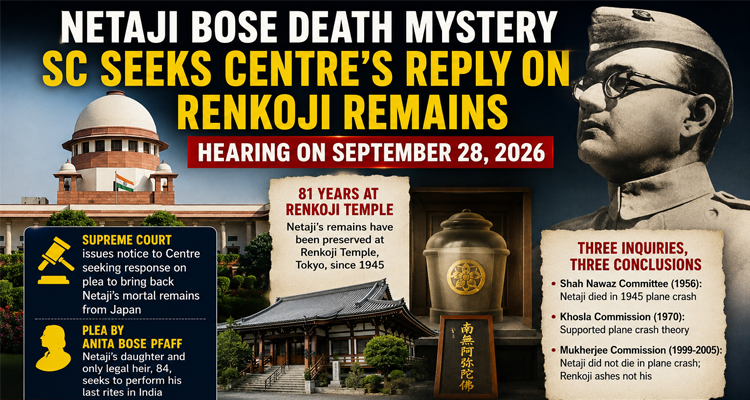
The Supreme Court on August 11 issued notice to the Union government, including the Ministries of Home Affairs and External Affairs, on a petition by Dr Anita Bose Pfaff, Netaji’s only child and direct heir, seeking the return to India of the mortal remains preserved at Tokyo’s Renkoji Temple. The matter has been listed for further hearing on September 28, 2026.
Senior advocate Abhishek Manu Singhvi, appearing for Pfaff, told the court that Netaji’s daughter is 84 and lives in Austria. Her central plea is that her father’s remains should finally be brought to India so that she can perform his last rites in accordance with her family’s religious and cultural traditions.
The petition also raises a broader question: why has no final decision been taken on the repatriation of the remains despite decades of government deliberation and repeated appeals?
From Family Appeal to Supreme Court Battle
The latest case is significant because it follows a direct invitation from the Supreme Court itself.
In March 2026, the apex court declined to entertain a petition filed by Ashis Ray, Netaji’s grand-nephew and a senior journalist, seeking the return of the remains believed to be those of Bose from Renkoji Temple.
During that hearing, Singhvi informed the Bench that Anita Bose Pfaff was virtually present and supported the plea. But the Bench, headed by Chief Justice Surya Kant, indicated that if Netaji’s direct heir wanted the remains returned, she herself should approach the Court.
Justice Joymalya Bagchi made the position clear: the Court respected her sentiments but wanted those sentiments translated into legal action through her own petition. The petition was consequently withdrawn, leaving the door open for Pfaff to approach the Court directly.
Pfaff has now done precisely that.
The August proceedings therefore represent more than another petition concerning Netaji. For the first time in this latest round of litigation, his daughter herself is before the Supreme Court seeking judicial intervention.
81 Years at Renkoji: A Relic of an Unfinished History
The story of the Renkoji remains goes back to the closing days of the Second World War.
According to the widely accepted account, Bose suffered severe burns in a Japanese military aircraft crash at Taihoku, now Taipei, on August 18, 1945, and died later that day in a military hospital.
The remains attributed to Bose were subsequently cremated and transported to Tokyo in early September 1945. They were placed at Renkoji Temple, where the urn has remained for more than eight decades.
Over the years, the temple has become an important place of remembrance for Indians visiting Japan. Indian leaders and dignitaries have paid homage there, while successive temple priests have preserved the urn.
Historical records also show that the Indian government has, at various times, contributed towards the preservation of the remains at Renkoji. Declassified records indicate that the issue of maintaining the ashes at the temple, or bringing them back to India, has been discussed by successive governments for decades.
But there is one crucial caveat: the identity of the remains has never been universally accepted.
Three Inquiries, Three Chapters of Controversy
India has conducted several official inquiries into Netaji’s disappearance and reported death.
Shah Nawaz Committee — 1956
The Shah Nawaz Khan Committee concluded that Bose died in the 1945 air crash.
Justice G.D. Khosla Commission — 1970–74
The Khosla Commission, constituted in 1970, also broadly accepted the plane-crash theory. Its report was submitted in 1974. Government records list both the Khosla and Mukherjee inquiries among the major official investigations into Bose’s disappearance.
Justice M.K. Mukherjee Commission — 1999–2005
The third major inquiry produced the most controversial conclusion.
The Mukherjee Commission, constituted in 1999, concluded that Bose did not die in the alleged 1945 plane crash and that the ashes preserved at Renkoji Temple were not his.
The then UPA government rejected those findings in 2006, specifically disagreeing with the Commission’s conclusions about both the plane crash and the Renkoji remains.
The result has been an extraordinary historical contradiction: official inquiries have not spoken with one voice, while governments have continued to treat the issue cautiously.
What Does the Government Actually Believe?
A significant development came in 2017, when the Ministry of Home Affairs responded to an RTI query stating that, after considering the findings of the Shah Nawaz Committee, the Khosla Commission and the Mukherjee Commission, the government had concluded that Netaji died in the 1945 plane crash.
Yet the remains attributed to him have never been formally brought back to India.
That apparent contradiction has kept the controversy alive.
The historical record suggests that the hesitation has not been simply a diplomatic issue. Successive governments have also been conscious of disagreements within the Bose family and among political groups and Netaji’s followers over the circumstances of his death and the authenticity of the Renkoji remains. Declassified files show that the question of bringing the remains back was repeatedly considered but was also viewed as potentially divisive.
DNA Test: The Scientific Route to Closure?
One possible way out of the controversy has been repeatedly suggested: DNA testing.
Pfaff herself has supported DNA testing of the remains. In 2022, she said scientific testing could establish whether the remains preserved at Renkoji were actually those of her father.
The issue is technically complicated because the material is more than 80 years old and was subjected to cremation. Whether sufficient recoverable DNA exists is therefore a scientific question that cannot simply be assumed away.
Importantly, however, historical records indicate that the Renkoji priest had previously conveyed that he had no objection to DNA testing and, if testing confirmed the remains to be Bose’s, was willing to hand over the casket to India while retaining a portion at the temple.
That makes the question of scientific examination even more significant.
Is Japan Really the Obstacle?
The evidence suggests that it would be too simplistic to portray Japan or Renkoji Temple as the principal obstacle.
Recent reporting based on documentary material from the Netaji files says temple authorities have indicated willingness to cooperate with testing and, subject to the relevant conditions, transfer of the remains.
Historical Indian government records also show that the Japanese side and the Renkoji priesthood have, at different points, expressed willingness to discuss the return.
The greater difficulty has historically been India’s own unresolved political, historical and family consensus over what exactly the urn contains and what its return would signify.
A Daughter’s Final Wish
For Anita Bose Pfaff, however, the issue is more personal than political.
She has repeatedly said that she believes her father most likely died in the 1945 crash and has called for his remains to return to independent India.
Her position has evolved around a simple principle: if the remains are indeed those of Netaji, they should return to his homeland; if doubts remain, modern science should be allowed to address them.
In January 2026, she again appealed for support for the transfer of what she described as her father’s mortal remains to India for a final and fitting disposal.
Now, at 84, she has taken the issue directly to the country’s highest court.
SC Notice Puts the Centre on the Spot
The Supreme Court’s August 11 notice does not settle the historical question of whether Netaji died in the 1945 crash. Nor has the Court declared the Renkoji remains conclusively to be his.
What it has done is place the Union government directly before the Court on a petition filed by the person identified in the proceedings as Netaji’s direct heir.
The next hearing on September 28 could therefore become an important moment in a controversy that has survived governments, commissions, political changes and generations.
The question before the Modi government is now difficult to avoid:
Will it merely defend the position it has maintained for years, or will it present a concrete, time-bound roadmap for determining the status of the Renkoji remains and, if appropriate, bringing them back to India?
For millions who continue to revere Netaji, the issue is not simply about an urn in a Tokyo temple.
It is about whether one of the most powerful unfinished chapters of India’s freedom struggle can finally receive a dignified conclusion — with Netaji’s mortal remains, if authenticated, returning at last to the soil for which he gave everything.