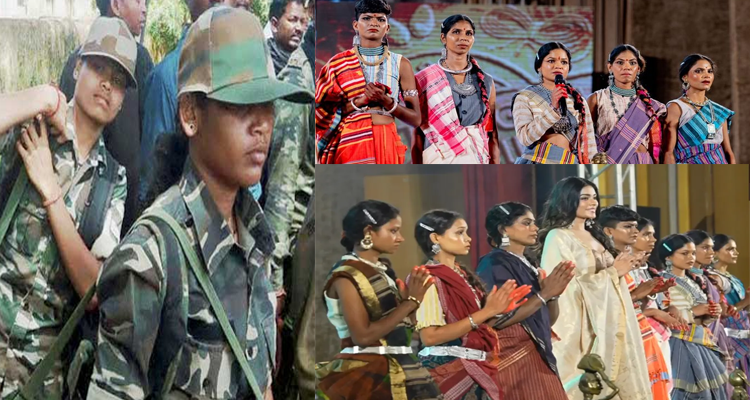
From Maoist insurgency to fashion catwalk, former women Maoists from Bastar walked the ramp in traditional handloom attire on National Handloom Day.
Raipur: From the dense forests of Bastar to the spotlight of a fashion runway, a group of former women Naxals scripted a striking story of transformation on National Handloom Day, walking the ramp in traditional Chhattisgarhi handloom attire at a special event in Raipur.
The women, who had once been associated with armed Maoist insurgency in Bastar and later surrendered to return to mainstream society, appeared alongside professional models at the Pandit Deendayal Upadhyay Auditorium in Raipur. Dressed in traditional handloom garments, including locally celebrated Kosa silk, they received loud applause from the audience.
The event, held on August 7, National Handloom Day, brought together two very different narratives — the promotion of Chhattisgarh’s indigenous textile heritage and the rehabilitation and reintegration of former Maoist cadres.
From the forest to the fashion runway
For these women, the ramp was far removed from the difficult years they had spent in Bastar’s conflict-affected forest areas.
According to The New Indian Express, the participants came from rehabilitation centres in Bastar, and for many of them the visit to Raipur itself was a new experience. They underwent a week-long grooming and training programme before appearing on the runway, receiving guidance in body language, walking and presentation from a professional trainer from Mumbai.
The ramp had a different kind of power today.
Former Naxal women from Bastar walked the ramp on National Handloom Day, turning a moment of transformation into one of confidence, dignity and hope.
For me, this is the real meaning of change: when women once associated with… pic.twitter.com/9hwQl2Bb4f
— Bhavesh Gujrati (@Bhaveshlivelife) August 13, 2026
The transformation was visible on the final day. Women who had once lived amid armed conflict walked confidently in traditional attire, sharing the stage with professional models and presenting Chhattisgarh’s handloom traditions before a large audience.
Former participant Madvi Malle said she had been nervous when the training began but gained confidence through regular practice. Another participant, Punem Deve, said she had never imagined walking on a ramp before so many people and that the respect she received during the programme encouraged her to move forward.
A different kind of journey
The symbolism of the event was hard to miss.
These women were not appearing on stage to revisit their past. Instead, they were presenting traditional textiles and becoming part of a public celebration of India’s handloom heritage.
Their participation was consequently presented as an example of what rehabilitation and reintegration can mean when former insurgents are provided opportunities to acquire skills, earn livelihoods and rebuild their relationship with society.
Chhattisgarh Chief Minister Vishnu Deo Sai also interacted with the women and encouraged them during the event. In a social-media post, he highlighted the contrast between their past in Bastar’s forests and their appearance on the runway showcasing the state’s handloom heritage.
Handloom becomes a bridge to a new identity
The fashion presentation also put the spotlight on Chhattisgarh’s traditional textiles. The women wore locally rooted handloom creations, including Kosa silk, connecting the event to the state’s cultural and weaving traditions.
National Handloom Day is observed every year on August 7. The day recognises India’s handloom heritage and the contribution of weavers and artisans. The Development Commissioner (Handlooms), under the Ministry of Textiles, continues to document and promote initiatives connected with the country’s handloom sector.
This year’s Raipur event added another dimension to that celebration: the handloom became a platform through which former insurgents could participate in a public cultural event and present a different image of their lives.
From conflict to confidence
The runway walk does not erase the complicated history of Bastar or the violence associated with the Maoist insurgency. But for the women who have surrendered, it represents a visible departure from that past.
The images of former women Maoists walking confidently in traditional sarees, smiling before an applauding audience, offered a powerful visual contrast to their earlier lives in the forests.
More importantly, the episode underlines a broader challenge facing rehabilitation efforts: surrender is only the beginning; sustainable reintegration requires skills, livelihood opportunities, dignity and acceptance within mainstream society.
In Raipur, for a few minutes on a fashion runway, that journey of reintegration was placed centre stage.
From carrying weapons in the forests of Bastar to carrying the colours and craftsmanship of Chhattisgarh’s handloom tradition, the runway walk became more than a fashion statement — it became a striking picture of a life seeking a second beginning.