
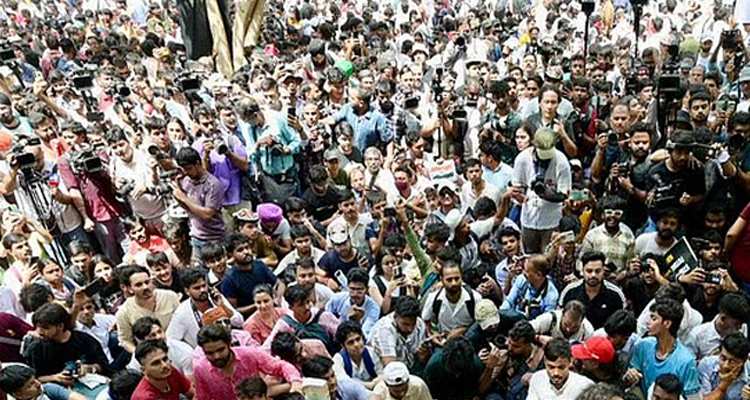
CJP Protest: Police Flagged 2,873, But at Least 25 Were Already in Jail
New Delhi: Delhi Police’s facial-recognition exercise at the Cockroach Janta Party (CJP) protest at Jantar Mantar has come under sharp scrutiny after an investigation found that at least 25 people flagged by the system were actually in jail when they were supposedly detected at the protest site.
The revelation has put the spotlight on the reliability of the technology after the Supreme Court recently allowed Delhi Police to proceed against 2,873 people whom it says have serious criminal antecedents and were identified during the July 20–26 protests.
The 2,873 figure was cited by Delhi Police in an affidavit/application before the Supreme Court. Of these, 2,402 were identified through the police’s Crime-Kundli database and 471 through its dossier records, according to the police data reported earlier.
A face match—and a major red flag
The most significant challenge to the identification exercise emerged from The Indian Express, which examined 205 people from the police list who were linked to serious allegations, including murder, attempted murder, rape and offences under the Protection of Children from Sexual Offences Act.
Its investigation found at least 25 people who were reportedly in jail during the period when Delhi Police’s facial-recognition system identified them at Jantar Mantar. Police, prison and court records were used to verify their custody status.
The 25 included people facing allegations of murder, rape, attempted murder and crimes against children. The findings therefore raise a basic but crucial question: if a person was behind bars, how did the system place that person at a protest hundreds of kilometres—or, in some cases, simply outside the prison—at the same time?
One example cited in the investigation is Pratap Singh Sisodia, an accused in the 2014 kidnapping and murder of a 13-year-old boy. Delhi Police’s system reportedly flagged him as present at the CJP protest, while records showed that he was in custody at the relevant time.
Another case involved Yogesh alias Raju, who was reportedly flagged at Jantar Mantar at about 4.24 pm on July 25. Jail records examined by The Indian Express showed that he was lodged in Tihar Jail.
#ExpressInvestigation | Delhi Police told the Supreme Court its facial recognition system flagged 2,873 people with criminal records at protest, assured no action without verification.
An Express verification shows at least 25 on that list, facing serious charges, were in jail.… pic.twitter.com/6phk7s5Zau
— The Indian Express (@IndianExpress) September 4, 2026
Police: No action on facial recognition alone
Delhi Police, however, has stressed that a facial-recognition match is not by itself the final basis for prosecution.
The police has said that the 2,873 identifications would undergo further field verification before action is taken. A senior police officer also pointed out that custody records can sometimes continue to reflect an accused as being in jail even when the person has temporarily left custody—for example, on parole, furlough or for medical treatment.
That explanation makes independent verification all the more important.
The controversy, therefore, is not simply about whether facial recognition can produce a match. It is about whether such a match can establish that a particular individual was physically present at a particular place and time.
What does 2,873 actually mean?
Another important distinction is being lost in the headline figure.
The police identification of 2,873 people does not mean that all 2,873 have been convicted of crimes, nor does it by itself establish that every one of them participated in violence at Jantar Mantar.
Earlier police data reported that among those identified were 101 people linked to murder cases and 62 linked to attempt-to-murder cases, alongside people with alleged involvement in robbery, rape, kidnapping, narcotics and other offences.
Thus, “criminal antecedents”, “accused in a criminal case”, “convicted criminal” and “participant in protest violence” are not interchangeable descriptions.
Supreme Court draws a line
The development comes days after the Supreme Court invoked Article 142 to bring an end to FIRs arising from the July student protests, while permitting Delhi Police to register a fresh FIR against the 2,873 people with alleged serious criminal antecedents.
The court’s move was aimed at protecting young people who had participated bona fide in peaceful demonstrations, while allowing investigation into those whom the authorities allege were involved in serious offences.
The Centre and Delhi Police were specifically allowed to proceed against the 2,873 if investigation establishes their involvement in offences involving bodily harm or destruction of property; the exception was not framed as an automatic finding of guilt.
The bigger question
The 25 apparent mismatches now make the next stage—physical verification—critical.
If facial recognition merely generates investigative leads, those leads must be tested against CCTV footage, photographs, witness accounts, custody records and other independent evidence before criminal liability is attributed to an individual.
For Delhi Police, the issue is therefore bigger than one software system.
The real test is whether technology can identify a face—and then reliably prove that the person behind that face was actually there.
Until that second question is answered through independent verification, the figure of 2,873 should remain an identification claim, not a finding of guilt.
updated