
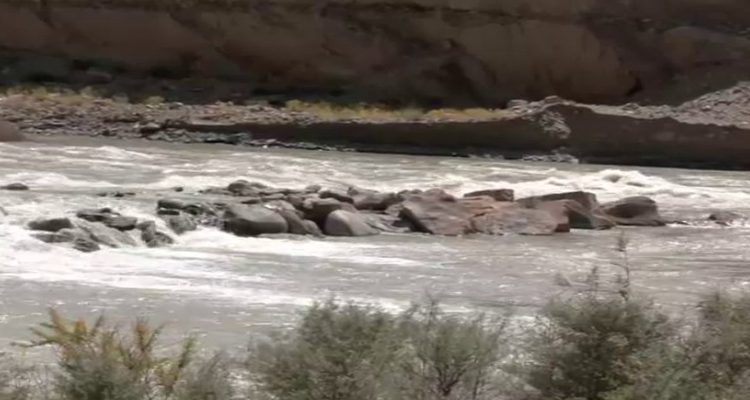
Leh: Amid the continuing India-Pakistan row over the Indus Waters Treaty, India has quietly moved to strengthen water security along the Indus in Ladakh—with an unconventional structure made not of concrete and steel, but massive rocks locked together in the riverbed.
The first-ever Himalayan Rock Check Dam in India has been built at Upshi in Leh, around 44 km from Leh at an altitude of 11,400 feet. Inaugurated on May 27, 2026, the project is part of the Sindhu Jal Samriddhi Abhiyan (SJSA) launched by the Ladakh administration to address seasonal water shortages and improve irrigation in the high-altitude region.
The project assumes added significance at a time when the Indus Waters Treaty remains in abeyance, according to the Indian government. New Delhi has linked its position to Pakistan’s support for cross-border terrorism.
A rock barrier across the Indus
The Upshi check dam is a striking example of simple engineering adapted to Ladakh’s difficult terrain.
Nearly 180 metric tonnes of rocks, ranging from about 500 kg to 10 tonnes each, were interlocked across the riverbed. There is no cement or concrete in the structure.
The dam stretches nearly 200 feet, with a 30-foot-wide base, a 15-foot-wide top deck and a height of around five feet above the riverbed.
Even more striking: it was constructed in just seven days—from May 12 to May 18, 2026.
Ground Report | लेह के उपशी में भारत ने अपना पहला Rock Check Dam बनाया है। इसे बनाने में सिर्फ़ प्राकृतिक पत्थरों का इस्तेमाल किया गया है और ज़रा भी सीमेंट का इस्तेमाल नहीं हुआ है।
Mir Fareed की ग्राउंड रिपोर्ट #ReporterDiary #Leh #Upshi #GroundReport | @MirFareed2 pic.twitter.com/18Gh7avlEn— AajTak (@aajtak) September 4, 2026
40 million litres held back
The objective is not to block the Indus but to slow its flow and raise the local water level, creating a deeper pondage area from which farmers can draw water.
According to the Ladakh administration, the Upshi structure has created a pondage area extending around 1,500 feet upstream and can store nearly 40 million litres of water. Water depth reaches about 4–5 feet along the edges and up to 10 feet in the middle of the river.
This addresses a very local but critical problem. During parts of the agricultural season, the Indus becomes too shallow in some stretches for conventional pumps to lift water to fields situated at higher elevations. The check dam is designed to provide a more reliable water pool during the sowing season.
Why the timing matters
The project should not be described as a direct implementation of India’s Indus Waters Treaty policy. The Ladakh administration presents it as a water-conservation, irrigation and agricultural-sustainability initiative.
But its timing inevitably gives the project a larger strategic backdrop.
India announced in April 2025 that it was putting the Indus Waters Treaty in abeyance following the Pahalgam terror attack and has subsequently reiterated that position. On August 31, 2026, an Indian government statement again said India’s decision to keep the treaty in abeyance remained in force.
Against that backdrop, efforts to capture and utilise more of the water flowing through India’s upper Indus basin are attracting heightened attention.
Still, the Upshi project is fundamentally about Ladakh’s own water crisis rather than diverting the Indus away from Pakistan.
From one dam to 36
The experiment has already moved beyond a single structure.
By August, the Ladakh administration said five Himalayan Rock Check Dams had been completed. It has also submitted a proposal to the Union Ministry of Jal Shakti for 36 additional check-dam projects—seven Himalayan Rock Check Dams in Leh and 29 RCC check dams/weirs in Kargil.
The proposed projects are estimated to cost more than ₹56 crore and, according to the administration’s detailed project report, could bring over 18,600 acres of land under assured irrigation.
The administration says pilot structures have been able to store an average of 25–30 million litres and withstand the seasonal rise in river flow. It reported that Indus flow rises from around 25 cusecs in May to nearly 200 cusecs in August.
The bigger water battle: capturing India’s snowmelt
Ladakh has glaciers, snow and abundant seasonal meltwater—but much of it flows away before it can be used for agriculture.
The administration estimates that less than 1% of annual snow and glacial meltwater is currently utilised. The new strategy is therefore less about building giant dams and more about creating a network of relatively small, locally adapted structures to hold water where it is needed.
The approach has also received high-level attention. Vice-President C. P. Radhakrishnan visited the first rock check dam at Upshi on June 20, 2026, according to the Vice-President’s official website.
A small structure with a strategic backdrop
The Upshi dam may be modest compared with India’s giant hydroelectric and irrigation projects, but its significance lies elsewhere.
It represents a shift towards capturing more of Ladakh’s own water resources through low-cost, locally sourced infrastructure. And with the Indus Waters Treaty dispute adding a strategic dimension to every major development concerning the Indus basin, the project is bound to draw attention beyond agriculture.
For now, however, the clearest story is this: in the high Himalayas, India is trying to make the Indus work harder for Ladakh—one rock at a time.