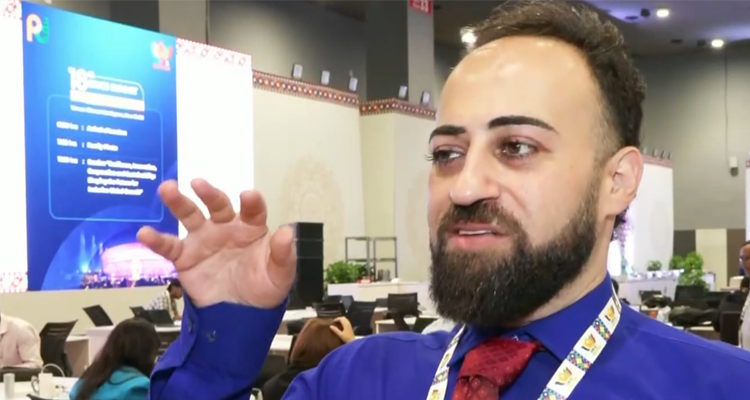
News Desk: A provocative remark by Iranian journalist Basim Laleh has sparked attention in India after he reportedly told Pakistan Army chief Field Marshal Asim Munir, “Mr Munir, you are fired,” while praising Prime Minister Narendra Modi’s role in the changing West Asian diplomatic landscape.
The sharp comment, made in New Delhi amid the BRICS-related diplomatic activity, has been widely circulated online and interpreted as a pointed swipe at Islamabad’s efforts to position itself as a key mediator in the Iran-US crisis.
‘Munir, You Are Fired’
Laleh’s reported remark is significant because Pakistan has spent much of 2026 trying to build its credentials as a diplomatic bridge between Tehran and Washington.
Munir has personally travelled to Iran several times and held talks with senior Iranian officials as Islamabad sought to revive stalled negotiations. Al Jazeera reported in August that Munir’s latest Tehran visit was part of Pakistan’s continuing attempt to mediate between Iran and the United States.
That makes Laleh’s “you are fired” line particularly striking: it appears to question whether Pakistan’s much-publicised mediation role can translate into lasting diplomatic influence.
‘Mr Munir, You Are Fired’: Iranian Journalist Praises Modi, Questions Pakistan’s Role In West Asia#AsimMunir #PMModi https://t.co/MYTq1ghUDb
— News18 (@CNNnews18) September 14, 2026
Modi Gets the Praise
The Iranian journalist, according to reports circulating from his interaction in New Delhi, contrasted Munir’s role with what he portrayed as the growing diplomatic stature of Prime Minister Modi and India.
The remarks come at a time when India is seeking to maintain relationships across competing power centres in West Asia while pushing dialogue and de-escalation.
India’s engagement with Iran is also not new. Tehran and New Delhi have maintained diplomatic and strategic ties for decades, including cooperation around Chabahar Port, while both countries have used BRICS as an important multilateral platform.
But Pakistan’s Role Cannot Be Written Off
Despite the dramatic headline, the broader picture is more complicated.
Pakistan has genuinely played a role in the Iran-US mediation efforts. Reuters reported in April that Islamabad had moved from relative diplomatic isolation to becoming an important intermediary in the Iran conflict, with Munir emerging as one of the central figures in those efforts.
Pakistan subsequently hosted high-level US-Iran talks and continued carrying messages between the two sides. In May, Munir again travelled to Tehran as part of mediation efforts.
More recently, Reuters reported that Pakistan was facing increasing pressure to balance its position as a Saudi defence partner with its role as a mediator with Tehran. The report also noted that Iran had publicly acknowledged Pakistan’s mediation efforts, although questions remained over Islamabad’s ability to sustain that role.
India’s Different Diplomatic Play
New Delhi, meanwhile, has pursued a broader strategy: maintaining ties with Iran while simultaneously engaging Saudi Arabia, the UAE, the United States and other major regional powers.
That balancing act gives India a different diplomatic profile from Pakistan. Rather than positioning itself solely as a mediator, New Delhi has sought to expand its economic, strategic and multilateral engagement across the region.
The BRICS platform has further strengthened India’s ability to engage with Iran and other major emerging economies.
A Journalist’s Comment — Not Tehran’s Official Position
The most important caveat is that Laleh’s remarks should not be treated as an official Iranian government statement.
There is no evidence that the Iranian government has formally declared Pakistan’s mediation role finished or endorsed the journalist’s “you are fired” characterization.
In fact, available reporting indicates that Tehran has continued to engage with Islamabad, while Munir has remained involved in diplomatic contacts with Iranian officials.
The Bigger Message
The episode nevertheless highlights a much larger geopolitical contest.
Pakistan wants to emerge as a crucial mediator. India wants to emerge as a crucial global power and strategic partner. Iran needs channels to the outside world. And the Gulf states are looking for security, investment and reliable partners.
Against that backdrop, Laleh’s blunt “Mr Munir, you are fired” remark has become a provocative symbol of the debate over who really matters in the new West Asian diplomatic order.
For India, the significance lies less in the journalist’s dramatic words and more in the underlying strategic question: Can New Delhi convert its growing economic and diplomatic weight into a larger role in shaping West Asian peace and security?