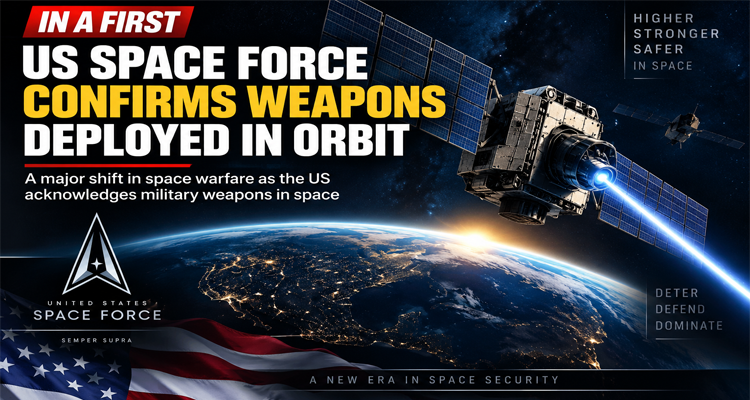
News Desk: The United States has publicly acknowledged for the first time that it has weapons deployed in orbit, marking a major shift in Washington’s traditionally guarded approach to offensive military capabilities in space.
US Secretary of the Air Force Troy Meink made the disclosure on September 14 while delivering the opening keynote at the Air & Space Forces Association’s 2026 Air, Space & Cyber Conference in National Harbor, Maryland.
BREAKING: US Space Force confirms it has weapons deployed in orbit for the first time, as the US, China and Russia race to militarise space. pic.twitter.com/siyanGfuvc
— HIT.com (@HIT) September 14, 2026
“Today, the United States now has on-orbit space control weapons capable of defending the joint force against hostile adversary action,” Meink said. The statement was subsequently backed by a US Space Force spokesperson, who said the capabilities could be used for both offensive and defensive purposes.
US confirms space weapon deployed into Earth’s orbit for first time amid Russia and China threathttps://t.co/YCJqRoEpj3
— GB News (@GBNEWS) September 15, 2026
Weapons remain undisclosed
Despite the unprecedented admission, the Pentagon has not revealed what weapons are in orbit, how many systems exist, which spacecraft carry them, when they were deployed or what their precise capabilities are.
Meink repeatedly declined to provide details, saying the wording of his announcement had been carefully considered for deterrence purposes. He also refused to say whether the systems were kinetic or non-kinetic, or whether they had already been tested.
The Space Force describes “space control” as activities intended to contest and control the space domain using both kinetic and non-kinetic means to affect an adversary’s capabilities. Such systems could therefore include capabilities designed to disrupt, disable or otherwise counter hostile satellites rather than necessarily destroy them.
Why the disclosure matters
The announcement is significant because US officials have historically maintained considerable ambiguity around offensive space capabilities. While Washington has openly discussed counter-space warfare and the need to protect satellites, Meink’s statement is being described by defence specialists as the most direct public acknowledgement yet that American weapon systems are already operating in orbit.
The disclosure comes amid growing competition with China and Russia, both of which Washington regards as major strategic competitors in space. The US Space Force says China is developing space and counter-space capabilities as part of its military modernisation, while Russia increasingly treats space as a potential warfighting domain.
JUST NOW: The United States military stunned the world by confirming that the U.S. Space Force has deployed space weapons in orbit. pic.twitter.com/ESnRqgvkhC
— WORLD NEWS (@_MAGA_NEWS_) September 14, 2026
Space becoming a battlefield
Modern military operations depend heavily on satellites for communications, navigation, intelligence, surveillance and targeting. That dependence has made space increasingly important to national security and has encouraged major powers to develop ways of protecting their own satellites while potentially disrupting an adversary’s systems.
The United States established the US Space Force in 2019, reflecting Washington’s growing emphasis on space as a contested military domain. Since then, American officials have increasingly discussed counter-space capabilities and the possibility of conducting military operations in space.
Publicly known US counter-space capabilities have included systems capable of electronic warfare and satellite interference. In 2026, the Space Force also acquired Meadowlands, an electromagnetic warfare system designed to disrupt adversary satellite communications without physically destroying satellites. However, there is no public evidence establishing that Meadowlands is one of the undisclosed weapons Meink referred to as being in orbit.
Golden Dome adds another dimension
Meink’s announcement also came as the Pentagon accelerates work on President Donald Trump’s Golden Dome missile-defence initiative.
According to Air & Space Forces Magazine, Meink said the Space-Based Interceptor programme had progressed from an initial contract to flight-ready hardware in less than a year. The Space Force is also developing a space-based air-moving-target-indication constellation intended to improve the tracking of airborne threats.
The Pentagon has not said that these planned missile-defence systems are the same weapons already deployed in orbit. The distinction is important: the existence of orbital weapons has been confirmed, but their identity and mission remain classified.
Could it trigger a new space arms race?
The disclosure is likely to attract close attention from Beijing and Moscow. Analysts have warned that openly acknowledging American orbital weapons could encourage rival powers to further expand or publicly justify their own counter-space programmes.
Experts have also pointed out that the lack of information makes it difficult to assess the actual military significance of the announcement. A non-kinetic system, such as a jammer, would have very different consequences from a kinetic weapon capable of physically destroying another spacecraft.
There is also a broader concern over space debris. Destroying satellites with kinetic weapons can generate debris that remains in orbit and potentially threatens other spacecraft. This is one reason analysts have increasingly focused on electronic warfare, cyber capabilities and other non-destructive methods of counter-space warfare.
What international law says
The disclosure does not automatically mean the US has violated the Outer Space Treaty. The 1967 treaty prohibits placing nuclear weapons or other weapons of mass destruction in orbit, but it does not impose a blanket ban on every conventional military capability in space.
The bigger strategic question is whether the US announcement signals the beginning of a more openly acknowledged era of orbital warfare, in which major powers move beyond protecting satellites to deploying systems specifically designed to control or contest space.
For now, Washington has confirmed the existence of the weapons—but kept their type, number, location and capabilities secret. That deliberate ambiguity may itself be part of the deterrence strategy.
In short: the US has crossed a significant public-policy threshold—not necessarily by deploying space weapons for the first time, but by openly acknowledging that such weapons are already in orbit.