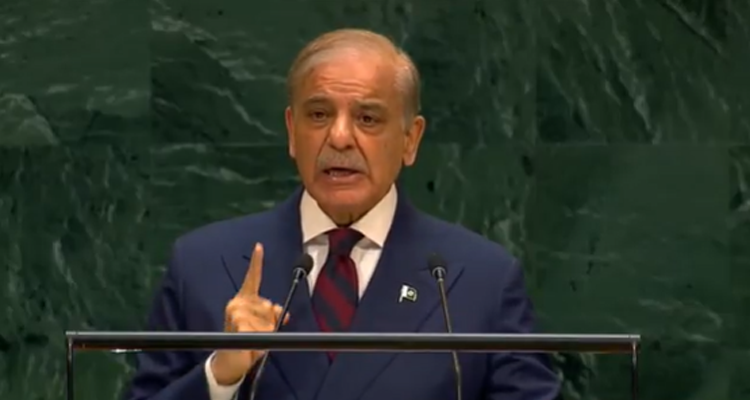
New York: Pakistan Prime Minister Shehbaz Sharif used his nearly 23-minute address to the 81st United Nations General Assembly to highlight a wide range of regional and global issues, including Kashmir, the Indus Waters Treaty, the 2025 India-Pakistan military confrontation, Gaza, Iran-US tensions, terrorism, Islamophobia, climate change and reforms to the international system.
One of the strongest portions of his speech focused on Pakistan’s water rights and the Indus Waters Treaty (IWT). Sharif warned India that any attempt to stop, impede or divert Pakistan’s share of the river waters would be treated by Islamabad as an “act of war.” He also criticized India’s decision to hold the treaty in abeyance, arguing that the move had no legal basis.
The 1960 Indus Waters Treaty, brokered by the World Bank, governs the sharing and use of the Indus river system between India and Pakistan. India announced that it was placing the treaty in abeyance following the April 2025 Pahalgam terror attack, saying the measure would remain until Pakistan credibly and irrevocably ended its support for cross-border terrorism. Pakistan has rejected India’s allegations.
Kashmir issue raised at the UN
Sharif also devoted attention to the Kashmir dispute. He argued that a lasting peace in South Asia required what Pakistan describes as a “just and fair” solution to the Kashmir issue.
Referring to the military confrontation between India and Pakistan in 2025, Sharif said the region must ensure that it never again reaches the same level of escalation. Pakistan has consistently raised Kashmir at international forums and describes it as an unresolved dispute.
India maintains a fundamentally different position, considering Jammu and Kashmir an integral part of India and rejecting Pakistan’s characterization of the issue.
Pakistan PM Shehbaz Sharif “thanks” Trump at UN for “resolving” May 2025 conflict with India, a standard line of Islamabad after India made deadly strikes on its airbases. Also rakes Kashmir, Indus Water Treaty, on expected lines. pic.twitter.com/8nGh5CpVO3
— Sidhant Sibal (@sidhant) September 25, 2026
Sharif thanks Trump for role in 2025 conflict
Sharif also praised US President Donald Trump for his role in helping bring the 2025 India-Pakistan hostilities to an end.
He thanked Trump for what he described as his “resolute and visionary leadership”, saying the US president’s “timely intervention” helped prevent a much larger conflict and saved hundreds of millions of lives in South Asia.
Trump has separately claimed credit for helping stop the India-Pakistan fighting in May 2025. During his own UNGA address earlier this week, he again said he had intervened to help end the conflict and praised Sharif as a “terrific man.”
India, however, has disputed the characterization of the ceasefire as US-brokered, maintaining that the understanding to halt military action was reached through direct communication between the Indian and Pakistani military authorities.
Warning over water and regional escalation
The Indus Waters issue was presented by Sharif as part of a broader regional security concern. His warning came amid continuing tensions between New Delhi and Islamabad following the 2025 confrontation.
Sharif linked the question of water security with regional peace and stability and called for international attention to Pakistan’s position on the treaty.
Pakistan’s position is that the IWT remains legally operative, while India has maintained that it will remain in abeyance under the circumstances cited by New Delhi.
Gaza and Palestine
The Pakistan prime minister also addressed the war in Gaza and the Palestinian question, reiterating Islamabad’s support for Palestinian rights and statehood.
Pakistan’s Foreign Ministry had identified Palestine as one of the principal issues Sharif was expected to raise at the UNGA. Islamabad has continued to call for a peaceful resolution of the conflict and support for Palestinian self-determination.
Iran-US tensions and maritime security
Another important component of Sharif’s address was the worsening situation involving Iran and the United States.
Sharif highlighted Pakistan’s diplomatic efforts to encourage dialogue and de-escalation and warned about the consequences of continued military confrontation for the wider region.
He also called for key international maritime routes to remain open and secure, stressing the importance of freedom of navigation through strategic waterways. Pakistan has been seeking a diplomatic role in efforts to reduce tensions between Washington and Tehran.
Terrorism, Afghanistan and Islamophobia
Sharif also spoke about terrorism and regional security, including Pakistan’s concerns regarding militant activity emanating from Afghanistan.
Islamophobia was another issue highlighted in the speech. Pakistan has repeatedly called for international action against religious hatred and discrimination and has sought a stronger role for the UN in addressing the issue.
The Pakistani leader also referred to developments affecting the wider Muslim world and stressed the need for international cooperation against terrorism and extremism.
Climate change and global challenges
Climate change featured among the broader issues discussed by Sharif. Pakistan has frequently highlighted its vulnerability to extreme weather events and has called for greater international support for developing countries facing climate-related disasters.
The speech also touched upon global economic challenges, sustainable development and the concerns of countries of the Global South.
Pakistan’s Foreign Ministry had stated ahead of the UNGA that Sharif would use the forum to discuss sustainable development, climate change, counter-terrorism, Islamophobia, global economic challenges and issues confronting the Global South.
Call for diplomacy and UN reform
A recurring theme of Sharif’s address was the importance of dialogue and diplomacy over military confrontation.
He argued that international disputes should be addressed through peaceful means and called for stronger multilateral institutions. Pakistan has also been advocating reforms to make the United Nations more representative and effective in dealing with contemporary global challenges.
Sharif’s UNGA speech therefore went well beyond the Kashmir issue. His address combined Pakistan’s positions on Kashmir and the Indus Waters Treaty with warnings over regional security, praise for Trump’s role in the 2025 India-Pakistan ceasefire, and calls for diplomatic solutions to conflicts in the Middle East.
The speech also underscored Islamabad’s effort to present Pakistan as a participant in wider diplomatic initiatives involving the United States, Iran, Saudi Arabia, Türkiye and other regional actors, while pressing its longstanding positions on Kashmir, water rights and Palestine.