
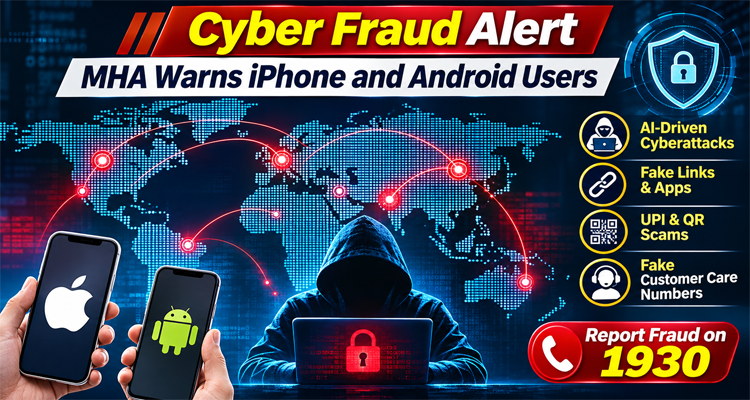
News Desk: The Indian Cyber Crime Coordination Centre (I4C) has sounded an alert over the growing threat of financially motivated cyberattacks (cyber fraud) powered by artificial intelligence (AI), urging banks, non-banking financial companies (NBFCs) and fintech firms to urgently strengthen their cybersecurity systems.
In an advisory to financial institutions, the Union Home Ministry’s cybercrime coordination agency has asked them to implement security measures recommended by the Indian Computer Emergency Response Team (CERT-In) and align their systems with the cybersecurity guidelines issued by sectoral regulators.
The warning follows observations by I4C’s National Cybercrime Threat Analysis Unit and CERT-In of an emerging pattern of cyberattacks targeting financial institutions, with criminals increasingly exploiting AI-assisted techniques to identify and exploit vulnerabilities in digital infrastructure.
Financial institutions have specifically been advised to follow CERT-In’s May 2026 blueprint for reducing exposure to AI-assisted vulnerability exploitation. They have also been directed to report cybersecurity incidents to CERT-In within six hours of detection. Banks and NBFCs must additionally report such incidents to the Reserve Bank of India (RBI) through its DAKSH portal within the same timeframe.
AI agents enable faster financial fraud
Banks face six-hour reporting deadline
India warns banks of AI cyberattacks
@kanishka9996 brings you more in this report https://t.co/x6qjk53xAW
— WION (@WIONews) November 5, 2026
iPhone Users Also on Cybercriminals’ Radar
The growing threat is not limited to banks and financial institutions. Individual smartphone users, including iPhone owners, are increasingly being targeted through sophisticated phishing and malicious application scams.
In an advisory issued on January 15, 2026, I4C warned iPhone and iPad users against downloading applications through unofficial links or sources outside Apple’s App Store. Fraudsters reportedly lure users with promises of investment opportunities, trading services, gaming applications and other offers before directing them to fake websites.
These websites may prompt users to install configuration or provisioning profiles, potentially exposing their devices and sensitive information to malicious applications. Users have been advised not to install unverified profiles or download applications through suspicious links.
Another warning, issued on May 5, 2026, highlighted phishing attempts targeting owners of lost or stolen iPhones. Fraudsters impersonate Apple Support and send messages claiming that a missing device has been located or that its data is at risk of being erased.
Such messages contain fraudulent links resembling Apple’s official services, including Find My iPhone. Victims are then asked to share their Apple ID credentials and one-time passwords (OTPs), potentially allowing criminals to access their iCloud accounts and interfere with device security.
2/3
The scale is alarming: #Taiwan saw NT$41.76 million taken from 418 bank customers in one day. #SouthKorea reported 37 financial firms breached. #Indonesia saw 6,609 Bank Jambi accounts hit, with Rp144.82 billion transferred out. #Nepal even ordered some bank websites offline. https://t.co/l1Lb1PdkP9— Subhankar Bera (@subhankar_org) November 5, 2026
UPI, QR Codes Becoming Tools of Fraud
Digital payment fraud is another growing concern, particularly during festive seasons when UPI transactions increase significantly.
Cybercriminals often exploit people’s attraction to cashback offers, rewards and free gifts by sending fraudulent QR codes. Users are tricked into scanning these codes and entering their UPI PINs, believing they are receiving money.
However, scanning a QR code and entering a UPI PIN generally authorises a payment, not the receipt of money. Users should therefore remain cautious whenever someone asks them to scan a QR code or enter their PIN to claim a reward or receive funds.
Experts also advise against installing screen-sharing or remote-access applications at the request of unknown callers. Such applications can give fraudsters access to sensitive information and potentially enable unauthorised financial transactions.
I4C Sounds Alarm Over AI-Driven Cyberattacks; Banks, NBFCs Asked to Strengthen Security
Fake Customer Care Numbers Add to Risks
Fraudsters are also exploiting online searches for customer care numbers. People seeking assistance with failed payments, delayed deliveries or other service-related problems often turn to Google, where criminals may post fake helpline numbers.
Once contacted, fraudsters pose as company representatives and attempt to obtain bank account details, debit or credit card information, OTPs and other confidential credentials. In some cases, victims are persuaded to install suspicious applications under the pretext of resolving their complaints.
Consumers have been advised to obtain customer support numbers exclusively from official company websites or verified mobile applications rather than relying on unverified numbers circulating online or on social media.
Call 1930 Immediately If You Lose Money
The I4C has also emphasised the importance of reporting cyber fraud without delay. Anyone who notices an unauthorised transaction should immediately contact the national cybercrime helpline at 1930 and lodge a complaint through the National Cyber Crime Reporting Portal.
Quick reporting gives banks and law enforcement agencies a better opportunity to trace or potentially block suspicious transactions before the money is transferred further. However, timely reporting does not guarantee recovery of the lost amount.
With AI increasingly being exploited to make cyberattacks more sophisticated, the latest warning underlines the need for stronger institutional safeguards and greater public awareness. Financial institutions must strengthen their digital defences, while ordinary users should remain alert against suspicious links, unsolicited calls, fake payment requests and attempts to obtain confidential information.