
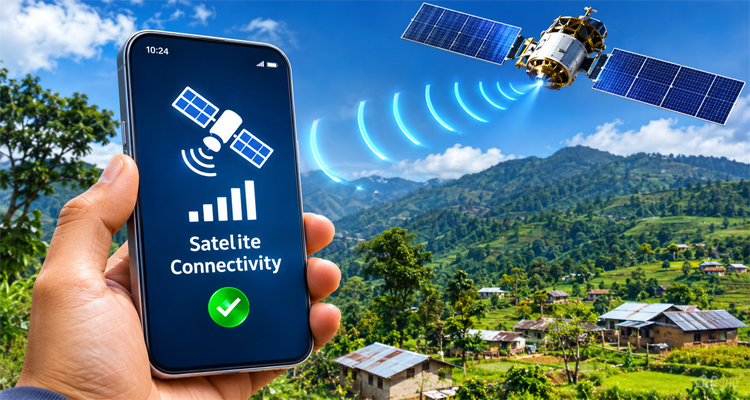
New Delhi: Mobile phone connectivity in India could soon undergo a major transformation, with satellites potentially bringing network access to regions where mobile towers are unavailable. The Telecom Regulatory Authority of India (TRAI) has recommended a new framework to facilitate Direct-to-Device (D2D) satellite communication, opening the possibility of mobile phones connecting directly to satellites without depending entirely on conventional cellular towers.
In its recommendations released on November 5, TRAI has proposed allowing satellite-based communication through both Mobile Satellite Service (MSS) spectrum and International Mobile Telecommunications (IMT) spectrum, which is currently used by conventional mobile networks. The move could help extend connectivity to remote villages, mountainous regions, forests, border areas and other locations where establishing mobile towers is difficult or economically unviable.
How will satellite connectivity work on mobile phones?
Under Direct-to-Device technology, compatible smartphones can communicate directly with satellites orbiting the Earth. Unlike conventional satellite broadband, which generally requires a dedicated dish or terminal, this technology aims to establish a direct communication link with supported mobile devices.
The proposed framework identifies two possible routes. The first involves using Mobile Satellite Service spectrum in the L-band and S-band, while the second would allow satellite-based D2D communication through existing terrestrial mobile spectrum, subject to specified regulatory and technical conditions.
TRAI has recommended that the government encourage smartphone manufacturers to incorporate the necessary modules to support applicable satellite frequency bands in future handsets sold in India. This means that not every smartphone currently in use will necessarily support the technology.
New authorisation framework for satellite operators
A major part of the recommendation is the introduction of a separate category called the Satellite Communication Network Provider Authorisation under the Telecommunications Act, 2023.
Under this arrangement, authorised satellite network providers would be allowed to offer Satellite Communication Network-as-a-Service (SCNaaS) to eligible telecom and satellite service providers. However, these network infrastructure providers would not be permitted to offer telecommunication services directly to consumers.
Instead, existing authorised telecom operators and eligible satellite service providers could partner with satellite network companies to deliver connectivity to users.
TRAI has proposed that the new authorisation cover the entire country for a period of up to 20 years, with the possibility of renewal for another 20 years.
Which mobile frequency bands could be used?
For satellite-based D2D communication using existing mobile spectrum, TRAI has recommended allowing the 600 MHz, 700 MHz, 800 MHz, 900 MHz, 1,800 MHz and 2,100 MHz bands.
However, such operations would be permitted on a non-interference and non-protection basis, meaning satellite transmissions must not cause harmful interference to existing authorised services and would not receive protection against interference from those services.
The regulator has also recommended that the government allow this framework to move forward without waiting for the outcome of the World Radiocommunication Conference 2027 (WRC-27). Any subsequent government decision following the conference would apply to the service thereafter.
What does it mean for people living in remote areas?
The proposed framework could prove particularly significant for people living in geographically isolated regions. Villages in hilly terrain, forest areas, remote border locations and disaster-prone zones often face difficulties in accessing reliable mobile networks.
Direct satellite connectivity could help overcome some of these geographical barriers and improve access to communication services. It could also prove valuable during natural disasters, landslides, floods and other emergencies when terrestrial mobile infrastructure is damaged or disrupted.
For India, where providing reliable connectivity across geographically challenging regions remains a major infrastructure challenge, satellite-to-mobile technology could become an important addition to the existing telecom network.
Is satellite connectivity coming to every smartphone immediately?
Not yet. TRAI’s recommendations establish a proposed regulatory framework; they do not mean that satellite connectivity is immediately available to all mobile users.
The Department of Telecommunications (DoT) and the Central Government will have to consider the recommendations and take the necessary policy and regulatory decisions. Telecom operators and satellite network providers will also need to establish commercial partnerships, technical arrangements and compatible infrastructure.
The availability of the service will depend on handset compatibility, satellite coverage, spectrum permissions and the eventual service plans offered by operators.
A new chapter in India’s telecom connectivity
The recommendations could create fresh opportunities for satellite communication companies and established telecom operators to work together. Companies operating in the satellite communication sector, including Starlink, Eutelsat OneWeb and other potential players, could find new opportunities under the proposed framework, subject to obtaining the required authorisations and meeting regulatory conditions.
If implemented, the initiative could gradually change how mobile connectivity reaches India’s most inaccessible locations. Rather than relying exclusively on a network of ground-based towers, future mobile communication could combine terrestrial networks with satellite infrastructure, bringing the country closer to the goal of connectivity for all.