
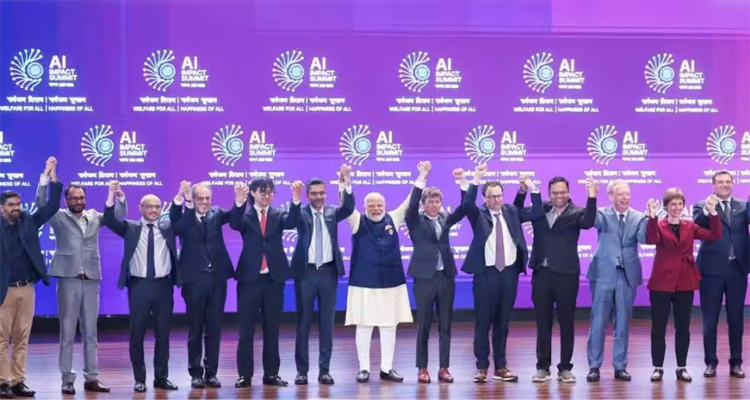
New Delhi: The India AI Impact Summit 2026 concluded at Bharat Mandapam with sweeping international endorsement of India’s responsible and human-centric artificial intelligence vision. The Ministry of External Affairs confirmed that 88 countries and international organisations have adopted the Delhi Declaration on AI Impact, marking a major milestone in global AI cooperation.
Built on the guiding philosophy “Sarvjan Hitaye, Sarvjan Sukhaye” (welfare for all, happiness for all), the Declaration positions AI as a public good aimed at advancing shared prosperity worldwide.
Summit Sees Massive Global Participation
The five-day global convening witnessed unprecedented international engagement. Over 20 Heads of Government and 59 ministerial-level representatives attended, alongside official delegations from 118 countries. More than 100 global AI leaders, CEOs and CXOs, and over 500 leading AI experts participated in the landmark event.
In total, the Summit drew more than five lakh participants, while momentum had been building globally through 550 pre-summit events across 30 countries and more than 500 side events during the main gathering—making it one of the largest multi-stakeholder AI forums to date.
Seven “Chakras” to Shape AI Cooperation
At the core of the Delhi Declaration are seven priority pillars—referred to as AI chakras—guiding responsible development:
- Human capital development
- Social empowerment
- Trust and security
- Energy efficiency
- AI for science
- Democratisation of AI resources
- AI for economic growth and social good
The framework promotes voluntary cooperation rather than binding regulation, while respecting national sovereignty.
$250 Billion Infrastructure Push Signals Confidence
Highlighting the Summit’s economic impact, Union IT Minister Ashwini Vaishnaw said global infrastructure pledges linked to AI have crossed $250 billion, alongside nearly $20 billion in deep-tech venture commitments—a strong vote of confidence in India’s AI ecosystem.
“The numbers are important, but what truly matters is that the world has confidence in India’s role in the new AI age,” Vaishnaw said, stressing that India is helping shape the global AI transformation.
The Minister also pointed to unprecedented youth engagement, noting that over 2.5 lakh students participated in discussions on responsible AI, contributing to a Guinness World Record.
Focus on Access, Trust and Sustainability
Participating countries underscored AI’s transformative potential across healthcare, agriculture, education, climate resilience and public service delivery. The Declaration calls for:
- Equitable access to computing power and data
- Promotion of open-source AI ecosystems
- Energy-efficient and resilient infrastructure
- Large-scale skilling and reskilling initiatives
Public trust and inclusive access remain central themes of the global consensus.
India Pushes Human-Centric AI Vision
Union IT Minister Ashwini Vaishnaw said on X that the wide international support reflects growing alignment with Prime Minister Narendra Modi’s human-centric approach to artificial intelligence.
The Declaration strongly advocates democratising AI resources — making advanced tools affordable and accessible so that developing nations are not left behind in the global AI race.
88 countries and international organisatons have signed the AI Impact Summit Declaration. Entire world has endorsed PM @narendramodi Ji’s human-centric vision of AI.
The declaration is inspired by the principle of ‘Sarvajana Hitaya, Sarvajana Sukhaya’, for democratising AI… pic.twitter.com/dnnNTIMysl
— Ashwini Vaishnaw (@AshwiniVaishnaw) February 21, 2026
A Cooperative, Not Prescriptive, Framework
Officials described the Summit as a defining moment in India’s technological rise. Vaishnaw emphasised strong international backing for India’s sovereign AI model strategy and praised indigenous AI innovation driven by frugal engineering.
Aligned with Prime Minister Narendra Modi’s vision of Viksit Bharat 2047, the Summit is being seen as a decisive step toward building long-term technological, semiconductor and AI capacity in the country.
With broad global support and record participation, the Delhi Declaration is expected to shape the next phase of cooperative, inclusive and responsible AI development worldwide.