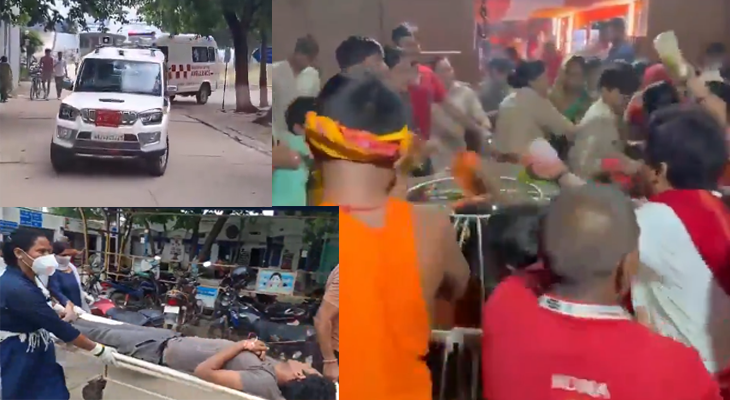
Lakhisarai, Bihar: At least seven devotees were killed and more than a dozen injured after a stampede broke out at the Ashok Dham Temple in Bihar’s Lakhisarai district early Monday morning, turning the third Monday of the holy Sawan month into a tragedy.
The incident occurred as a massive number of devotees gathered at the temple to offer prayers and perform Jalabhishek of Lord Shiva. The Ashok Dham temple, also known as the Indradamneshwar Mahadev Temple, is an important Shiva shrine in Lakhisarai and witnesses heavy footfall during the Sawan season. Bihar Tourism also lists Ashok Dham among the prominent religious destinations of Lakhisarai.
What Happened at Ashok Dham?
According to preliminary reports, the stampede-like situation developed at around 6:40 am, when the already crowded temple area witnessed a sudden surge of devotees. Officials said the crowd became difficult to control after barricading reportedly gave way under pressure.
Lakhisarai District Magistrate Shailendra Kumar said the crowd had increased sharply between around 6:30 am and 7 am, with two trains arriving at Ashok Dham Halt in quick succession, adding significantly to the number of devotees near the temple.
At the same time, reports emerged that an electrical pole or overhead cable had fallen, triggering panic among devotees. Some reports said rumours of a live electrical wire or possible electrocution spread rapidly through the crowd. Police officials, however, indicated that the precise sequence and cause would have to be established through verification and investigation.
As panic spread, devotees began rushing to safety. The pressure on the crowd reportedly caused barricades to collapse, with several people falling and others being trapped in the resulting crush.
🚨At least six devotees dead, several injured in a stampede at Ashok Dham Temple in Bihar’s Lakhisarai district pic.twitter.com/Fe28fE9PAM
— The Tatva (@thetatvaindia) August 17, 2026
Seven Women Among Those Killed
Authorities have confirmed seven deaths, with subsequent reports stating that all seven victims were women. More than a dozen devotees were injured and taken for medical treatment.
The rescue and relief operation was launched immediately, with police, district officials and medical teams reaching the site. The injured were shifted to hospitals for treatment.
The incident has raised fresh questions about crowd-management arrangements at major religious gatherings, particularly on auspicious days when thousands of devotees arrive within a short period.
President Murmu Expresses Grief
President Droupadi Murmu expressed deep sorrow over the loss of lives in the Lakhisarai stampede and offered her condolences to the families of the deceased.
In her message on X, the President described the incident as “extremely painful” and conveyed her deepest sympathies to the bereaved families. She also prayed for the speedy recovery of those injured in the incident. DD India and other reports confirmed the President’s condolence message following the tragedy.
Her message came as the scale of the tragedy became clear, with seven devotees confirmed dead following the crowd surge at the Ashok Dham Temple.
PM Modi Also Condoles Deaths
Prime Minister Narendra Modi also expressed grief over the deaths and conveyed his condolences to the families who lost their loved ones. He wished those injured a speedy recovery.
The Bihar government has also announced ₹4 lakh ex-gratia assistance for the family of each deceased devotee, while officials have been directed to ensure proper treatment of the injured. Bihar minister Vijay Kumar Sinha said the circumstances surrounding the tragedy would be investigated and action would be taken if anyone was found responsible.
Crowd Management Under Scanner
The Lakhisarai tragedy has once again highlighted the risks associated with uncontrolled crowd movement at major religious gatherings.
The available reports suggest that multiple factors may have combined to create the deadly situation: an exceptionally large Sawan crowd, the arrival of two trains within a short interval, pressure on barricades and panic following reports of a fallen electrical cable or pole.
However, it would be premature to attribute the deaths to any one factor until the authorities complete their investigation.
The crucial questions now are whether the crowd was adequately regulated, whether entry and exit routes were sufficiently wide, whether barricading could withstand the pressure, and whether emergency evacuation and electrical-safety arrangements were adequate for the expected turnout.
The tragedy at Ashok Dham is yet another reminder that religious faith on a massive scale requires equally massive attention to public safety. On days when tens of thousands of devotees can converge on a shrine within hours, crowd-density monitoring, staggered entry, strong barricading, clear emergency routes and rapid-response teams are not optional measures—they are essential safeguards.
The Lakhisarai incident remains under investigation, and details about the exact trigger and sequence of events may be revised as officials establish the facts.