
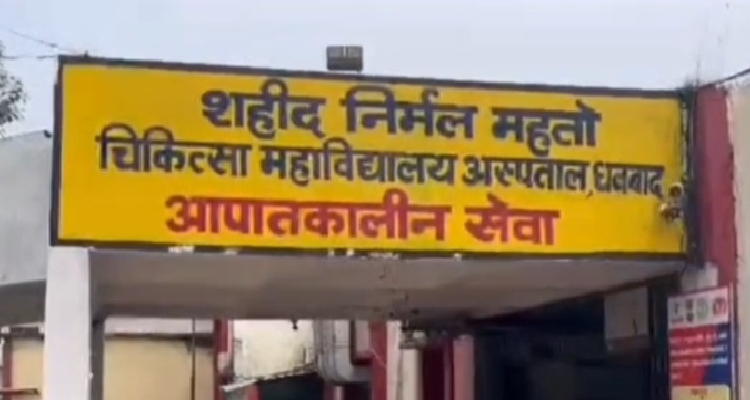
Dhanbad: A power failure lasting nearly 30 minutes at Shaheed Nirmal Mahto Medical College and Hospital (SNMMCH), Dhanbad, has triggered serious questions over the hospital’s emergency power backup after a 48-year-old woman admitted to the Surgical ICU died during the outage.
The deceased, Panmuni Devi of Giridih, had been admitted to SNMMCH after being bitten by a venomous snake on Saturday. She was initially treated at a private hospital in Giridih before being referred to Dhanbad as her condition deteriorated. Doctors subsequently shifted her to the Surgical ICU because of her critical condition.
According to her family, the ICU suddenly lost power on Sunday and the interruption continued for around half an hour. They alleged that essential life-support equipment, including the ventilator, was affected during the outage and that adequate backup was not immediately available. Panmuni Devi died during this period.
However, it has not been established that the power failure directly caused her death. Given her critical condition following the snakebite, determining the precise cause of death would require a medical assessment or investigation. Reports from multiple local outlets likewise caution against conclusively attributing the death to the blackout.
Generator reportedly out of service
The incident has put SNMMCH’s backup power arrangements under renewed scrutiny. According to the hospital administration, the generator has been non-functional for about a week, leaving the hospital vulnerable when the main power supply fails.
The development is particularly concerning because the same hospital had reportedly faced another power disruption just a day earlier, when several services were affected after the electricity supply failed and the backup system also faced problems.
Patients struggle as wards go dark
Sunday’s outage was not confined to the ICU. Power was also disrupted in the male and female wards, leaving patients and attendants struggling in the heat. Relatives were reportedly seen using hand fans to provide relief to patients during the blackout.
The episode has raised broader questions about SNMMCH’s emergency power infrastructure, ICU backup systems and preparedness for prolonged electricity failures.
While the exact circumstances surrounding Panmuni Devi’s death remain to be established, the incident has highlighted the critical importance of uninterrupted power and dependable backup systems in a hospital where patients in life-threatening conditions rely on electrically powered medical equipment.