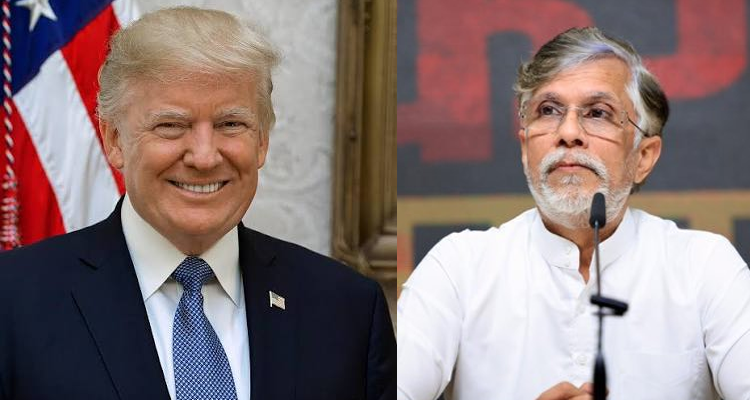
New Delhi: US President Donald Trump’s praise for India’s voter identification system has sparked a fresh political exchange in India, with Congress leader Pawan Khera taking a sarcastic swipe at Trump and Chief Election Commissioner Gyanesh Kumar.
Trump, while renewing his push for the SAVE America Act, cited India’s election process as an example of how voter identification could be strengthened in the United States. Referring to his recent interaction with CEC Gyanesh Kumar, Trump highlighted India’s requirement for voters to establish their identity before casting their ballots and argued that the US should adopt stricter voter-ID norms.
Trump’s remarks come amid his broader campaign for tighter election rules in the US. The SAVE America Act (Safeguard American Voter Eligibility Act) seeks to require documentary proof of US citizenship when registering to vote in federal elections and photo identification when voting. The legislation also proposes measures to ensure that non-citizens are removed from federal voter-registration lists.
The bill, introduced in the US House of Representatives as H.R. 7296 on January 30, 2026, was referred to the House Committee on House Administration. Its stated objective is to amend the National Voter Registration Act to require proof of US citizenship for registration in federal elections.
Trump points to India
In making his case, Trump referred to India’s experience of conducting elections involving hundreds of millions of voters. The 2024 Lok Sabha election had 97.98 crore registered electors, with 64.64 crore votes cast, according to the Election Commission of India’s official election atlas.
Trump’s argument centres on the use of photo identification as an additional safeguard at polling stations. His comments effectively place India’s election-management practices in the middle of an ongoing American political debate over voter eligibility, election security and identification requirements.
However, the India-US comparison is not entirely like-for-like. In India, the Electoral Photo Identity Card (EPIC) is not the only document that can be used for voter identification. The Election Commission permits registered electors to use other approved photo-identification documents under its prescribed rules.
Congress turns Trump’s praise into a political attack
Trump’s endorsement of India’s system did not go down well with the Congress. Responding to his remarks, party leader Pawan Khera posted a sarcastic message on X, saying, “Please take Gyanesh Kumar to America.” He also made a pointed reference to India’s electronic voting machines, suggesting that they too could be sent to the US.
Dear @realDonaldTrump,
Please take Gyanesh Kumar Gupta to America. And keep him there. We will send our EVMs too by the next available flight.
For all the insults and bullying you’ve sent our way, this is the least we can do for you.
To SIR With Love,
from India. pic.twitter.com/vyS8sUETjF— Pawan Khera 🇮🇳 ಪವನ್ ಖೇರಾ (@Pawankhera) August 18, 2026
Khera’s response was aimed not merely at Trump but also at the Election Commission. The Congress has repeatedly raised questions over the functioning of the poll panel and its handling of electoral issues. The party has particularly criticised the Commission over the Special Intensive Revision (SIR) of electoral rolls.
The latest exchange therefore carries a distinctly domestic political dimension. While Trump is using India’s election practices to strengthen his argument for tougher voting rules in America, the Congress is using Trump’s praise to renew its criticism of the Election Commission.
India’s election system gets US political spotlight
Trump’s remarks have given India’s electoral system an unusual role in the US debate over election reforms. India, with its enormous electorate and large-scale election infrastructure, has long been cited as an example of conducting elections on a massive scale.
The 2024 Lok Sabha election involved 543 parliamentary constituencies, nearly 98 crore registered electors and more than 64 crore votes, underscoring the sheer scale of India’s electoral exercise.
For Trump, India’s voter-identification arrangements offer political ammunition in his campaign for stronger voting safeguards. For the Congress, however, the same endorsement has provided another opportunity to question the Election Commission and its leadership.
The controversy thus goes beyond voter ID. It has brought Trump, the SAVE America Act, Gyanesh Kumar, India’s EVM-based electoral system and the Congress’ criticism of the Election Commission into a single political debate—linking an American election reform push with India’s continuing domestic argument over electoral transparency and voter rolls.