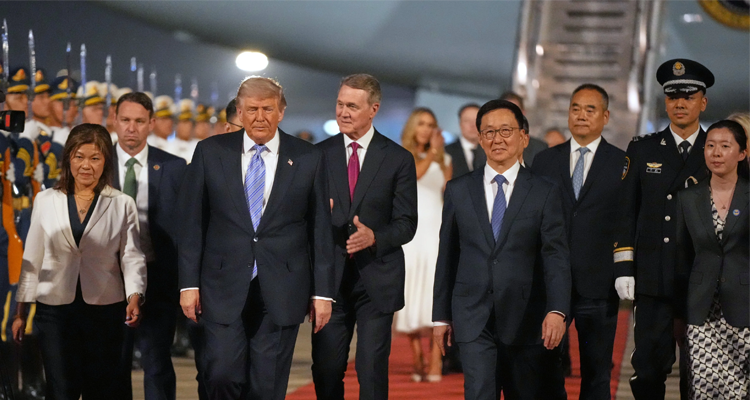
Beijing: US President Donald Trump touched down in Beijing on Wednesday for a crucial face-to-face meeting with Chinese President Xi Jinping amid rising global tensions over Iran, Taiwan and an intensifying economic rivalry between the world’s two biggest powers.
The high-profile visit, the first by a sitting US president to China in years, comes at a volatile geopolitical moment as Washington and Beijing struggle to manage disputes ranging from tariffs and technology restrictions to military tensions in the Indo-Pacific.
Trump arrived with a powerful business delegation that included billionaire entrepreneur Elon Musk and NVIDIA chief Jensen Huang, highlighting the administration’s attempt to revive trade momentum and secure major commercial agreements.
🚨 🇺🇸🇨🇳 Trump has landed in Beijing for 2 days of very important talks with Xi.
Key topics on the table:
• Trade & tariffs
• AI and semiconductors
• Taiwan
• Iran and energy flows
• Rare earth supply chainsThis is the first US presidential visit to China in nearly a… pic.twitter.com/MJwHsdhTjG
— Jack Prandelli (@jackprandelli) May 13, 2026
Chinese officials rolled out an elaborate welcome ceremony at the airport, complete with military honours, cultural performances and students waving national flags, signalling the importance Beijing is placing on the summit.
Iran Conflict Casts Shadow Over Talks
The Beijing summit is unfolding against the backdrop of growing instability in West Asia, with the Iran conflict adding fresh strain to the global economy and energy markets.
Trump, before departing Washington, insisted the United States could handle the Iran situation independently, but diplomatic observers believe the crisis will remain central to discussions with Xi as both nations seek to avoid wider economic fallout.
The US president is also facing mounting political pressure at home ahead of the upcoming midterm elections, where inflation and foreign policy are expected to dominate campaign debates.
Trade and AI Battle Takes Centre Stage
Economic tensions are expected to dominate closed-door negotiations between the two leaders. Washington is likely to press Beijing on market access, intellectual property concerns and restrictions affecting American technology firms.
Advanced semiconductors, artificial intelligence competition and supply-chain security are also expected to feature prominently during the summit.
Trump has indicated he wants broader opportunities for US businesses operating in China and is pushing for progress on trade deals involving agriculture, aviation and manufacturing sectors, including potential aircraft agreements for Boeing.
Meanwhile, Beijing is expected to raise concerns over US export controls and sanctions targeting Chinese technology companies.
China Draws Red Lines Before Summit
Ahead of Trump’s arrival, Beijing reiterated four core issues it considers non-negotiable in bilateral relations:
- Taiwan
- Democracy and human rights
- Political systems
- China’s development rights
Chinese officials stressed that relations between the two powers should be based on “mutual respect, peaceful coexistence and win-win cooperation.”
The “four red lines” were first outlined by Xi during his meeting with former US President Joe Biden in 2024.
Taiwan Set to Be Most Sensitive Issue
Among all issues on the table, Taiwan is expected to trigger the sharpest exchanges.
China has repeatedly warned the United States against expanding military cooperation with Taipei, viewing the self-ruled island as an inseparable part of Chinese territory.
The tensions intensified after Washington approved a massive defence package for Taiwan last year, drawing strong protests from Beijing.
While the US officially follows the One China policy, it continues to provide military assistance to Taiwan under American law — a position that remains a major source of friction between the two global powers.
The outcome of the Trump-Xi talks is expected to shape not only future US-China relations but also the broader geopolitical balance across Asia and beyond.