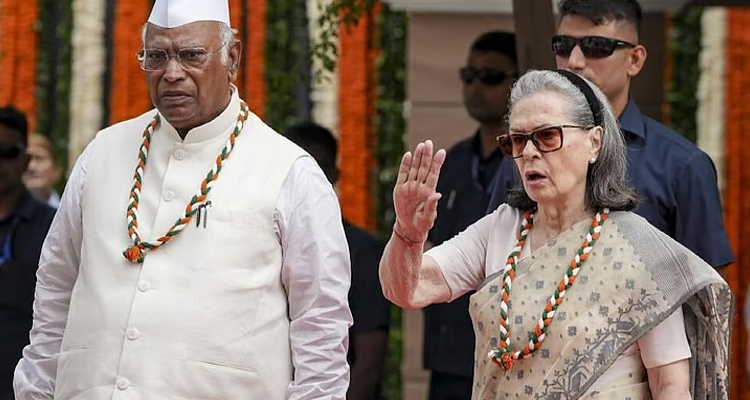
New Delhi: A video from the Congress’s Independence Day celebrations at its headquarters in New Delhi has triggered a political controversy, with the BJP alleging that Congress Parliamentary Party chairperson Sonia Gandhi and party president Mallikarjun Kharge gestured for the rendition of Vande Mataram to be stopped.
The Congress, however, has rejected the allegation, saying the gestures seen in the video were related to arrangements for Kharge, who had been standing for some time.
The controversy erupted after footage from the Independence Day programme at Indira Bhavan, the Congress headquarters, circulated widely on social media. The video appears to show Sonia Gandhi and Kharge making hand gestures while Vande Mataram was being rendered. Rahul Gandhi is also seen making a similar gesture moments later, according to reports.
🚨CONTROVERSY: Sonia Gandhi Appears to Object to “Vande Mataram”
A video purportedly shows Sonia Gandhi gesturing to Congress workers to stop while Vande Mataram was being played. pic.twitter.com/qXRS2FYjjc
— The Analyzer (News Updates🗞️) (@Indian_Analyzer) August 15, 2026
What Does the Viral Video Show?
According to video reports and news accounts, Sonia Gandhi, Kharge and Rahul Gandhi were present during the Independence Day function when Vande Mataram was being sung.
During the rendition, Sonia Gandhi appears to make a hand gesture towards people involved in the programme. Kharge is also seen communicating with people nearby. The visuals were interpreted by BJP leaders and some social-media users as an indication that the Congress leaders wanted the song to be stopped.
However, the available footage by itself does not conclusively establish what Sonia Gandhi was saying or what her gesture meant.
The Congress has offered a different explanation.
#WATCH | On being asked about the full Vande Mataram rendition at Congress’ I-Day celebrations today, party MP Jairam Ramesh says, “The full version of Vande Mataram was sung here at Indira Bhawan today, and there is no controversy in it. There was no attempt to stop it. Since… pic.twitter.com/2Ref7iVQD5
— ANI (@ANI) August 15, 2026
Congress: Sonia Gandhi Was Asking for a Chair for Kharge
Congress MP Jairam Ramesh strongly rejected the allegation that the party leadership attempted to stop Vande Mataram.
Ramesh said the full version of the National Song was sung at Indira Bhavan and there was no attempt to interrupt it. He explained that Kharge had been standing for a considerable period and Sonia Gandhi was asking for a chair to be brought for him.
The fact that the rendition continued to completion is central to the Congress’s defence.
Reports said Kharge subsequently hoisted the national flag after the rendition.
BJP Targets Congress Leadership
The BJP has seized on the video to attack the Congress leadership, alleging that Sonia Gandhi and Kharge were uncomfortable with the complete rendition of Vande Mataram.
BJP leaders questioned the conduct of the Congress leaders during the Independence Day programme and accused them of showing disrespect towards the National Song. The allegations have added another flashpoint to the continuing political debate between the BJP and Congress over Vande Mataram.
The BJP’s criticism has largely focused on the timing of the gestures, particularly as the song continued beyond the portions traditionally rendered at many Congress functions.
Why the Full Version of Vande Mataram Matters
The controversy comes against the backdrop of new guidelines issued by the Union Ministry of Home Affairs (MHA) earlier this year.
In January-February 2026, the Centre laid down a protocol for the rendition of Vande Mataram. The guidelines specify that the official version comprises all six stanzas of Bankim Chandra Chattopadhyay’s National Song and that the complete rendition takes about 3 minutes and 10 seconds.
The MHA protocol also provides that when Vande Mataram and the National Anthem are both performed at an event, Vande Mataram should be rendered first. It further prescribes standing at attention when the official version is sung or played, subject to specified exceptions.
The guidelines have revived a longstanding debate over the portions of the song traditionally used at public and political functions.
Congress and the Two-Stanza Tradition
Historically, only the first two stanzas of Vande Mataram have generally been used at national and official gatherings. The later stanzas contain religious imagery that had become a subject of debate during the freedom movement.
A Rajya Sabha debate record from December 2025 notes that discussions among Congress and Hindu-Muslim leaders had focused particularly on references to deities in some of the later stanzas, following which the first two stanzas were accepted for national use in 1937.
The Centre’s 2026 protocol has now brought the complete six-stanza version back into focus for specified official occasions.
Did Sonia Gandhi Actually Ask for Vande Mataram to Be Stopped?
The viral video has triggered the allegation, but the footage alone does not establish Sonia Gandhi’s intention.
News reports describe her gestures as appearing to signal that the rendition should stop, while the Congress has categorically disputed that interpretation and provided an alternative explanation—that she was asking for a chair for Kharge.
Most importantly, reports from the event state that the full rendition of Vande Mataram continued and was completed.
Therefore, the controversy currently rests on two competing interpretations of the same visuals: the BJP’s claim that the gestures were an attempt to halt the song, and the Congress’s explanation that the gestures concerned Kharge’s seating arrangement.
Political Controversy on Independence Day
The incident has quickly become a political talking point on India’s 80th Independence Day, with the viral footage being shared extensively online.
For the BJP, the episode provides an opportunity to question the Congress’s position on the complete rendition of Vande Mataram. For the Congress, the controversy is being dismissed as an attempt to manufacture an issue from gestures that, according to the party, had nothing to do with stopping the National Song.
With the video continuing to circulate, the political debate is likely to remain focused on what exactly Sonia Gandhi’s gestures meant—and whether the visuals should be interpreted as an objection to the song or simply as an interaction concerning arrangements at the event.