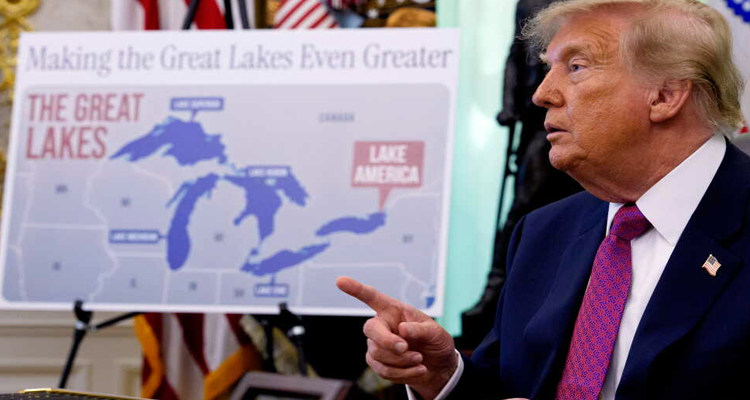
Washington: US President Donald Trump has signed an executive order directing the United States to rename Lake Ontario as “Lake America”, adding an extraordinary symbolic dimension to an already escalating trade dispute with Canada.
Trump signed the order on August 27, directing the US Interior Department and the Board on Geographic Names to update the federal government’s geographic records within 30 days. The White House said the change is intended to recognize the lake’s importance to the United States and its contribution to American commerce, transportation and economic activity.
BREAKING: “Lake America” becomes official as President Trump signs an executive order to change the geographic name of Lake Ontario “effective immediately.” pic.twitter.com/NmEmshwlu1
— Fox News (@FoxNews) August 27, 2026
A name change with a political message
The move comes just days after Trump announced that Washington was considering renaming Lake Ontario, saying the United States did not expect to do much business with the Canadian province of Ontario. The announcement came as trade negotiations between Washington and Ottawa broke down and both sides moved toward higher tariffs.
The latest order applies only to US federal usage. It cannot compel Canada, international organisations or private companies to adopt “Lake America.” The lake remains known as Lake Ontario in Canada, and Canadian officials have rejected the American designation.
Trump’s decision follows his earlier effort to rename the Gulf of Mexico as the “Gulf of America” in 2025. The White House has framed such changes as part of a broader effort to emphasize what it describes as American heritage and national interests.
Canada rejects the renaming
Canadian Prime Minister Mark Carney swiftly dismissed the move, insisting that Canadians will continue to call the waterway Lake Ontario.
Carney pointed out that the name is more than 400 years old and predates both Canadian Confederation and the American Declaration of Independence. The name is derived from the Wendat language and has long-standing Indigenous and historical significance.
Ontario Premier Doug Ford has likewise rejected the proposed American terminology, while New York Governor Kathy Hochul, whose state borders Lake Ontario, said New York would not use the new name. Vermont Governor Phil Scott also described Trump’s move as “petty and disappointing.”
Indigenous leaders have been particularly critical. Wendat Nation Grand Chief Pierre Picard condemned the renaming as an attempt to erase history, stressing the Indigenous origins of the lake’s traditional name.
Trade war provides the backdrop
The geographical dispute is unfolding against a much larger confrontation between Washington and Ottawa.
The Trump administration has imposed 50% tariffs on about $20 billion worth of Canadian goods, while Canada has announced retaliatory measures. The escalation followed the collapse of intensive trade negotiations between the two countries.
Trump has also threatened further tariffs, including duties targeting Canadian steel and automobiles. Ottawa has accused Washington of treating Canada as though it were subordinate to the United States — a characterization the Trump administration rejects.
Against that backdrop, the Lake Ontario renaming is being viewed less as a practical geographical change and more as a symbolic act of political pressure against Canada.
Can Trump actually rename the lake?
Yes — but only to a limited extent.
The US president can direct federal agencies to change the name used in the US government’s official geographic database. The executive order specifically instructs the Interior Department to work with the Board on Geographic Names and update the Geographic Names Information System (GNIS).
But Washington has no authority to force Canada to change its own geographic records or terminology. Canada will continue using “Lake Ontario,” and international organisations and private mapping companies are not automatically bound by the US order.
That distinction could leave the lake with two competing names depending on who is referring to it — “Lake America” in US federal documents and “Lake Ontario” in Canada and much of the international community.
More than a lake
Trump’s latest move may therefore have consequences far beyond cartography.
Lake Ontario is one of North America’s five Great Lakes and is shared by the United States and Canada. Its waters, ports and surrounding communities are deeply connected to cross-border trade, transportation, manufacturing, agriculture and energy networks.
The renaming comes at a moment when those very economic links are under pressure from tariffs and failed negotiations. Rather than easing tensions, the move risks adding another source of friction to an already strained relationship.
Trump even suggested that the Atlantic or Pacific Ocean could eventually become targets for similar renaming efforts, saying that after a gulf and a lake, “all we need is an ocean.”
A symbolic escalation
The battle over Lake Ontario’s name is unlikely to change the physical geography of North America. But politically, it sends a powerful message.
For Trump, “Lake America” fits his broader campaign to emphasize American sovereignty, economic power and national identity. For Canada, however, the attempt touches a much deeper issue: history, Indigenous heritage and the question of whether Washington can unilaterally redefine something shared by both countries.
With trade negotiations already faltering, tariffs mounting and Canadian officials refusing to recognize the new name, Lake Ontario has suddenly become another symbol of the widening divide between two traditionally close neighbours.
The lake itself has not moved. Its history has not changed. But the name has become the latest battleground in the US-Canada trade war.