New Delhi: The Defence Research and Development Organisation (DRDO) has signed its first high-value deep-tech project agreement under the Technology Development Fund (TDF) scheme for the indigenous development of a specialised cryogenic system designed for quantum technology applications.
The agreement has been signed with Zero mK India Private Limited, an Alwar, Rajasthan-based start-up, for the development of a 20 millikelvin (mK) dilution refrigerator. The project marks the first high-value agreement under a ₹500-crore corpus approved for deep-tech and cutting-edge technology projects.
Focus on Indigenous Quantum Infrastructure
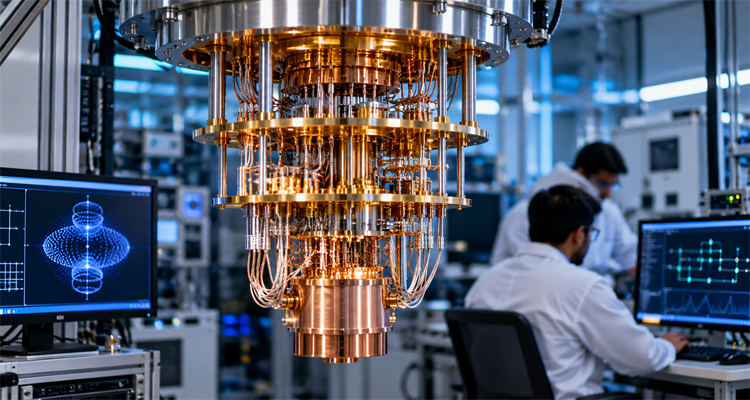
A dilution refrigerator is an advanced cryogenic system capable of achieving temperatures in the millikelvin range. Such extremely low temperatures are required for the operation and testing of several types of quantum-computing platforms and other quantum technologies.
The proposed 20 mK-class system is therefore an important enabling technology for India’s emerging quantum ecosystem. It is intended to provide the ultra-cold environment needed for research, development and testing of quantum hardware.
The project is aligned with the objectives of India’s National Quantum Mission and is expected to strengthen domestic capabilities in quantum technology, advanced cryogenics and other strategic technology areas.
DRDO has signed its first high-value deep-tech project agreement under the Technology Development Fund (TDF) scheme with Zero mK India Pvt Ltd for indigenous development of a 20 mK-class Dilution Refrigerator for Quantum Applications. The project, supported by the Rs 500 crore… pic.twitter.com/SUyWjWe6BT
— Ministry of Defence, Government of India (@SpokespersonMoD) September 24, 2026
Reducing Dependence on Imported Technology
One of the key objectives of the project is to reduce India’s dependence on imported cryogenic infrastructure. Advanced cooling systems are critical components of quantum research facilities, and developing them domestically could give Indian researchers and technology companies greater access to essential infrastructure.
The initiative also represents a deeper role for Indian start-ups in developing technologies with strategic and defence applications. Through the TDF framework, DRDO works with industry, particularly Indian start-ups and MSMEs, to develop indigenous technologies.
First Project Under ₹500-Crore Deep-Tech Corpus
The agreement is significant because it is the first high-value project to be taken up under the ₹500-crore corpus sanctioned for deep-tech and cutting-edge projects.
The corpus is intended to support the development of advanced technologies rather than the ₹500 crore representing the financial value of this particular refrigerator project. The distinction is important because the individual project agreement should not be described as a ₹500-crore contract unless a separate project value is officially disclosed.
Defence Minister Rajnath Singh congratulated DRDO, Zero mK India and other stakeholders involved in the initiative. He said the collaboration could provide a precedent for future DRDO-industry partnerships in emerging technology areas.
DRDO Laboratory to Monitor Project
The project will be monitored, mentored and supported by the Solid State Physics Laboratory (SSPL) of DRDO. Senior officials from DRDO’s Micro Electronic Devices & Computational System and Cyber Security, Technology Management and SSPL were present during the signing.
The partnership brings together DRDO’s research and technical expertise with the capabilities of a specialised Indian start-up. Its progress will be closely watched as India seeks to build a broader domestic ecosystem around quantum technologies.
Why the Project Matters
Quantum technologies are increasingly being explored for applications in computing, communications, sensing and other strategic areas. However, building a complete quantum technology ecosystem requires not only quantum processors but also specialised supporting infrastructure.
The indigenous development of a 20 mK dilution refrigerator addresses one such critical infrastructure requirement. If successfully developed and deployed, the technology could strengthen India’s ability to undertake quantum research and develop related systems without relying as heavily on imported cryogenic equipment.
The agreement consequently represents an early test of India’s deep-tech funding and industry collaboration model in a highly specialised field. It also highlights the growing intersection of quantum technology, advanced cryogenics, defence research and indigenous technology development.