
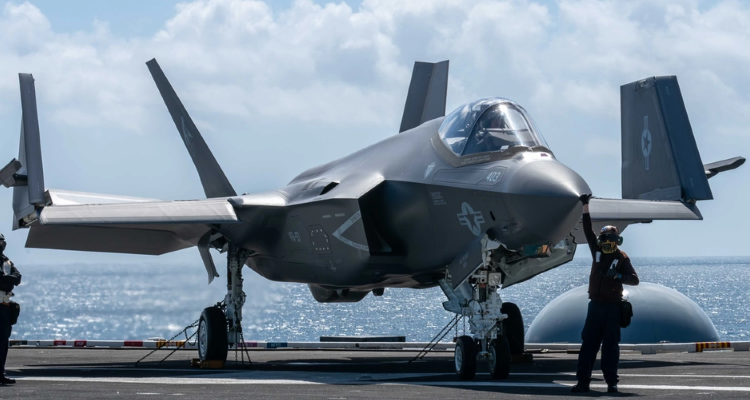
F-35 parts sent from Australia to the United States for inspection were unexpectedly routed through South Korea and then Hong Kong. US and Australian authorities are investigating how the components ended up in Chinese possession.
News Desk: A shipment containing components from an Australian F-35 Lightning II stealth fighter that was supposed to reach the United States has been diverted to Hong Kong, with people briefed on the incident saying that the Chinese government subsequently took possession of the parts.
The episode has triggered an investigation by US authorities and raised questions about security procedures surrounding the international supply chain of the F-35, one of the world’s most sophisticated fighter aircraft.
According to reporting based on people familiar with the matter, the shipment included a cockpit canopy and a weapons-bay door from an Australian military F-35. The components were being sent to the United States for inspection and possible repair or disposal when the shipment was unexpectedly rerouted in late May.
The Chinese government has taken possession of potentially sensitive F-35 stealth aircraft parts that were inexplicably diverted to Hong Kong while being sent to the US from Australia, people briefed on the incident said. @nicolesyLIVE has more https://t.co/ibjJMZhJIl… pic.twitter.com/pcxXErSOyf
— Bloomberg (@business) September 24, 2026
From Australia to South Korea — then Hong Kong
The components were transported by UPS and were initially moving toward the United States. According to the reports, the shipment stopped in South Korea before being routed onward to Hong Kong.
Why the shipment went through South Korea and why it was subsequently diverted to Hong Kong remains unclear. It is also not publicly established whether the diversion resulted from an accidental logistics error or was deliberate.
People briefed on the incident told Bloomberg that Chinese authorities later took possession of the components and had not returned them as of September 24. A Chinese embassy spokesman did not immediately comment on the report.
Why the F-35 components have attracted attention
The concern surrounding the shipment is linked particularly to the materials used on the components.
The cockpit canopy and weapons-bay door were supplied by Lockheed Martin and reportedly had radar-absorbing material associated with the F-35’s low-observable, or stealth, characteristics. Such materials are designed to reduce the aircraft’s radar signature.
That does not necessarily mean the components themselves contain classified electronics or provide a complete picture of the F-35’s stealth technology. Australian Defence Minister Richard Marles has said his understanding was that the missing items were not considered “sensitive” equipment.
The distinction is important because the F-35 contains thousands of components, ranging from relatively routine parts to highly sensitive systems. Defence analysts cited by Australian media noted that the sensitivity of individual components can vary considerably.
Pentagon confirms a shipment problem
The US F-35 Joint Program Office has acknowledged that authorities are aware of a shipment problem involving unserviceable F-35 Lightning II components.
The programme office said it was working with US authorities and industry partners to retrieve the components, investigate what happened and introduce safeguards intended to prevent a similar incident in the future.
The Pentagon’s involvement is significant because the F-35 is operated through a highly integrated international sustainment network involving the US government, Lockheed Martin and partner countries.
The US Defense Logistics Agency has previously described the F-35 as having a global supply chain supporting aircraft operated by numerous countries. Its logistics system includes government and commercial transportation arrangements, including commercial carriers.
Australia assisting the investigation
Australia has confirmed that it is helping investigate the incident.
Defence Minister Richard Marles said Canberra was examining what had happened at the Australian end of the supply chain and was working with the United States and Lockheed Martin.
Marles also sought to reduce concerns over the technological significance of the missing equipment, saying there was a level of confidence that the items involved were not sensitive parts.
Australia operates 72 F-35A aircraft and serves an important role in the regional F-35 support network. The country is also involved in the maintenance and sustainment ecosystem supporting F-35 operations in the Indo-Pacific.
Congressional scrutiny
The incident has also attracted attention in Washington.
According to reporting on the matter, congressional committees have received briefings and are examining how the F-35 components were diverted to Hong Kong.
The issue was reportedly discussed during a closed Senate Armed Services Committee hearing in June, while House committees have also been briefed on the matter.
The investigation is expected to examine the entire chain of custody — from the components’ departure from Australia and their transportation arrangements to the unexpected routing through Hong Kong and the subsequent handling of the parts.
A sensitive moment for US-China relations
The revelation comes at a particularly sensitive moment in US-China relations, as Chinese President Xi Jinping is visiting the United States for a state visit hosted by President Donald Trump.
The reported presence of F-35 components in Chinese possession has therefore added another security dimension to already complicated US-China relations.
However, there is currently no public evidence establishing that Beijing deliberately arranged the diversion of the shipment. The circumstances surrounding the rerouting remain under investigation, and Chinese authorities have not publicly provided an explanation for the reported possession of the components.
What could happen next?
US authorities are seeking the return of the components while investigating how the shipment ended up in Hong Kong.
The inquiry could focus not only on the individual shipment but also on broader weaknesses in the F-35’s international logistics and supply-chain security.
The incident is particularly noteworthy because the F-35 programme involves a multinational network of operators, suppliers, maintenance facilities and transportation providers. The US Defense Logistics Agency has previously highlighted the importance of maintaining visibility across this global supply chain.
For now, the key unanswered questions are why the shipment was diverted, who authorised the change in routing, how the components came into Chinese possession, and whether any sensitive technical information could have been obtained from them.
The investigation will determine whether the episode was a serious security breach, a logistics failure involving relatively routine components, or a combination of both.
The most important distinction at this stage is that the reported Chinese possession of the F-35 parts is established through sources briefed on the incident, while the circumstances and intent behind the diversion remain unresolved.
Meanwhile, the United States has launched an investigation into how parts of its most advanced fighter jet ended up in Hong Kong. A report published Wednesday said China had obtained the F-35 equipment, raising fresh questions about how the sensitive shipment was diverted and whether any security protocols were breached. The incident has also drawn attention to vulnerabilities in the F-35’s complex international supply and logistics network.