
Cape Canaveral, Florida: In a landmark step toward humanity’s return to deep space, NASA successfully launched its Artemis II mission on Wednesday evening, sending four astronauts into orbit aboard the Orion spacecraft from Kennedy Space Center.
The agency’s powerful Space Launch System (SLS) rocket lifted off from Launch Pad 39B at 6:35 p.m. EDT on April 2 (4:05 a.m. IST, April 3), marking the first crewed mission of the Artemis programme and the beginning of a new era in lunar exploration.
‘Defining Moment’ for Deep Space Exploration
Calling the launch a historic milestone, NASA Administrator Jared Isaacman said:
“Today’s launch marks a defining moment for our nation and for all who believe in exploration. Artemis II builds on the vision set by President Donald J. Trump, returning humanity to the Moon for the first time in more than 50 years… It marks our return not just to visit, but to eventually stay.”
He emphasized that the mission is part of a broader strategy to establish a sustained human presence on the Moon and lay the groundwork for future missions to Mars.
🚨 NASA’s Artemis II Mission Launches!
Four astronauts have blasted off from Florida on a 10-day journey around the Moon.
This historic mission is a major step toward returning humans to the lunar surface later this decade — ahead of China’s planned first crewed landing.… pic.twitter.com/VKWrAWJX3X
— Global Affairs 24 (@GlobalAffair24) April 2, 2026
Crew of Four Begins 10-Day Mission
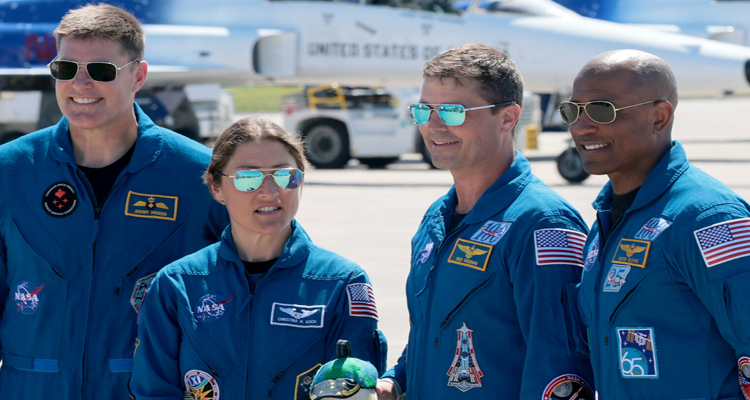
The mission carries four astronauts:
- Reid Wiseman – Commander
- Victor Glover – Pilot
- Christina Koch – Mission Specialist
- Jeremy Hansen – Mission Specialist
The crew will undertake an approximately 10-day test flight, becoming the first humans in over 50 years to travel beyond low-Earth orbit since the Apollo program era.
Orion Activated, Systems Under Test
Soon after reaching space, the Orion spacecraft deployed its solar array wings, enabling it to draw power from the Sun. Engineers and astronauts immediately began transitioning from launch to in-flight operations, checking navigation, communication, and life-support systems.
NASA Associate Administrator Amit Kshatriya described the mission as a critical test phase:
“Artemis II is a test flight, and the test has just begun… Over the next 10 days, the crew will put Orion through its paces so future astronauts can go to the Moon’s surface with confidence.”
Complex Flight Path: From Earth Orbit to Lunar Flyby
About 49 minutes after liftoff, the SLS upper stage fired to place Orion into an elliptical Earth orbit. A second burn will push the spacecraft—named “Integrity” by the crew—into a high Earth orbit extending nearly 46,000 miles beyond Earth before separating from the rocket.
During the mission:
- Orion will remain in high Earth orbit for about a day
- Astronauts will conduct manual piloting tests
- Mission control at Johnson Space Center will guide system checks
If all systems perform as expected, a translunar injection burn will send Orion toward the Moon, using lunar gravity for a slingshot return to Earth.
Scientific Payload and Global Collaboration
In addition to the crewed mission, the rocket will deploy four CubeSats from international space agencies, including Argentina, Germany, South Korea, and Saudi Arabia, to conduct scientific experiments and technology demonstrations in space.
Lunar Flyby and Historic Observations
The spacecraft is scheduled for a multi-hour lunar flyby on April 6, during which astronauts will capture images and observations of the Moon’s far side—regions rarely seen directly by humans.
The unique lighting conditions are expected to reveal surface details such as ridges, craters, and slopes, providing valuable insights for future missions. Scientific studies, including human health experiments like AVATAR, will also be conducted.
Return Journey and Splashdown
Following the lunar flyby, Orion will begin its return trajectory to Earth, concluding with a splashdown in the Pacific Ocean.
Gateway to Moon Base and Mars Missions
As the first crewed Artemis mission, Artemis II is designed to validate systems essential for sustained lunar exploration. It will pave the way for future missions, including landing astronauts on the Moon and eventually establishing a permanent lunar base.
The mission is also a crucial step toward NASA’s long-term ambition of sending humans to Mars, ushering in what the agency describes as a “Golden Age of exploration and innovation.”
A New Chapter Beyond Apollo
With Artemis II now underway, humanity has officially begun its return to deep space—this time with the goal not just to reach the Moon, but to stay, explore, and push further into the solar system.