
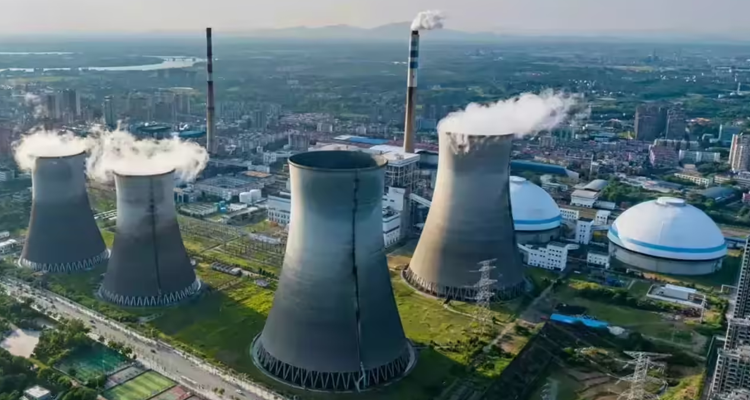
New Delhi: India has embarked on an ambitious expansion of its nuclear power programme, with the government positioning atomic energy as a key pillar of the country’s clean energy transition, energy security and long-term economic growth. The country currently operates 24 nuclear power reactors with a combined installed capacity of 8.78 Gigawatts (GW) and has unveiled an aggressive roadmap to raise this capacity to around 22 GW by 2031-32 and an unprecedented 100 GW by 2047 under the Nuclear Energy Mission.
The expansion comes as India seeks reliable round-the-clock electricity to complement rapidly growing renewable energy sources such as solar and wind, while simultaneously reducing dependence on fossil fuels and meeting its climate commitments.
Government Unveils Long-Term Nuclear Roadmap
According to information tabled in Parliament by the Department of Atomic Energy, India plans to increase its present nuclear generation capacity from 8.78 GW to nearly 22 GW by 2031-32 through the progressive completion of projects already under construction.
Beyond 2032, another 32 GW of nuclear capacity is proposed to be developed primarily by the Nuclear Power Corporation of India Ltd. (NPCIL), using indigenous Pressurised Heavy Water Reactors (PHWRs) and Light Water Reactors (LWRs). The remaining capacity required to achieve the 100 GW target by 2047 is expected to come through participation by public sector enterprises, state governments, joint ventures and private companies following recent policy reforms.
India expanding its nuclear power with 24 power reactors and 8.78 Gigawatt capacity
𝑅𝑒𝑎𝑑 𝑚𝑜𝑟𝑒👇https://t.co/kTot7LMgXZ pic.twitter.com/YRbEJ2zNtx
— All India Radio News (@airnewsalerts) July 14, 2026
Nuclear Energy Mission Gets Fresh Momentum
The government’s Nuclear Energy Mission aims to transform nuclear energy from a relatively small contributor into one of India’s major sources of clean electricity.
Officials believe nuclear energy offers several strategic advantages:
- Reliable 24×7 baseload electricity generation.
- Zero carbon emissions during power generation.
- Reduced dependence on imported fossil fuels.
- Enhanced long-term energy security.
- Support for India’s Net Zero target by 2070.
In 2024-25, India’s nuclear power stations generated 56,681 million units (MU) of electricity, contributing around 3.1% of the country’s total electricity generation.
Eight Reactors Under Construction
India’s expansion is already underway, with eight reactors currently under construction across multiple states.
Major ongoing projects include:
- Rajasthan Atomic Power Station Unit-8
- Kudankulam Units 3, 4, 5 and 6 in Tamil Nadu
- Kaiga Units 5 and 6 in Karnataka
- Gorakhpur Haryana Anu Vidyut Pariyojana
In addition, new indigenous 700 MW PHWR reactors have been planned at several locations, including Rajasthan, Haryana and Madhya Pradesh.
Indigenous Technology at the Core
India’s nuclear expansion is increasingly being driven by indigenous reactor technology.
The country has successfully developed its own 700 MW Pressurised Heavy Water Reactor (PHWR) design, reducing dependence on imported reactor technologies while strengthening domestic manufacturing capabilities.
Simultaneously, India continues to advance its three-stage nuclear programme through the 500 MW Prototype Fast Breeder Reactor (PFBR) at Kalpakkam, a milestone expected to accelerate the country’s long-term utilisation of thorium reserves.
Private Sector Participation Opens New Chapter
Recent legislative and policy reforms have opened the door for broader participation in India’s nuclear sector.
The government’s roadmap envisages future nuclear projects being developed through collaborations involving public sector companies, state governments, joint ventures and private enterprises. This diversification is expected to accelerate project execution, attract investment and build a domestic nuclear manufacturing ecosystem.
Meeting India’s Rising Energy Demand
India is one of the world’s fastest-growing energy consumers, with electricity demand projected to increase sharply over the coming decades due to industrialisation, urbanisation, electric mobility and digital infrastructure.
Experts believe that while renewable energy will continue to dominate capacity additions, nuclear power will provide the dependable baseload generation necessary to maintain grid stability when solar and wind output fluctuates.
By significantly expanding its nuclear fleet alongside renewable energy, India hopes to create a balanced, low-carbon power mix capable of supporting sustained economic growth.
Strategic Importance Beyond Electricity
Beyond power generation, the nuclear expansion is expected to stimulate high-end manufacturing, create skilled employment, strengthen research and development, and reduce India’s dependence on imported energy resources.
The programme is also likely to reinforce India’s position as one of the few countries possessing an advanced indigenous nuclear technology ecosystem spanning reactor design, fuel production, heavy engineering and waste management.
With 24 operational reactors already generating 8.78 GW and multiple large projects moving toward completion, India’s nuclear power sector appears poised for its biggest expansion since the country’s atomic energy programme began more than five decades ago. If the government’s roadmap stays on track, nuclear energy could emerge as one of the defining pillars of India’s clean energy future by the time the nation celebrates its centenary of Independence in 2047.