
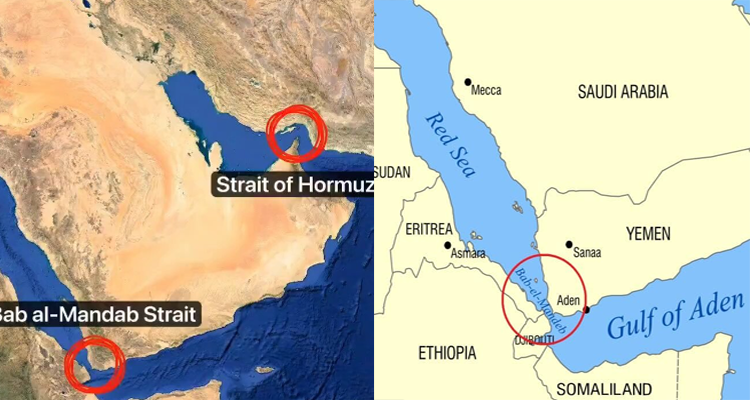
Tehran/Global Desk: With tensions in the Middle East continuing to escalate, Iran has signaled that it may expand pressure beyond the Strait of Hormuz by targeting the strategically vital Bab el-Mandeb Strait, a move that could trigger a major disruption in global trade and energy supplies. The warning comes amid Tehran’s suspension of indirect communications with the United States and its growing confrontation with Israel and Western allies.
According to reports from Iran’s state-linked Tasnim News Agency, Tehran and its regional allies are considering actions that could affect another critical maritime chokepoint after the effective closure and disruption of shipping through the Strait of Hormuz. Iranian officials and advisers close to the country’s leadership have indicated that the Bab el-Mandeb Strait, located between Yemen and the Horn of Africa, could become the next pressure point in the ongoing geopolitical standoff.
Make no mistake, with their allies, they can and will fully close the Bab el-Mandeb Strait. Trump’s latest failure of judgment, born of sheer stupidity and arrogance, has led him to ignore the obvious fallout once again. pic.twitter.com/Td0m1tC79v
— MCDC25 (@25_mcdc) June 1, 2026
Why Bab el-Mandeb Matters
The Bab el-Mandeb Strait serves as the gateway between the Red Sea and the Gulf of Aden, linking Europe and Asia through the Suez Canal. It is one of the world’s most important maritime trade corridors, carrying a significant portion of global oil, liquefied natural gas, and container shipping traffic. Analysts estimate that around 12 percent of global seaborne oil trade passes through the narrow waterway.
The strategic importance of the strait has increased dramatically since disruptions in the Strait of Hormuz forced shipping companies to seek alternative routes. Any closure or sustained threat to Bab el-Mandeb would effectively place two of the world’s most critical energy chokepoints under simultaneous pressure, potentially sending global oil prices sharply higher and disrupting supply chains worldwide.
BREAKING !!
Iran telah menangguhkan negosiasi dengan AS
▪︎ Karena pelanggaran gencatan senjata dan situasi saat ini di Lebanon, semua kontak dengan AS ditangguhkan.
▪︎ Iran juga mempertimbangkan untuk sepenuhnya memblokir Selat Hormuz lagi, serta Selat Bab el-Mandeb. pic.twitter.com/m6UKJOCOBq
— Ji (@jisatu01) June 1, 2026
Houthi Factor Raises Concern
Security experts believe Iran’s influence over Yemen’s Houthi movement gives Tehran a significant leverage point near the Bab el-Mandeb Strait. The Houthis, who control large parts of Yemen’s western coastline, have previously targeted commercial and military vessels in the Red Sea, causing shipping companies to reroute vessels around Africa.
Recent statements from Iranian officials suggest that Tehran could rely on its regional allies, often referred to as the “Resistance Front,” to intensify pressure on maritime routes if military and diplomatic tensions continue to worsen.

Diplomatic Fallout
The latest threat coincides with Iran’s decision to halt indirect message exchanges with Washington through mediators, citing Israeli military operations in Lebanon and Gaza. Tehran has warned that any violation of regional ceasefire arrangements could lead to broader escalation across multiple fronts.
International observers fear that expanding the confrontation from Hormuz to Bab el-Mandeb could transform a regional conflict into a global economic crisis. The European Union, the United States, and several maritime powers have already increased discussions on protecting shipping lanes and ensuring freedom of navigation in both waterways.
Impact on India and Global Markets
For India, which relies heavily on maritime imports of crude oil and trade passing through the Red Sea route, any disruption at Bab el-Mandeb would likely increase shipping costs, insurance premiums, and energy prices. Similar concerns are being voiced across Europe and Asia, where industries remain dependent on uninterrupted movement through the Suez Canal corridor.
While no formal blockade has yet been announced, the mere possibility of simultaneous disruptions at Hormuz and Bab el-Mandeb has heightened global anxiety. Energy markets, shipping companies, and governments are closely monitoring developments as the Middle East crisis enters a potentially more dangerous phase.