
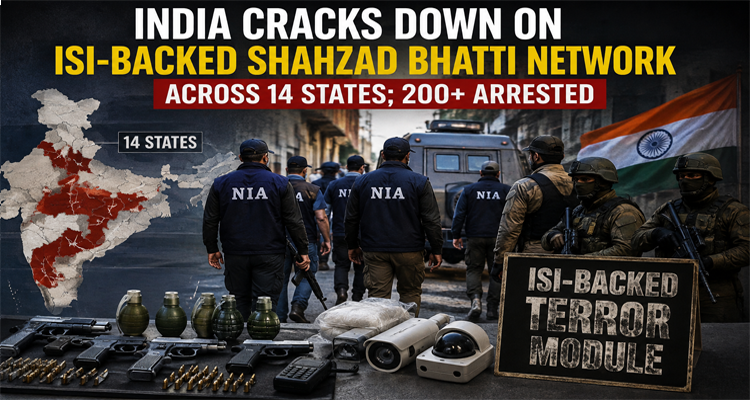
Multi-State Crackdown on ISI-Backed Network: Weapons, IEDs Seized
New Delhi: Indian security agencies have carried out a major coordinated crackdown against the Pakistan-based, alleged ISI-backed Shahzad Bhatti Network (SBN), detaining 253 people across 14 states and recording more than 200 arrests in cases linked to the syndicate, according to the Union Ministry of Home Affairs and statements cited by multiple reports.
The operation was conducted on August 12, just days before Independence Day, using a real-time intelligence-sharing mechanism involving central agencies and state police forces. Authorities said the action was aimed at disrupting suspected plans for subversive attacks around August 15.
Weapons, Explosives and Surveillance Equipment Seized
According to the Home Ministry’s account, security agencies recovered improvised explosive devices (IEDs), grenades bearing Pakistan Ordnance Factory markings, pistols and live ammunition during the operation. CCTV cameras allegedly intended for surveillance and espionage were also seized.
The government has described SBN as a Pakistan-based terror syndicate allegedly involved in grenade, IED and petrol-bomb attacks, targeted killings and reconnaissance of sensitive locations in India. Investigators allege that local recruits were paid to conduct reconnaissance of police, defence and religious installations and install surveillance cameras.
Union Home Minister Amit Shah said the coordinated operations had dismantled the network and thwarted its alleged plans for attacks ahead of Independence Day. He described the action as an example of the government’s “zero-tolerance” approach towards terrorism.
Modi govt destroyed the ISI-backed terror group Shahzad Bhatti Network ahead of Independence Day and thwarted its plans for subversive attacks by arresting more than 200 operatives.
Indian security forces ripped apart the network by launching coordinated operations across…
— Amit Shah (@AmitShah) August 17, 2026
Crackdown Spanned 14 States
The operation covered 14 states, highlighting the geographical spread that investigators believe the network had developed through local operatives and conduits. More than 80 FIRs have cumulatively been registered against SBN members and associates, with cases invoked under laws including the Unlawful Activities (Prevention) Act (UAPA), Bharatiya Nyaya Sanhita (BNS), Arms Act, NDPS Act and Explosive Substances Act.
The distinction between the figures is important: reports based on the Home Ministry statement put the number of people detained during the August 12 operation at 253, while more than 200 arrests have been recorded in cases against the network.
Cross-Border Terror Network Under Scanner | Who Is Shahzad Bhatti?
Pakistan-based handler Shahzad Bhatti is alleged to be running a cross-border terror and narco-terror network, using social media to target vulnerable Indian youth and recruit them for surveillance and other… pic.twitter.com/Eb3vSFsiJW
— TIMES NOW (@TimesNow) August 18, 2026
Shahzad Bhatti Under NIA Investigation
The crackdown follows months of investigations into Shahzad Bhatti, a Pakistan-based gangster-turned-terror suspect who has emerged in several Indian terror investigations.
The National Investigation Agency (NIA) has previously linked Bhatti to the November 2025 grenade attack on the Women Police Station in Sirsa, Haryana. In May 2026, the agency chargesheeted nine accused, including two Pakistani nationals, in that case and said the attack was part of a conspiracy allegedly orchestrated by Bhatti.
The NIA has also conducted searches in Punjab and Haryana in multiple cases linked to Bhatti. Its June 2026 investigation specifically described the cases as involving a Pakistan-based terrorist and Shahzad Bhatti-linked terror-gangster network.
Social Media Allegedly Used for Recruitment
Investigators have alleged that Bhatti and his associates used social media platforms and encrypted communication channels to recruit and radicalise Indian youths, establish contacts with potential operatives and issue instructions.
A recent analysis by the Manohar Parrikar Institute for Defence Studies and Analyses also highlighted the growing convergence between organised crime, terrorism and digitally enabled recruitment, identifying Shahzad Bhatti as one of the criminal-terror figures whose activities have drawn the attention of Indian security agencies.
A Wider Security Challenge
The latest operation indicates that Indian agencies are increasingly focusing not only on conventional terror modules but also on distributed networks involving foreign handlers, organised crime, local recruits, encrypted communications and surveillance operations.
The August 12 crackdown is therefore significant beyond the number of arrests. By targeting suspected operatives across multiple states simultaneously, agencies appear to have attempted to disrupt the network’s ability to coordinate attacks, recruit fresh members and conduct reconnaissance.
While authorities have described the Shahzad Bhatti Network as dismantled, investigations into individual suspects, alleged foreign handlers, funding channels and previous attacks are expected to continue.
The crackdown comes as Indian security agencies maintain heightened vigilance against Pakistan-linked terror and organised-crime networks, particularly those suspected of exploiting social media and local criminal networks to create operational cells inside India.