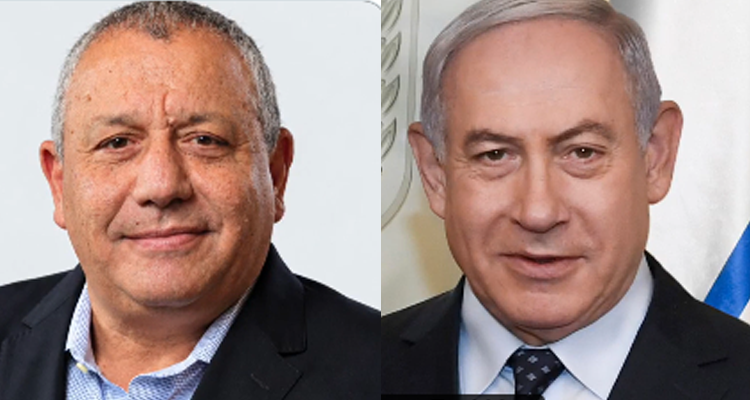
News Desk: Israel’s opposition parties have united behind former military chief Gadi Eisenkot as their candidate to form the next government, intensifying the political challenge to Prime Minister Benjamin Netanyahu following an inconclusive parliamentary election.
The move brings several major opposition parties together behind Eisenkot, leader of the centrist Yashar party, in an effort to prevent Netanyahu from securing another term in office. The opposition’s backing has strengthened Eisenkot’s position as negotiations begin over the formation of a new government.
However, the path to power remains complicated, as neither political camp has secured the 61 seats required for a parliamentary majority in the 120-member Knesset.
Netanyahu’s Likud party emerged as the largest individual party with 27 seats, while Eisenkot’s Yashar secured 21. The wider Netanyahu-led right-wing and ultra-Orthodox bloc has 53 seats, against 48 held by the Jewish-led opposition parties.
The remaining 19 seats belong to Arab political parties, whose support could prove decisive in determining the next government.
Arab parties hold the key
The opposition’s ability to form a government largely depends on securing cooperation from Arab lawmakers. The Joint List, with 11 seats, and the United Arab List (Ra’am), with eight seats, could provide the parliamentary support needed to challenge Netanyahu’s bloc.
The Joint List has indicated its willingness to support an Eisenkot-led government from outside the coalition, without necessarily joining it formally. Such an arrangement could help the opposition cross the majority threshold.
However, the proposal has exposed differences within the opposition camp. While some leaders favour cooperation with Arab parties, Avigdor Lieberman has rejected the idea of forming a minority government dependent on their external support.
Lieberman has backed Eisenkot as the opposition’s preferred candidate but maintains that such an arrangement would be politically unstable.
Speaking to David Hearst, Palestinian lawmaker Ahmad Tibi urged Israeli opposition leader Gadi Eisenkot to show political courage and work with Arab parties to end Prime Minister Benjamin Netanyahu’s rule. https://t.co/EPe8QRL6v7
— Middle East Eye (@MiddleEastEye) November 2, 2026
Netanyahu refuses to give up
Netanyahu, meanwhile, is seeking to retain power and has argued that Likud’s position as the largest individual party gives him a strong claim to lead the next government.
He has called for a broad national unity government under his leadership, although the numbers suggest that his existing political alliance remains short of the required majority.
The election outcome has left Israel facing another period of intense coalition negotiations, with both sides attempting to attract additional parliamentary support.
President Herzog to begin consultations
President Isaac Herzog is scheduled to begin consultations with representatives of the newly elected parties on November 4 to determine which candidate has the best chance of forming a government.
Following the consultations, Herzog will decide whom to assign the mandate to form the next government. The selected candidate will initially have 28 days to assemble a coalition, with a possible 14-day extension.
The newly elected Knesset is expected to convene on November 10.
Israel’s Arab parties, which won a record 19 seats, are set to back opposition leader Gadi Eisenkot’s bloc, dealing another blow to PM Benjamin Netanyahu’s hopes of forming a government.
Here’s the latest on Israel’s coalition talks ⤵️
https://t.co/3Xochq6G5D— Al Jazeera English (@AJEnglish) November 2, 2026
Fresh elections remain a possibility
Despite the opposition’s decision to rally behind Eisenkot, the challenge of securing a stable parliamentary majority remains unresolved. Cooperation with Arab parties, possible defections from rival political camps and negotiations with other factions could determine the final outcome.
If neither Netanyahu nor Eisenkot succeeds in assembling the necessary support, Israel could face another round of parliamentary elections.
For now, the opposition’s endorsement has placed Eisenkot at the centre of Israel’s government-formation battle. However, whether the political unity behind him can translate into a workable majority will determine Netanyahu’s political future and the direction of Israeli politics in the coming weeks.