
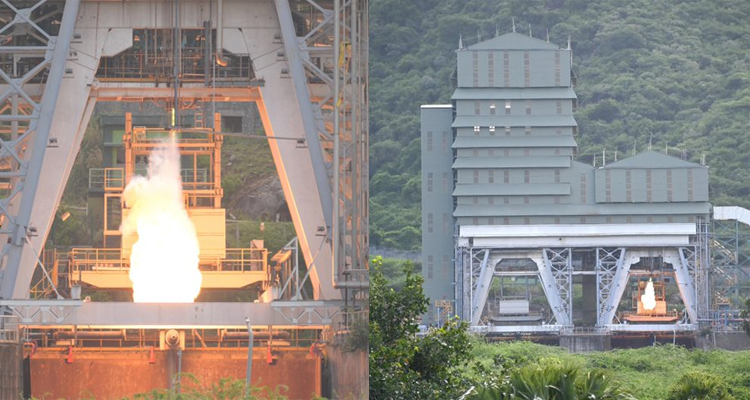
ISRO Nears Next Rocket Breakthrough with 175-Tonne Semi-Cryogenic Engine Test
New Delhi: The Indian Space Research Organisation (ISRO) has taken a significant step towards developing a more powerful generation of launch vehicles after successfully conducting a hot test of its Semi-Cryogenic Engine Power Head Test Article (PHTA) at 175 tonnes of thrust, or 88% of its rated capacity. The milestone strengthens India’s plans to substantially upgrade the payload capability of the LVM3, the country’s heaviest operational launch vehicle.
The test was carried out on June 24 at the ISRO Propulsion Complex (IPRC), Mahendragiri, Tamil Nadu, and marks the eighth hot test in the PHTA development programme. According to ISRO, the trial proceeded exactly as predicted, with all engine parameters remaining within expected limits throughout the firing.
The Power Head Test Article comprises all the critical systems of the semi-cryogenic engine—including the pre-burner, gas generator, turbopumps and control systems—except the thrust chamber. The objective was to study engine build-up after pre-burner ignition and demonstrate stable operation at significantly higher thrust levels.
ISRO makes progress in Semi-cryo engine development; 8th test firing done
(Report by @sdhrthmp)
READ: https://t.co/6NtiTf2FaChttps://t.co/6NtiTf2FaC
— WION (@WIONews) June 27, 2026
Biggest Leap Yet in Semi-Cryogenic Engine Development
Earlier PHTA tests had successfully demonstrated operation at 94 tonnes (47%) and 120 tonnes (60%) thrust. The latest firing represents the first successful operation at 175 tonnes (88%), bringing ISRO within striking distance of qualifying the engine at its full 200-tonne thrust.
During the test, the engine’s main turbopumps also achieved outlet pressures of 400 bar and 500 bar, validating the performance of critical high-pressure systems under near-flight conditions.
ISRO said the successful trial has provided sufficient confidence to proceed towards demonstrating steady-state performance at the engine’s full 200-tonne (100%) thrust level, a key milestone in the indigenous development of India’s semi-cryogenic propulsion technology.
New Engine to Transform LVM3
The semi-cryogenic propulsion system is being developed around the 2000 kN-class SE2000 engine, which will power the SC120 stage. Once inducted, it will replace the current L110 liquid core stage of the LVM3.
The upgrade is expected to significantly enhance the rocket’s payload capacity while improving operational efficiency. Unlike the existing hypergolic propulsion system, the new engine uses Liquid Oxygen (LOX) and purified kerosene (Isrosene)—a cleaner, more efficient and less toxic propellant combination widely used in modern heavy-lift launch vehicles.
Boost for India’s Future Space Missions
The semi-cryogenic propulsion stage will work alongside the uprated CE20 cryogenic upper stage, enabling future LVM3 missions to carry heavier communication satellites, deep-space probes, modules for the proposed Bharatiya Antariksh Station, and upcoming human spaceflight missions.
The latest success is another major step in ISRO’s long-term roadmap to develop high-performance indigenous propulsion systems and strengthen India’s position in the global commercial launch market.
With the successful 175-tonne hot test completed, ISRO has moved significantly closer to qualifying one of the most powerful rocket engines ever developed in the country—laying the foundation for the next generation of Indian heavy-lift launch vehicles.