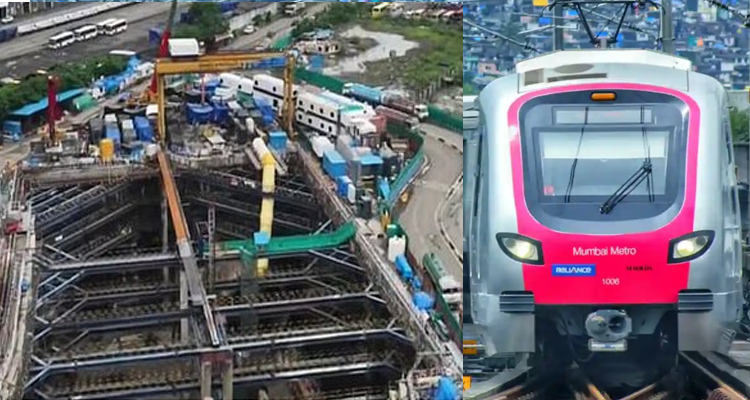
Mumbai: A major planning and design issue on Mumbai’s Metro Line 7A has put civil works worth more than ₹260 crore at risk, with a portion of the completed elevated viaduct potentially requiring dismantling and reconstruction if aviation authorities do not approve additional height clearance.
The problem has emerged on the 3.4-km Metro 7A corridor connecting Andheri East with Chhatrapati Shivaji Maharaj International Airport (CSMIA). The line is being developed as an extension of Metro Line 7 and is intended to provide a crucial link to the airport, including connectivity with the underground Metro Line 3.
Height mismatch triggers crisis
The controversy centres on the overhead electrification (OHE) system required to operate the metro. A section of the elevated alignment in Vile Parle East falls within the airport’s air-funnel zone, where strict height restrictions apply to protect aircraft operations.
Mumbai Metro 7A के वायाडक्ट पर संकट, 250 करोड़ की लागत का Elevated टूटेगा? | Airport Line | N18V#mumbaimetro #breakingnwews | @m_shivanipandey @imvivekgupta pic.twitter.com/ZP7Fiaoa6Y
— News18 India (@News18India) August 28, 2026
According to reports citing MMRDA officials, the additional height required for OHE equipment was not adequately incorporated into the design at the planning stage. The mismatch is reported to be as much as around 2.5 metres in some locations.
The issue is particularly serious because substantial construction had already been completed. MMRDA’s own project-status data showed the elevated viaduct’s major civil components had reached 100% completion by February 2026.
Nearly 1 km could be affected
If a technical solution cannot be found, nearly one kilometre of the elevated structure, including parts of the Airport Colony station, ramp and viaduct, could require modification or reconstruction.
The additional height requirement reportedly varies along the alignment. The Airport Colony ramp requires about 2.4 metres of additional height, while other portions require smaller increases. The central challenge is to accommodate the OHE while remaining within the aviation safety limits prescribed by the Airports Authority of India (AAI).
The situation has already raised the prospect of substantial financial consequences. While some reports put the potentially affected civil work at about ₹250 crore, MMRDA sources have indicated that more than ₹260 crore could be at risk. Importantly, this does not mean the entire Metro 7A has cost ₹260 crore; it refers to the value of work that could have to be modified or rebuilt.
#MumbaiMetro line 7A’s ₹250 crore elevated viaduct may face demolition due to design flaw: Reporthttps://t.co/ruAXfYEMYS
— CNBC-TV18 (@CNBCTV18News) August 27, 2026
Who is responsible?
The project’s general consultant is the SYSTRA-CEG-SMCIPL consortium, which was responsible for coordinating design and statutory requirements, including aviation-related restrictions.
MMRDA officials have said the necessary OHE-related height requirement was not adequately highlighted or incorporated during the design stage. SYSTRA, however, has reportedly disputed responsibility for the error.
The matter is now being pursued with the AAI, Mumbai International Airport Ltd (MIAL) and the Ministry of Civil Aviation. MMRDA has sought permission for the additional height, while awaiting the aviation authorities’ technical assessment.
A problem that surfaced after construction
The episode is particularly embarrassing because the height issue emerged only after considerable civil work had been completed.
According to The Indian Express, the problem was flagged in 2025, following which work on the affected stretch was halted and revised permissions were sought. By February 2026, the elevated viaduct had been completed and about 95% of the elevated ramp had also been constructed.
Earlier permissions from AAI also form part of the controversy. Hindustan Times reported that AAI had issued clearances but with height restrictions below what was required by the metro’s design, while an MMRDA internal document reportedly indicated that the Airport Colony station design did not adequately reflect the contents of the AAI clearance.
Another delay for an already-delayed project
Metro 7A was originally expected to open much earlier, with its initial target reportedly set for 2021. The project has already missed multiple deadlines, and the latest technical dispute could push commissioning further away. The Indian Express reported that the line is now unlikely to open during 2026-27 if the present problem remains unresolved.
The project has an overall base cost of ₹6,607 crore for the larger Metro 9/7A project, according to MMRDA’s official project information. The potential ₹250-260 crore exposure therefore represents a significant additional burden rather than the total cost of Metro 7A.
The larger question: planning or coordination failure?
The Metro 7A episode raises uncomfortable questions about project planning, consultant accountability and coordination between infrastructure and aviation authorities.
For a metro corridor approaching a major international airport, aviation height restrictions are a fundamental design consideration. Discovering a conflict after major structural work has been completed risks not only wasting public money but also extending construction timelines and increasing the eventual cost of the project.
For now, demolition is not yet certain. MMRDA is exploring whether engineering modifications can resolve the OHE-clearance problem without dismantling the completed structure. The final outcome will depend substantially on the technical assessment and decision of the aviation authorities.
If no workable solution emerges, however, Mumbai could face the extraordinary prospect of altering or demolishing a substantial stretch of a metro structure that has already been built—putting over ₹250-260 crore of completed work at risk.