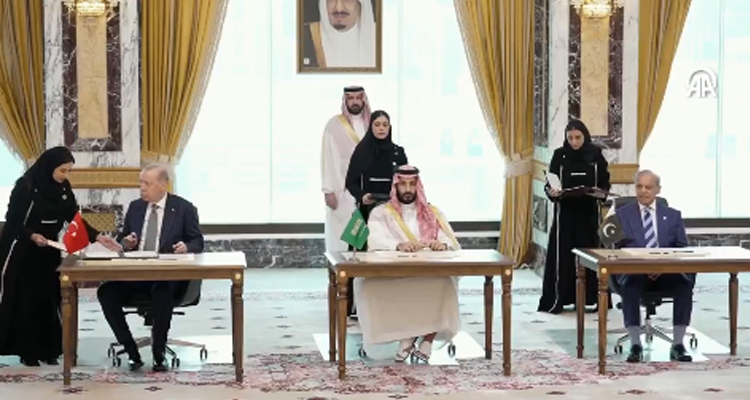
Mecca: In a major geopolitical development with far-reaching implications for the Middle East and South Asia, Saudi Arabia, Turkey and Pakistan on Friday signed a landmark trilateral defence pact committing themselves to collective security under the principle that an armed attack on any one of the three nations will be treated as an attack on all. The agreement, signed in Mecca, is being seen as one of the most significant strategic realignments in the Muslim world in recent years.
The pact was signed by Saudi Crown Prince Mohammed bin Salman, Turkish President Recep Tayyip Erdoğan, and Pakistani Prime Minister Shehbaz Sharif against the backdrop of escalating regional instability, including growing tensions involving Iran, Houthi attacks, and threats to Gulf shipping routes and critical infrastructure.
Pakistan, Turkiye and Saudi Arabia to sign defence deal
MBS to meet Erdogan and Sharif in Jeddah
New pact may cover joint military exercise, intelligence sharing @kripatistic has more details pic.twitter.com/m5pkCA0QuA
— WION (@WIONews) August 7, 2026
At the heart of the agreement is a mutual defence clause modelled on the principle of collective security, under which the three countries pledged to consult and coordinate military responses if any member comes under external attack. The pact also envisages deeper cooperation in defence production, intelligence sharing, military training, joint exercises, cybersecurity and counter-terrorism.
Saudi officials stressed that the agreement is defensive in nature and is not aimed at any specific country or intended to create a new military bloc. The three leaders said the objective is to strengthen regional stability, improve collective deterrence and expand strategic cooperation without affecting their existing international commitments.
Türkiye, Saudi Arabia and Pakistan sign Joint Defence Agreement https://t.co/q9c42DOtTW pic.twitter.com/k1EKozqpKH
— Presidency of the Republic of Türkiye (@trpresidency) August 7, 2026
Strategically, the alliance brings together Saudi Arabia’s financial and geopolitical influence, Turkey’s advanced defence industry and NATO experience, and Pakistan’s nuclear deterrent and one of the world’s largest armed forces. Defence analysts believe the partnership could accelerate joint weapons production, defence technology collaboration and military interoperability, while giving the three nations greater strategic autonomy amid shifting global power equations.
The agreement has drawn close international attention, with analysts describing it as a significant shift in the regional security architecture. While some commentators have dubbed it an “Islamic NATO“, the signatories have rejected that description, maintaining that the pact is an inclusive security arrangement designed to enhance peace and stability rather than confrontation.
The trilateral accord comes as Gulf nations reassess their security partnerships amid persistent regional conflicts and uncertainty over the future security role of major global powers. Observers say the pact could emerge as an influential strategic framework if backed by sustained political coordination and deeper military integration.