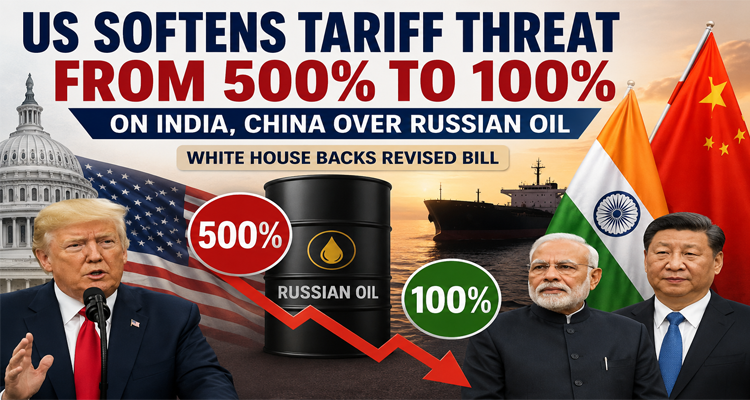
Washington: In a significant shift from its earlier hardline approach, a bipartisan group of US senators has introduced a revised sanctions bill proposing tariffs of up to 100 percent—instead of the previously proposed 500 percent—on imports from countries such as India, China, Brazil, and others that continue purchasing Russian oil.
The legislation, which has reportedly received the backing of the White House, marks a toned-down version of the earlier Sanctioning Russia Act introduced in the US Senate last year. That proposal had sought sweeping tariffs of up to 500 percent on countries importing Russian energy but failed to advance through Congress.
White House Support Boosts Bill’s Prospects
According to multiple US media reports, the revised bill has gained momentum after the White House agreed to its framework. Senate aides believe the legislation now stands a strong chance of clearing the Senate, reflecting growing bipartisan support for tougher economic measures aimed at increasing pressure on Russia over the ongoing Ukraine conflict.
The proposal was originally championed by the late Senator Lindsey Graham, who had long advocated imposing punitive trade measures on nations continuing to purchase Russian crude.
Tariff Proposal Scaled Back
The most notable change in the new legislation is the reduction of the proposed tariff rate from 500 percent to 100 percent, a move widely seen as an effort to make the sanctions more politically and economically viable while maintaining pressure on countries buying Russian oil.
India and China have significantly increased imports of discounted Russian crude since the outbreak of the Russia-Ukraine war, arguing that their purchases are guided by national energy security and economic interests rather than geopolitical considerations.
Blumenthal Urges Swift Passage
Democratic Senator Richard Blumenthal, a co-sponsor of the bill, urged lawmakers to pass the legislation without further delays.
He said the bill had been negotiated over nearly two years and already had President Donald Trump’s approval, arguing that reopening it for major changes could slow its progress.
Blumenthal also recalled his last conversation with Senator Lindsey Graham, saying Graham was optimistic after informing him from Kyiv that President Trump would support legislation imposing “scorching tariffs and sanctions” on countries purchasing Russian oil to weaken Russia’s ability to finance its military campaign.
The senator argued that stronger sanctions could help push Moscow toward peace, asserting that Ukraine had made gains on the battlefield while continuing to strike targets deep inside Russian territory.
Trump Signals Support, Suggests Broader Scope
When asked about the proposal earlier this week, President Donald Trump indicated support for the legislation, noting that Senator Graham had strongly advocated for it.
Trump also suggested the bill could be expanded to include Iran, calling it a significant addition, and said lawmakers were also considering including Hezbollah within the broader sanctions framework.
Implications for India
While the proposed tariff has been reduced substantially from the earlier 500 percent proposal, the legislation could still have important implications for countries such as India if enacted. New Delhi has consistently maintained that its energy imports are based on national interest and market considerations, while continuing to engage diplomatically with both Western nations and Russia.
If approved by Congress and signed into law, the revised bill would represent one of Washington’s most significant economic pressure tools aimed at discouraging global purchases of Russian oil, although its final form and implementation timeline remain subject to legislative approval.