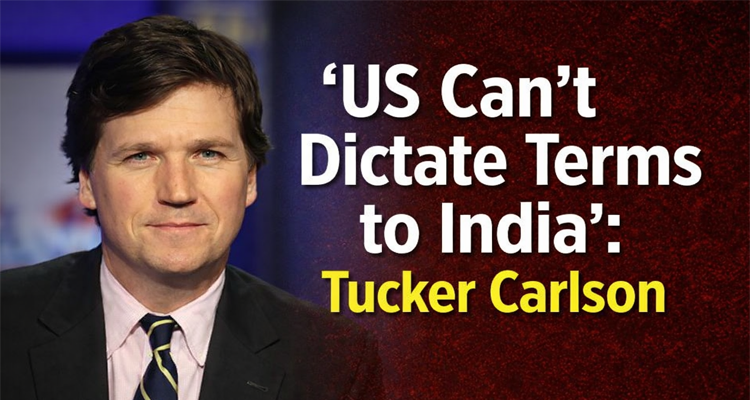
New Delhi: American journalist and former Fox News host Tucker Carlson has said the United States no longer holds the leverage to dictate terms to India, as negotiations around an India–US trade arrangement gather pace. Speaking in an interview with India Today Global, Carlson portrayed India as a transformed global power and described Prime Minister Narendra Modi as one of the defining leaders of the era.
Carlson argued that Washington’s attempts to pressure New Delhi over foreign-policy choices — particularly India’s continued purchase of Russian oil — reflect an outdated geopolitical mindset. According to him, India must now be engaged as an equal rather than viewed through legacy assumptions about global hierarchy.
🚨 Senior American journalist Tucker Carlson: “US can’t dictate to India on its sovereign right to purchase oil from Russia.”
“India is a GREAT POWER now, this is not the India we visited 25 years ago.” pic.twitter.com/Ujn3QmsW9M
— Megh Updates 🚨™ (@MeghUpdates) February 4, 2026
A changed India
Highlighting India’s evolution over the past two decades, Carlson said the country bears little resemblance to how Western powers perceived it in the late 1990s and early 2000s.
“This is not the India we visited 25 years ago,” he said, asserting that today’s India negotiates terms rather than accepting them. His remarks challenged entrenched views in sections of Washington about India’s role in the international order.
Praise for Modi
Carlson also lauded Prime Minister Narendra Modi, describing him as an influential and consequential figure in contemporary politics.
“Whether you like Modi or not, Modi is impressive. Nobody doubts that,” he said, adding that he hopes to interview the Indian leader in the future. He credited Modi with reshaping India’s global standing and projected that his leadership would be studied in years to come.
Criticism of pressure over Russian oil
Carlson’s sharpest criticism was aimed at US efforts to influence India’s energy sourcing. He said Washington lacked the authority to interfere in sovereign economic decisions, including oil purchases from Russia.
“The United States can’t dictate to India what oil it should buy,” he remarked, arguing that policymakers in the West have been slow to adjust to shifting global realities. He maintained that India has already emerged as an independent centre of power rather than an “emerging” one.
Multipolar world and shifting alliances
Placing India–US ties in a broader global context, Carlson said the international system has moved toward multipolarity, with major countries acting autonomously rather than as junior partners. He listed Modi among several influential contemporary leaders, calling the current period one marked by historically significant leadership that will shape future political study.
Tariffs as negotiation tools
On former US President Donald Trump’s use of tariffs, Carlson described the approach as an experimental bargaining strategy rather than a definitive economic doctrine. He said tariffs — revived after decades of limited use — should be understood as opening negotiation positions rather than punitive measures.
“There’s the opening bid and the real bid. That’s how deals work,” he said, suggesting trade tensions are often part of broader negotiation dynamics.