
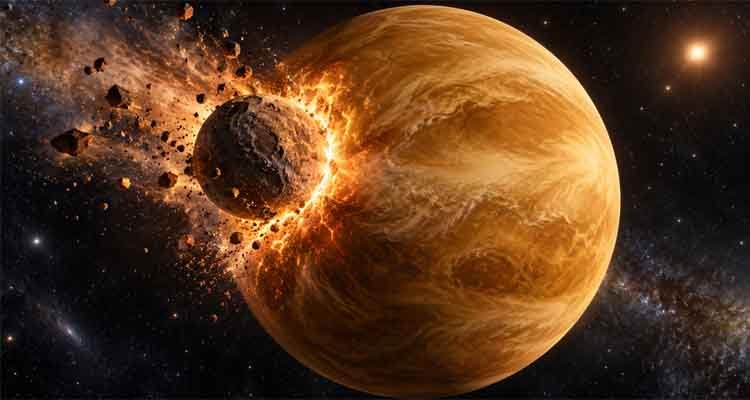
Venus, often described as Earth’s near-twin because of its similar size, mass and rocky composition, may once have had a moon — but the planet’s unusually slow rotation could have ultimately pulled the satellite back into itself, according to new research from the University of California, Riverside (UCR).
The study, led by UCR astrophysicist Stephen Kane and published in The Astrophysical Journal, offers a new explanation for one of the Solar System’s enduring puzzles: why Venus has no natural satellite today. Unlike earlier theories that suggested a moon may have been destroyed by another massive collision, the new modelling indicates that Venus itself could have driven a hypothetical moon into an eventual collision with the planet.
Venus’ extraordinarily slow spin may hold the clue
The key factor is Venus’ unusual rotation. NASA data show that Venus takes about 243 Earth days to rotate once on its axis, and it rotates in the opposite direction to Earth and most other planets. Its rotation period is actually longer than its roughly 225-day journey around the Sun.
Earth provides a striking contrast. Our planet completes one rotation in about 24 hours, and tidal interactions transfer some of Earth’s rotational energy to the Moon. As a result, the Moon is gradually moving away from Earth at roughly 3.8 centimetres per year.
According to Kane’s study, Venus’ extremely slow, retrograde rotation creates the opposite tidal evolution. Instead of a moon steadily spiralling outward, a satellite orbiting Venus could gradually lose orbital energy and move inward, eventually ending in a collision with the planet.
Computer simulations point towards a collision
Kane developed computer models to examine how a hypothetical Venusian moon would evolve under different conditions. The model was first tested against the Earth-Moon system before the researchers varied Venus’ rotation rate and the assumed mass of a potential moon.
The simulations examined hypothetical satellites ranging from about half the mass of Earth’s Moon to ten times its mass. In most of the scenarios, the satellite eventually moved inward and collided with Venus. The simulations also indicated that larger moons would generally reach the planet more rapidly.
The result does not prove that Venus ever possessed a moon. Rather, it demonstrates that if a substantial moon had formed around Venus, the planet’s tidal evolution could have made its long-term survival unlikely.
Did Venus once have a moon?
That question remains unresolved.
One possibility is that an enormous impact in the early Solar System created a moon around Venus, much as the leading theory for the formation of Earth’s Moon involves a giant collision. Another possibility is that Venus never formed a moon in the first place.
The new study addresses what could have happened if Venus did have a moon, rather than providing direct evidence that one actually existed. UCR notes that finding physical evidence of such an event would be extremely difficult because Venus has undergone extensive resurfacing. Around 80% of its surface is thought to be relatively young, meaning much of the planet’s earlier geological record may have been erased.
A hidden impact could still be buried beneath Venus
Scientists could potentially search for indirect evidence deep inside Venus. On Earth, studies of the planet’s interior have identified unusual structures that have been discussed in connection with ancient giant impacts.
If Venus absorbed a moon, the collision would have delivered a tremendous amount of energy and angular momentum to the planet. Such an event could have affected Venus’ rotation, geological activity and climate.
That possibility is particularly intriguing because scientists are still investigating whether Venus may have been dramatically different billions of years ago, including whether it could once have possessed conditions more favourable to liquid water.
The finding could matter beyond Venus
The research also has implications for the study of planets outside our Solar System.
Astronomers increasingly investigate whether potentially habitable exoplanets possess moons, since satellites can influence a planet’s evolution. Earth’s Moon, for example, contributes to tides and has played an important role in the long-term development of Earth’s environment, although scientists do not consider the presence of a large moon to be an established requirement for habitability.
The study suggests that the mere formation of a moon may not guarantee its survival. Around slowly rotating planets, tidal interactions could potentially send a satellite on a long inward journey toward its parent world.
Previous NASA-supported research has also examined how tides and rotation could influence the evolution of Venus and other slowly rotating, Venus-like worlds, reinforcing the importance of tidal processes in understanding planetary histories.
For now, Venus remains moonless — but the new research raises an intriguing possibility: perhaps it was not always that way, and its missing moon may have ended not by escaping into space, but by falling back onto the planet that created it.